Bonsai vs HoneyBook: Which is Actually Built for Agencies?
Bonsai vs HoneyBook for agencies. Get a clear side-by-side breakdown and verdict. Discover why many agencies switch to a better alternative. Read more.

William Nzewi

If you're comparing Bonsai vs HoneyBook for agencies, here’s the short answer: HoneyBook is the better choice for structured onboarding and client booking, while Bonsai works better for freelancers handling contracts and invoices. But for agencies managing ongoing client work, neither tool is a strong fit.
Both Bonsai and HoneyBook are built to help start client relationships. They handle contracts and payments well. If your workflow ends there, they can work well.
But being an agency, you don’t stop at onboarding. The real work starts after the deal is signed.
This is where things begin to break down.
Once you’re handling multiple clients and ongoing requests, delivering projects regularly, you start noticing the shortcomings:
You end up jumping between tools and emails just to keep things moving.
This is why many agencies start looking for HoneyBook and Bonsai alternatives. Not because these tools are bad, but because they’re not built for delivery at scale.
So instead of just comparing features, this guide focuses on something more important: workflow fit…
The biggest difference in the Bonsai vs HoneyBook comparison is when they work best in your workflow.
Both tools perform well pre-project. That is before a project starts.
They help you:
If your goal is to close deals faster and look professional, both tools do that well.
But you don’t make money from onboarding, but by delivering work over time.
Once a client is active, your workflow changes:
It's in this (ongoing work) phase that both tools start to struggle:
Bonsai and HoneyBook offer basic project tracking. You can see tasks or timelines at a high level. But for agencies handling multiple clients, this isn't enough.
You need to:
In both tools, this quickly becomes hard to manage. You end up relying on other tools just to keep things organized.
Besides results, clients want to monitor progress.
With Bonsai and HoneyBook, clients can sign contracts and pay. But they can’t easily track what’s happening next. There’s no clear dashboard showing work in progress.
So what happens?
Clients start asking questions:
“Any update on this?”
“What’s the status?”
“When will this be ready?”
Now your team spends time answering questions instead of doing the work.
This is one of the biggest issues for agencies.
Ongoing work usually comes in as requests:
In Bonsai and HoneyBook, there’s no proper system for this.
Requests come through:
In this scenario, files can easily go missing and things can quickly go wrong.
There’s no single place where clients can submit requests and have your team manage them. They can't track progress either.
This alone can ruin operations for productized or retainer-based agencies.
As your agency grows, your team increases as more people get involved:
You need a system where everyone can see what they need to do and update progress. A place they can work together without disorder.
Bonsai and HoneyBook aren't built for this level of collaboration. So teams end up switching between tools. And this slows everything down.
Client experience matters a lot.
According to McKinsey and Company, optimizing end-to-end client experience typically delivers 5–10 percent revenue growth and 15–25 percent cost reductions within 2–3 years. A clean client portal and branded experience are a good start. One place for communication, requests, updates and client feedback.
With Bonsai and HoneyBook, the experience is fixed and branding options are limited.
Hence many agencies move away from traditional client management software for agencies and look for tools built around complete delivery workflows, not just onboarding.
Instead of handling only proposals and payments, ManyRequests also:
Features are great but how do they fit into your agency’s day-to-day workflow?
Let's look at major Bonsai and HoneyBook features in the light of how agencies work.
Both tools are strong here. This is what they were built to perform.
Bonsai:
HoneyBook:
What does this mean for your agency?
If your process is:
1. Send proposal
2. Get approval
3. Start work
Both tools can handle it.
But HoneyBook has an edge because it feels more structured and automated.
Verdict: For agencies that want a smoother onboarding flow, HoneyBook outperforms Bonsai here.

HoneyBook contract template
This is where the differences start to show.
Bonsai:
Works fine if you’re managing a small number of clients
HoneyBook:
What this means for your agency:
HoneyBook is closer to a real CRM. You can:
Bonsai feels more like a lightweight tool. It works, but it’s limited.
That said, neither tool is built for complex agency workflows with:
Verdict: HoneyBook is better, but still not a full agency CRM.
Both tools handle payments well. This is one of their strongest areas.
Bonsai:
HoneyBook:
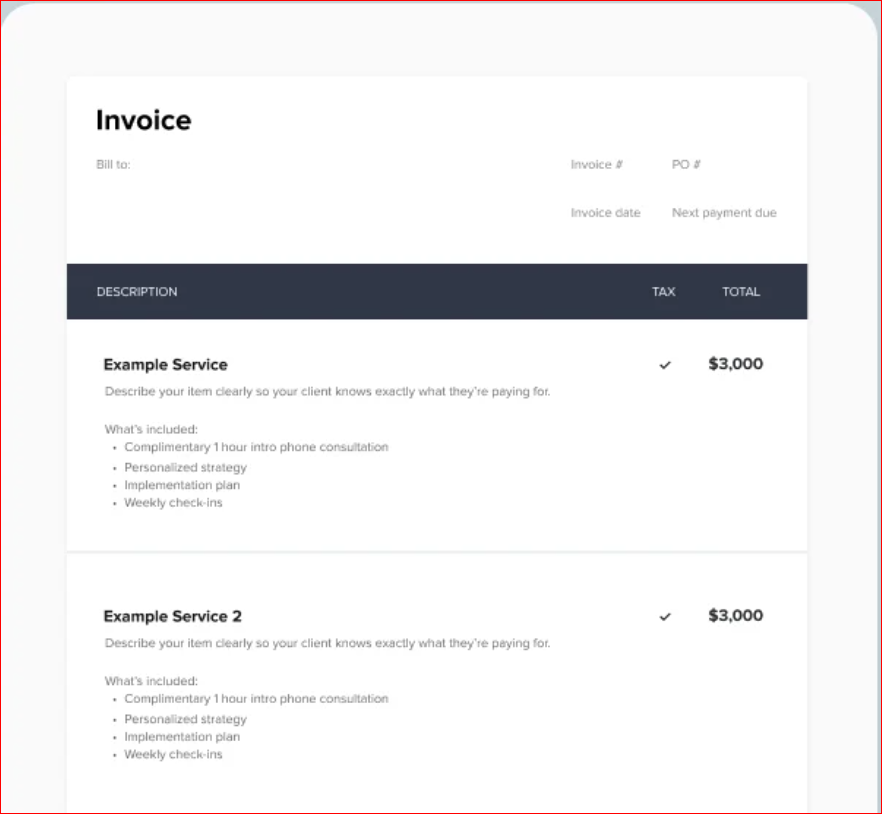
Honeybook invoice template
What this means for your agency:
If your revenue depends on:
Both tools will work.
But once you move into subscription-style services and request-based monthly delivery, you start to feel limits of both tools.
Verdict: Tie. Choose based on your billing style.
This is the most important section for agencies. And this is where both tools fall short.
Bonsai:
HoneyBook:
The issue is neither tool gives you:
The implication in practice is requests come in through email or chat. Tasks get tracked in a separate tool. Clients ask for updates because they can’t see progress. Your team jumps between tools to get work done
This slows work down and creates a poor client experience.
Verdict: Neither tool works well for agency delivery.
An integral part of service delivery. Unfortunately, some agencies treat this as an afterthought.
Bonsai:

Bonsai client portal
HoneyBook:
What agencies actually need:
Both tools fall short here. The experience feels more like a transaction system and not a working relationship.
Verdict: HoneyBook is slightly better, but neither delivers a strong client portal.
Both tools are weak when it comes to ongoing agency work.
Once delivery becomes your main focus, features alone aren't enough.
You're better off with a tool built around how agencies actually run day to day.
Both tools built for different types of businesses. The mistake most agencies make is picking based on features, instead of how they actually work day to day.
Bonsai works best for freelancers and small teams.
It fits workflows where:
You also handle contracts and invoices yourself.
Typical use cases:
Bonsai works here because:
You don’t need a complex system. Bonsai gives you just enough to run things smoothly.
Bonsai struggles when:
HoneyBook is built for service-based businesses which rely on bookings and onboarding.
It fits workflows where:
Typical use cases:
HoneyBook works here because:
If your business depends on:
HoneyBook is a strong option.
But it starts to struggle when:
HoneyBook is great at getting clients in.
It's not built to manage them long term.
Bonsai and HoneyBook are front-office tools, agencies need back-office systems.
Most agencies struggle with:
Neither Bonsai nor HoneyBook can handle all these. But ManyRequests, a tool built specifically for agencies does.
How does ManyRequests handle agency workflows better?
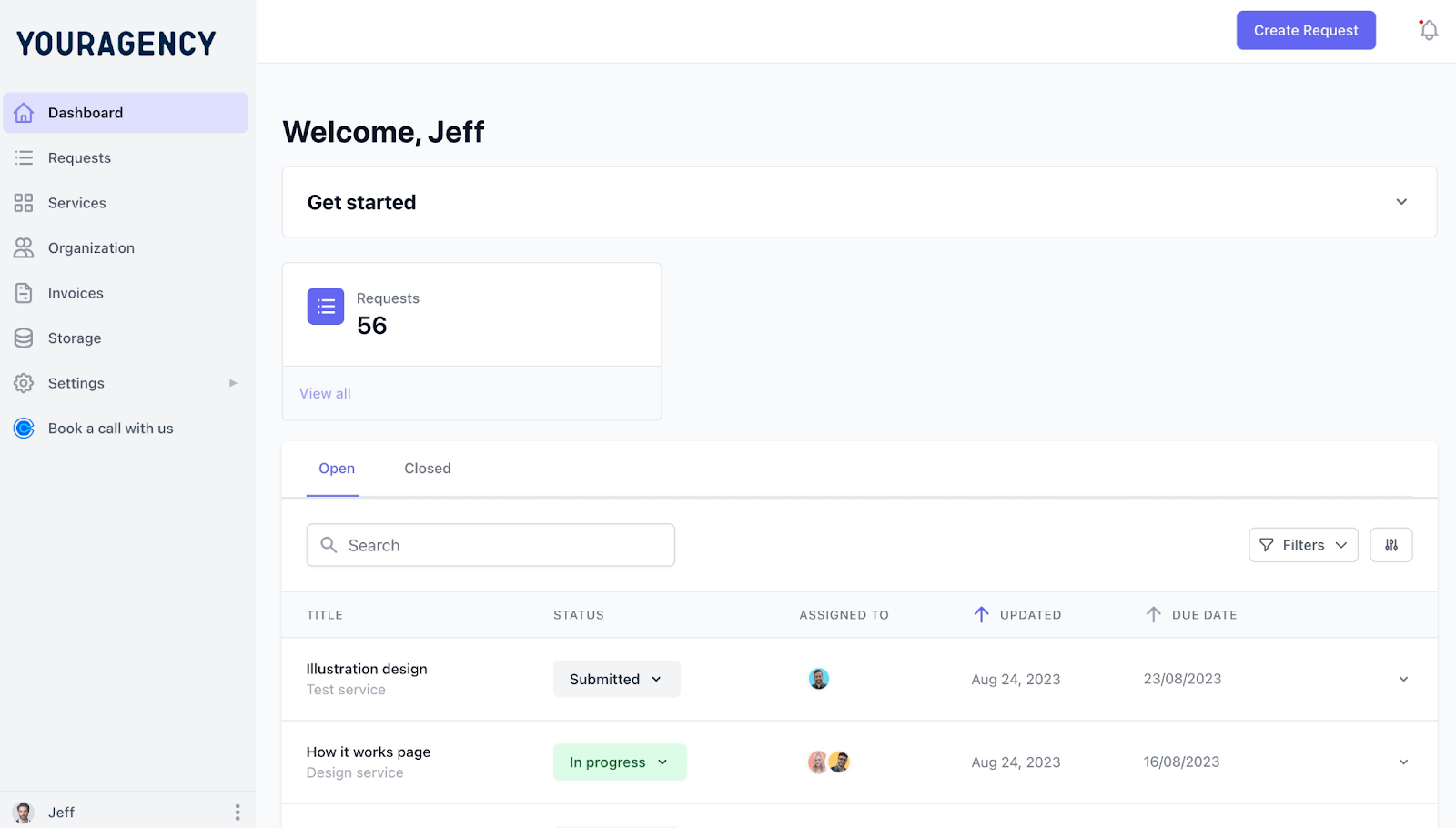
ManyRequests Client portal (Client view)
With ManyRequests, every client gets access to a dedicated portal.
Inside the portal, clients can:
Everything lives in one place, including agency-client communication. Clients can simply log in and see exactly what's happening without asking.

Requests (Team view)
Instead of tasks being created manually from emails, ManyRequests gives you a system where:
You can filter and manage requests across all clients from one dashboard.
ManyRequests is built for different income models, including retainers and productized services.
You can offer services through a catalog, or let clients purchase or subscribe. Then manage delivery based on those services.
This is very different from Bonsai and HoneyBook, which treat each project as a separate event.
In ManyRequests, clients don’t need to ask for updates.
They can easily log in and see:
This reduces back-and-forth and saves time. It also builds trust through transparency, as everything is there for the client to see.
Instead of using one tool for CRM, another for tasks and yet another for billing, ManyRequests connects requests, delivery, time tracking and billing in one potent system.
That means no switching between tools and no manual updates.
Your team and your clients see the same thing, in real time.
With Bonsai or HoneyBook:
With ManyRequests:
That’s a completely different workflow.
Should you go for the least expensive tool or the one which fits your workflow perfectly?
Bonsai charges per user per month. You can pay monthly or annually. Paying annually saves around 40%.
Bonsai is affordable at the start. It works well for freelancers and small teams.
But as your agency grows, you may need higher plans. You may also still need extra tools (for project tracking, requests, etc.)
So your total cost increases outside Bonsai.
Unlike Bonsai, HoneyBook charges a flat rate rather than per user. This makes costs easier to predict as your team grows. But the gap between Essentials and Premium is large.
HoneyBook is still affordable for small businesses. It works well if your focus is booking clients and managing leads.
But like Bonsai, once you grow, you may need other tools for delivery.
And costs increase as you stack tools.
ManyRequests has three plans: Core, Pro, and Enterprise. All plans include unlimited clients, a branded client portal, request management, billing, CRM, time tracking and reporting.
ManyRequests replaces multiple tools.
Instead of paying for:
You get everything in one place.
So while the monthly price is higher, the total cost of your stack can be lower.
Here’s what usually happens in real agency workflows…
With Bonsai or HoneyBook, you pay $20–$70/month. Then add:
The result?
Your total cost becomes higher than expected. And your workflow is split across tools.
With ManyRequests:
You pay more upfront. But you reduce:
The result?
A cleaner system and often similar total cost at scale.
The truth is ManyRequests replaces multiple systems.
The wrong tool can cost you more over time. Think about:
So choose a tool which fits how you make money, not necessarily the least expensive.
It depends on what you need.
Bonsai is better for contracts, invoicing and simple workflows.
HoneyBook is better for sending proposals and managing deals.
For most agencies, HoneyBook is the better choice. It offers stronger CRM features and better client onboarding.
Bonsai is more limited when it comes to managing multiple clients.
If your focus is delivery and ongoing work, ManyRequests is a better fit.
It gives you a structured system for managing client projects, including requests and subscriptions. HoneyBook doesn't handle this well.
For small teams that need more than basic invoicing, ManyRequests is a better option. It greatly improves how you manage and deliver work.
Both tools offer a form of client portal, but they are limited. They mainly focus on proposals, contracts and payments.
If you're a freelancer: Bonsai and HoneyBook are both solid tools. Pick HoneyBook if a polished client experience and fast proposal flow matter most to you. Pick Bonsai if you want better time tracking and a simpler setup.
If you're running an agency: both tools will slow you down eventually. They weren't built for what you need: request queues, multi-client delivery, design approvals and a branded portal that holds up as you grow. ManyRequests was.
Start for free today and see the difference
1. See how ManyRequests works in real life. Start a free trial and experience how productized agencies centralize requests, reduce chaos, and streamline delivery, without changing their entire workflow.
2. Read our Implementation Guide to launch smoothly with your team and clients.
3. Follow us on LinkedIn and YouTube for practical agency growth strategies
4. Check out The Productize Blueprint to learn how to turn your services into a scalable, productized offer.
William Nzewi is a data scientist and a writer. He likes to read and learn new things, especially about tech, business and life.