Client Intake Form for Productized Agencies (Template + Guide)
Client intake form for agencies, copy a proven template and learn how to structure requests, reduce revisions, and scale delivery.

Regina Ongkiko
A client intake form is a structured form that collects all the information your team needs before work begins. For agencies, it ensures every request is clear, scoped, and ready for execution without back-and-forth.
When client requests arrive as Slack messages, emails, or quick voice notes, your team has to interpret before they can execute. That costs you time at the start of every engagement, and it compounds fast when you're managing 20, 30, or 50 concurrent requests. That means multiple back-and-forths, misaligned outputs due to misinterpretation of requests, and overall slower delivery.
A structured client intake form solves this at the source. It captures the right context upfront, aligns expectations before work begins, and lets you scope, price, and deliver predictably. For productized agencies, it isn't just a form. It's the first delivery touchpoint of every engagement.
This guide shows you how to build a client intake form that supports structured, repeatable delivery and what happens to your agency when you don't have one.
A new client intake form is not a "tell us about your project" box. It's not a casual questionnaire. And it's definitely not a placeholder before a discovery call.
It's a structured brief that forces clarity before work begins. In a productized agency, it's the mechanism that makes repeatable delivery actually repeatable and scalable.
So before you build or improve your productized agency intake form, you need to clarify what it is. Because many get this wrong.
While both are called forms, they’re totally different.
That distinction matters more as request volume grows. A contact form treated as an agency intake form is a gap in your delivery system, not a form choice.
If you run a traditional project-based agency, you can rely on discovery calls. You have time to clarify. You can ask follow-ups. You can interpret vague answers in a kickoff meeting and course-correct right there and then.
But running a productized service agency is a different game. A productized service agency doesn't have that buffer and here’s why:
If your form can't do that, your team will have to do these during the implementation stage. When intake is weak at that volume, every vague submission becomes a clarification thread. Every clarification thread delays delivery. Every delay erodes the margin you built by productizing in the first place. That cost never shows up as a line item, but you’ll start noticing it when projects get delayed or when they get stuck in certain stages.
If your new client intake form is unstructured, the cost starts immediately though it’s not obvious on Day One. You only feel it later when a revision cycle starts that shouldn't have happened. Or when a client is disappointed by output that technically matched their request but not their unstated expectations.
Scope creep is an intake problem. It rarely starts because a client is difficult. It starts because the scope was never clearly defined in the first place, and both sides assumed they were aligned. Here’s what this looks like in reality:
Take a design subscription agency. A client sends: “Can you quickly update the homepage?” No dimensions. No assets. No context. But your team starts anyway with reasonable assumptions on what “update” means. Three revision rounds later, a “quick update” has turned into four hours of work, a week of back-and-forth, and multiple emails.
The client isn't wrong to be frustrated. The team isn't wrong to be frustrated. The request was never defined, yet it entered the delivery queue as if it were complete.
Having a structured client intake form template doesn't prevent difficult clients. It prevents the conditions where difficulty starts.
Most agencies treat revision cycles as inevitable or as a normal cost of doing business. Some even build them into the costing. But it doesn’t have to be this way.
Revision loops are symptoms of something earlier breaking down. Trace most revision requests back far enough and you'll find one of three intake failures:
When intake is weak, your team absorbs the cost of turning vague input into clear output. That work isn't tracked, isn't billed, and isn't optional. It just happens, every time, for every client whose request wasn't complete and crystal clear.
Productized delivery requires consistent inputs to produce consistent outputs. When inputs vary, timelines, quality, effort, and client experience all vary.
Now, it’s very difficult to systemize a process that has too many variables. Adding more clients to a weak intake process doesn't increase revenue efficiently. It just multiplies the inconsistency and the overhead that comes with it. Thus, it’s nearly impossible to scale because you don’t have repeatable delivery processes, predictable timelines, and clear inputs to manage recurring requests.
The agencies that scale delivery without proportionally scaling headcount are the ones with tight intake. It’s not because they hired better people, but because their system gives people the right inputs to work with.
Regardless of service type, these six fields are what separate a client intake form template that enables delivery from one that just collects responses.
“Describe your project” is one of the least useful questions you can ask because it invites noise. It invites clients to write whatever comes to mind, and what comes to mind is rarely what your team needs to act. It’s an open-ended question that doesn't specify what kind of information you need.
A vague description is worse than no description because it creates false alignment. Both sides think they understand what's being asked but the truth is neither side does.
Instead:
Assumptions about format and specs are where otherwise clear requests break down at the execution stage. Output format, platform, dimensions, file type, and technical requirements should be explicit fields, not things your team figures out by asking later.
Some examples include:
If a client can only describe what they want in words, your team has to translate language into execution decisions. Reference materials remove that layer of interpretation.
But there's a more important step most intake forms skip: asking clients what they like about the reference. A link without context tells you what exists. A link with rationale tells you what to replicate and what to avoid.
For example:
Not all requests carry the same urgency or complexity. If your intake process doesn't capture that distinction, everything gets processed as if it's equivalent work.
For agencies operating on SLAs or subscription tiers, triage depends on intake. A request that arrives without a priority signal gets queued behind everything else, regardless of its actual business impact. Capturing urgency and complexity at intake lets your team make better sequencing and prioritization decisions.
Who actually signs off on what? If this isn’t clarified upfront, you’ll soon run into problems where feedback comes from unexpected stakeholders even after approval.
The fix:
Most intake forms define what's included, but very few define what's excluded. However, that gap is where assumptions can accumulate.
Add a simple field in your client onboarding form or agency intake form: "This request does not include:" and pre-fill it with your standard exclusions for that service type. It feels counterintuitive to introduce limits at the start of an engagement, but it does prevent the friction that comes when you enforce them at the end.
Here’s a simple client intake form template you can use for your agency:
You can adapt this based on your service type, but these fields cover the core inputs needed for structured delivery.
Different productized services require different inputs and have different dominant variables. Your client intake form template should be built around these.
Dominant variable: Output clarity
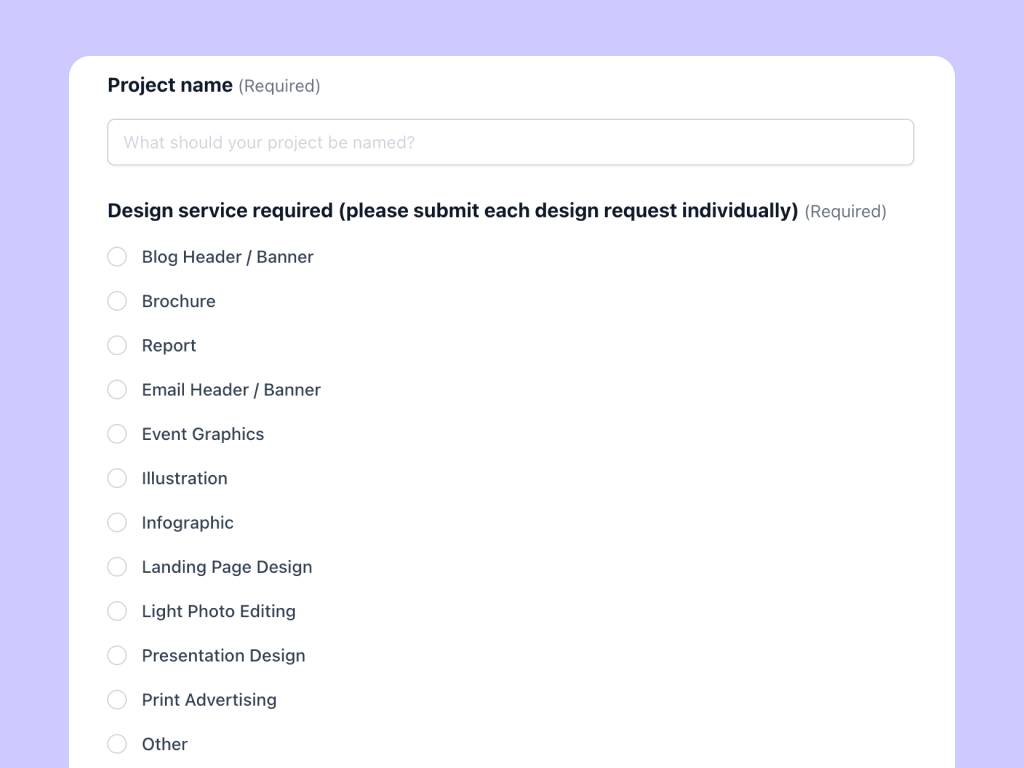
Because design is highly interpretive, vague inputs can lead to misaligned outputs. A structured client intake form template ensures designers aren’t guessing at specs or interpreting vague creative direction.
Key fields:
A structured intake form for a design subscription removes the guesswork so that designers don’t end up guessing specs and direction, and clients end up evaluating misaligned output.
Dominant variable: Strategic direction
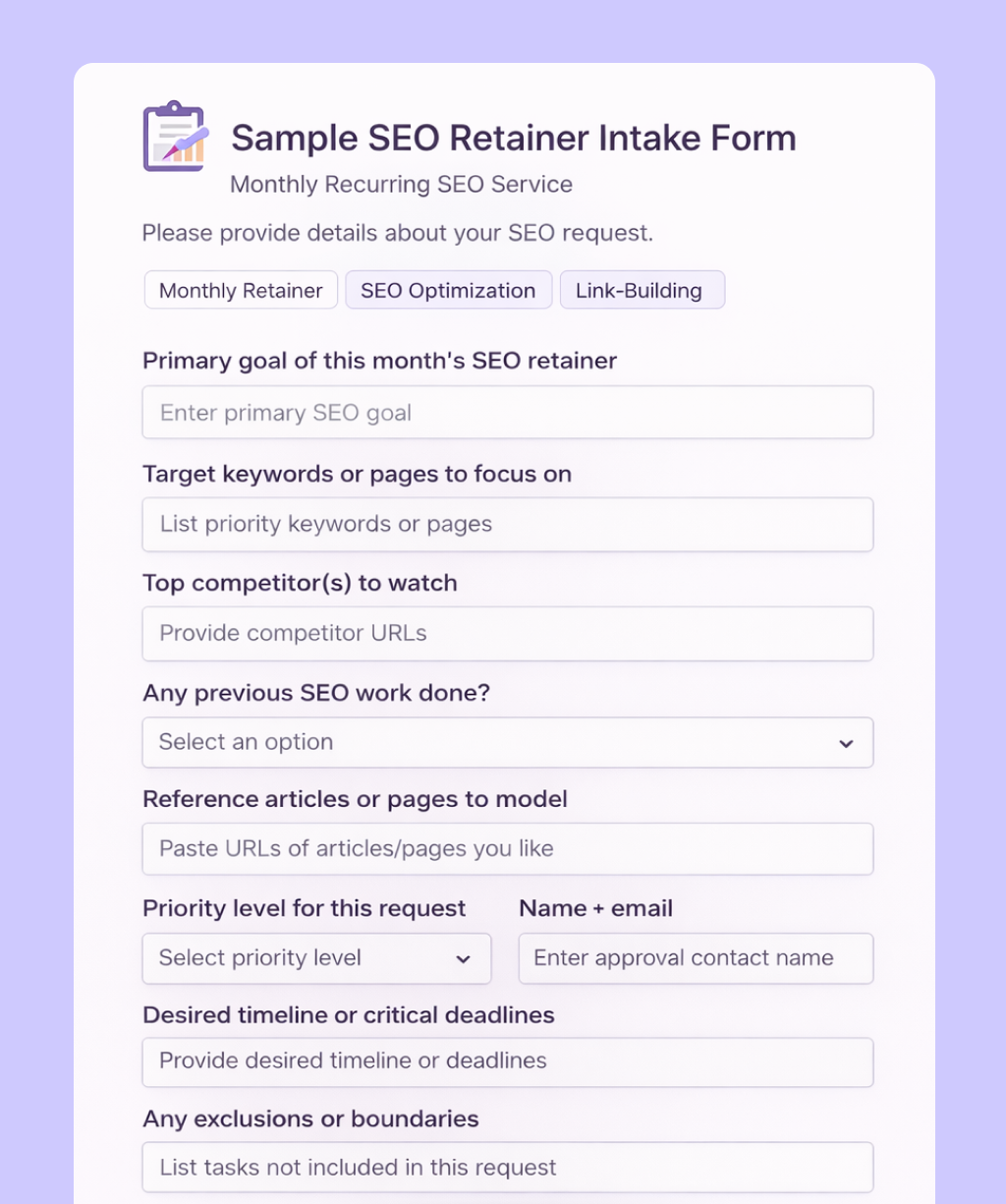
SEO requests fail when they lack direction. Why? Because SEO work without a clear anchor produces effort that may be technically correct but strategically misaligned.
Key fields:
Dominant variable: System complexity
Marketing ops requests are harder to scope. You aren't just doing the task but also managing the consequences of the request across platforms, automations, and data structures. A poorly scoped request can create problems that take longer to fix than the original task took to complete.
Key fields:
Dominant variable: Precision
Web development requests require precision. If things are even slightly unclear, web dev work breaks. Making assumptions and proceeding? "Done" must be defined before work begins, because once something is built to the wrong specification, correction costs multiply.
Key fields:
Google Forms and Typeform are built to collect responses and they do that well. But for a productized agency handling recurring client requests at volume, data collection is only the beginning of the problem.
The real gap is between input and execution. After a client submits a Google Form, someone on your team has to read it, interpret it, copy the relevant information into a project management tool, and manually create a task. That's three steps of manual coordination before work even starts.
At five clients, that overhead is annoying. At thirty, it's a structural bottleneck.
The issue isn’t the form itself, it’s what happens after submission. Without a system, intake creates more work instead of reducing it.
When intake lives inside a client portal, the entire dynamic changes.
No long email threads. No Slack messages. No manual re-entry by someone on your team. In ManyRequests, here’s how this flows:
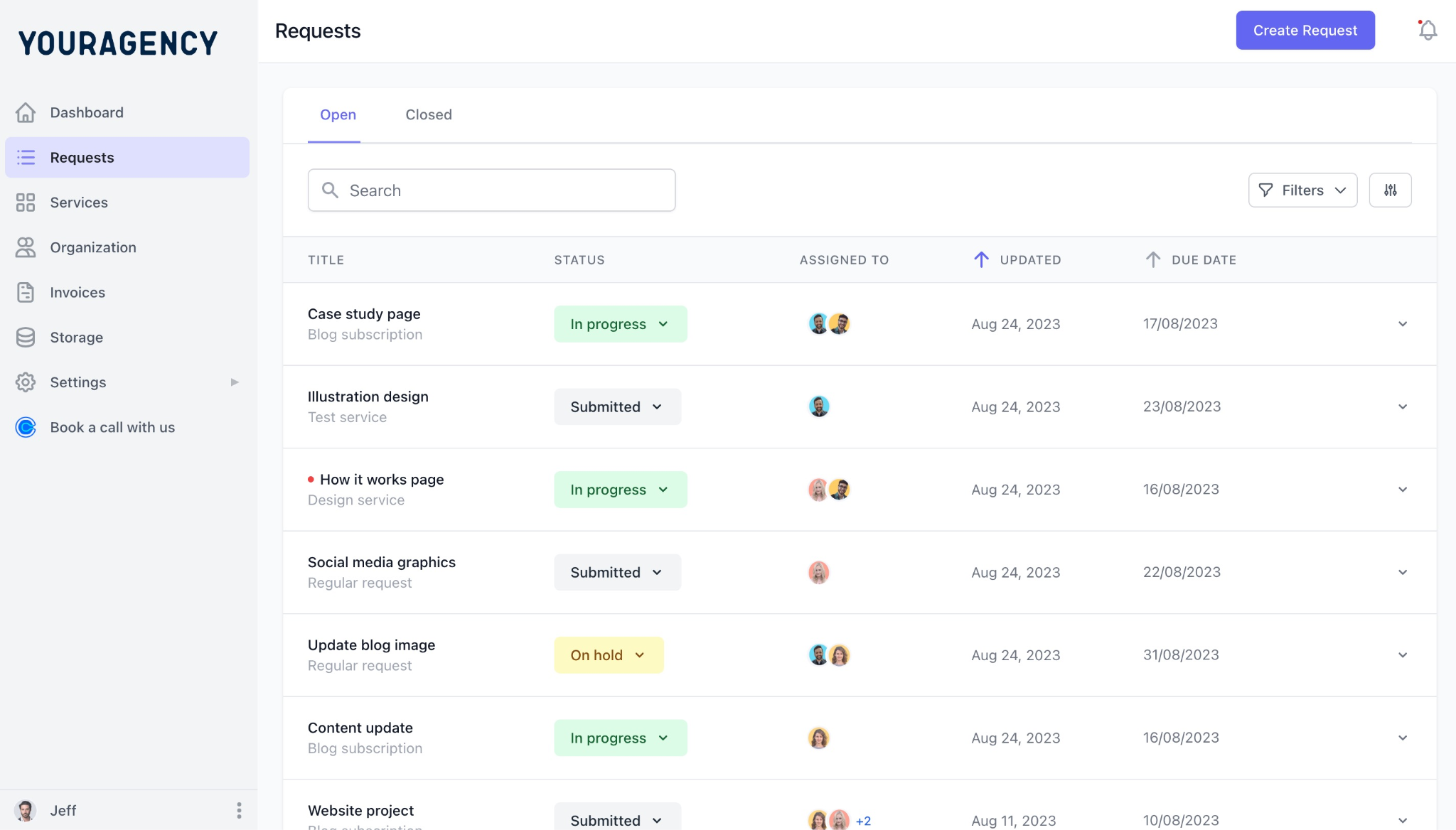
That's the operational difference between collecting data and running a delivery system.
How intake connects to client onboarding
Your intake form is not something you introduce after onboarding. It should be part of onboarding from day one, because onboarding's real job is to teach clients how to work with you.
When a client goes through a client onboarding form on their first request, they learn three things:
That training happens through the form itself, and not through a separate instruction document they'll probably just ignore.
Clients who learn to submit complete, structured requests early in the relationship create less operational overhead throughout the engagement. That’s actually a retention outcome. The experience of working with your agency feels smoother because the friction at the start of every request has been removed early on.
Most intake forms fail because the form was designed like a form instead of a workflow component. Here are common mistakes:
The most common mistake sounds harmless: “Tell us about your project.” It feels flexible and client-friendly. But in practice, it generates responses that can be too long without clarity, context without direction, and too many details that don’t help.
The fix:
The desire to cover every possible scenario can quickly lead to forms with 20 or 25 fields that apply to some requests but not others. When the form is too long, clients rush through them, skip fields, or avoid using them entirely.
The fix:
You have a well-designed new client intake form. But clients still send Slack messages, emails, and “quick requests.” Because it feels easier at the time. This effectively makes the form “optional.” Plus, those accepted requests submitted outside the intake form make your intake form can quickly pile up as you scale.
The fix:
When you don’t set boundaries early, clients assume everything adjacent to their request is included. So by the time you push back, it feels like friction.
The fix:
Your service evolves. Your offers change, process improves, and your team learns what information actually matters. So, don’t let your client request form templates stay the same. I will slowly become misaligned with how you deliver.
The fix:
Retention is usually discussed in terms of results and relationship quality. While those matter, there's an earlier factor that also shapes whether a client renews: how easy the agency was to work with throughout the engagement.
Better intake improves retention by making your agency easier to work with. If every request turns into a follow-up question, a clarification thread, and a delay before work even starts…the experience feels slow, clunky, and heavy. Even if the final output is good.
A structured intake changes that because:
ManyRequests is built specifically for productized agencies that handle recurring client requests. Intake isn't a standalone feature. It's the entry point to the entire delivery system. Every request is natively structured, tracked, and executed from a single place.
When you step back, this is the real shift ManyRequests enables: The shift to transform you from a reactive agency (that waits for client instructions, relies on scattered messages, and constantly clarifies what needs to be done) to a proactive agency (that uses structured intake, controls how requests are submitted, and delivers through a predictable system).
For productized agencies, delivery doesn’t start when work begins. It starts when a request is submitted. If that request is vague, incomplete, or scattered across channels, everything that follows becomes harder than it needs to be.
If requests still come in through email or Slack, your intake process is creating work, not eliminating it. A branded client portal with structured intake, trackable requests, and billing connected to delivery is what replaces that.
If you’re ready to make your delivery get easier to manage, easier to scale, and easier for clients to trust, start with ManyRequests or download a ready-to-use client intake form template designed for productized agencies.
A client intake form is a structured form that collects all required information before work begins, ensuring requests are clear, complete, and actionable.
A client intake form should ideally include request type, goal, required assets, success definition, deadline or priority, approval contact, and scope boundaries.
Use structured fields instead of open text, explain why each question matters, and keep the experience simple and guided.
An intake form captures structured inputs at the start. A project brief is often unstructured and requires interpretation, which introduces ambiguity.
1. See how ManyRequests works in real life. Start a free trial and experience how productized agencies centralize requests, reduce chaos, and streamline delivery, without changing their entire workflow.
2. Read our Implementation Guide to launch smoothly with your team and clients.
3. Follow us on LinkedIn and YouTube for practical agency growth strategies
4. Check out The Productize Blueprint to learn how to turn your services into a scalable, productized offer.