Foot-in-the-Door Offers for Agencies: Examples, Pricing, and How to Use Them
Learn how foot-in-the-door offers help agencies win retainers with examples, pricing, and proven strategies for recurring revenue.

Adetola Rachael Iyanuoluwa

A foot-in-the-door offer is a small, paid, scoped service a prospect buys before they commit to a retainer. For productized agencies, it's the fastest way to turn a cold lead into a subscriber.
Instead of pitching a 12-month retainer to someone who has never worked with you, you sell something small and specific. Once a client pays and sees the work, the subscription sells itself.
The best foot-in-the-door offer is a small paid project that doubles as the discovery that sells the retainer. so you skip the free trial games that attract people who were never going to pay.
This guide gives you six offers by agency type with real pricing, the design rules that make them convert, and the exact setup that turns a one-time buyer into a subscriber.
It works because of what psychologist Robert Cialdini calls commitment and consistency: once someone says yes to a small ask and has a good experience, saying yes to the bigger ask feels natural. You stop being a stranger asking for a 12-month commitment and become the agency they've already paid and already have results from.
This model works perfectly if you own a productized agency. Your service is already defined and packaged, so carving off a small, fixed-scope entry version is straightforward. That's the foundation of what I'll call the Foot-in-the-Door Path: a small scoped offer, fast delivery that proves your value, and the retainer upsell the offer already set up.
It's different from a free trial or a lead magnet because with a foot-in-the-door offer, you get paid for the work you do.
A free trial gives your product away and attracts people who just look around. A lead magnet swaps a PDF for an email address. A foot-in-the-door offer at $199 asks for a real brief instead, which filters out browsers and shows the prospect is serious.
The strongest foot-in-the-door offers are a single, recognizable slice of your core service, priced low enough to be a no-brainer and scoped tightly enough that you deliver in days.
Here are six by agency type, each with what's included, the delivery, and the retainer it sets up.
The prices in each example are illustrative. What you actually charge depends on your market, your overhead, and how you position the work.
A design agency can offer a single landing-page design for, let's say, $299. One page, one round of revisions, delivered in under a week. Your client walks away with a real asset they can ship. You walk away with a working relationship and a clear read on their brand and feedback style. Most teams that need one page need ten, and that's what sells them on the unlimited design subscription.
Your foot-in-the-door offer: A technical site audit for $199. You scope it to crawlability and on-page issues, then deliver a recorded walkthrough and a prioritized fix list. The audit proves your expertise. It also surfaces problems that take months of ongoing work to fix, which is your natural lead-in to the monthly retainer.
Offer a 30-day content calendar for around $149. You map topics and formats directly to the client's target keywords. It's fast, affordable, and genuinely useful on its own. But a calendar with no one to write the articles is just a very organized to-do list that nobody will complete, and that gap sells your content subscription without you having to pitch it.
Offer a 30-day ad campaign audit for around $249. You review their current ad account, flag wasted spend, and hand them a concrete action plan. When the audit shows money leaking every week, the ads management retainer isn't a hard sell. It's the fix they already want.
Offer a site speed and performance audit for around $179. You run a focused diagnostic on load times and Core Web Vitals, then hand them a remediation list. It's repeatable, and it opens the door to the maintenance or development retainer.
Offer a brand positioning workshop for around $399. You run a 90-minute working session that maps their positioning and messaging, then follow up with a short summary doc. It gives clients a paid taste of your strategic thinking and naturally leads them into a full brand sprint.
Notice the pattern. Every one of these is a diagnostic or a single finished asset. As JP Garbaccio, Head of SEO and AEO at Seachable, put it in a recent AEO masterclass, the discovery audit is "the same data that prices, closes, and reports the deal."
Design your offer so the deliverable doubles as the strategy document that justifies the retainer, and the upsell stops being a pitch and becomes the next logical step.
A foot-in-the-door offer converts when it's tightly scoped and aimed straight at the retainer. Five rules get you there.
The client should know exactly what they're getting before they pay. Vague scope is what turns a $199 audit into three weeks of unpaid work, so spelling out the inclusions is also the front line of managing client expectations.
A prospect who gets real, finished work back in days believes you'll handle their retainer the same way. Slow delivery on the small job kills trust in the big one before you ever pitch it.
The offer is a sample, so you shouldn't give half effort results. Treat the $199 job exactly like the $1,999 one. A weak deliverable kills the upsell faster than no offer at all.
The audit that finds ten issues you can't resolve in one pass, or the calendar nobody on their side has the time to execute. Price your retainer on that problem.
The prospect should be able to pay and submit the brief in the same five minutes. A discovery call puts back exactly the friction the offer exists to remove.
Use this template to define yours:
We deliver [scoped deliverable] for [client type] in [3–5 days] for [$149–$499], which reveals [the specific problem] that [the retainer] solves.
An SEO agency might frame it this way: "We deliver a technical SEO audit for SaaS companies in 5 days for $199, which reveals the crawl and content issues that our monthly SEO retainer fixes."
The offer only scales if buying, briefing, delivering, and upselling run in one place instead of four, which is what productized service software is built for. Here's the exact setup in ManyRequests. It takes an afternoon, and then the offer runs itself.
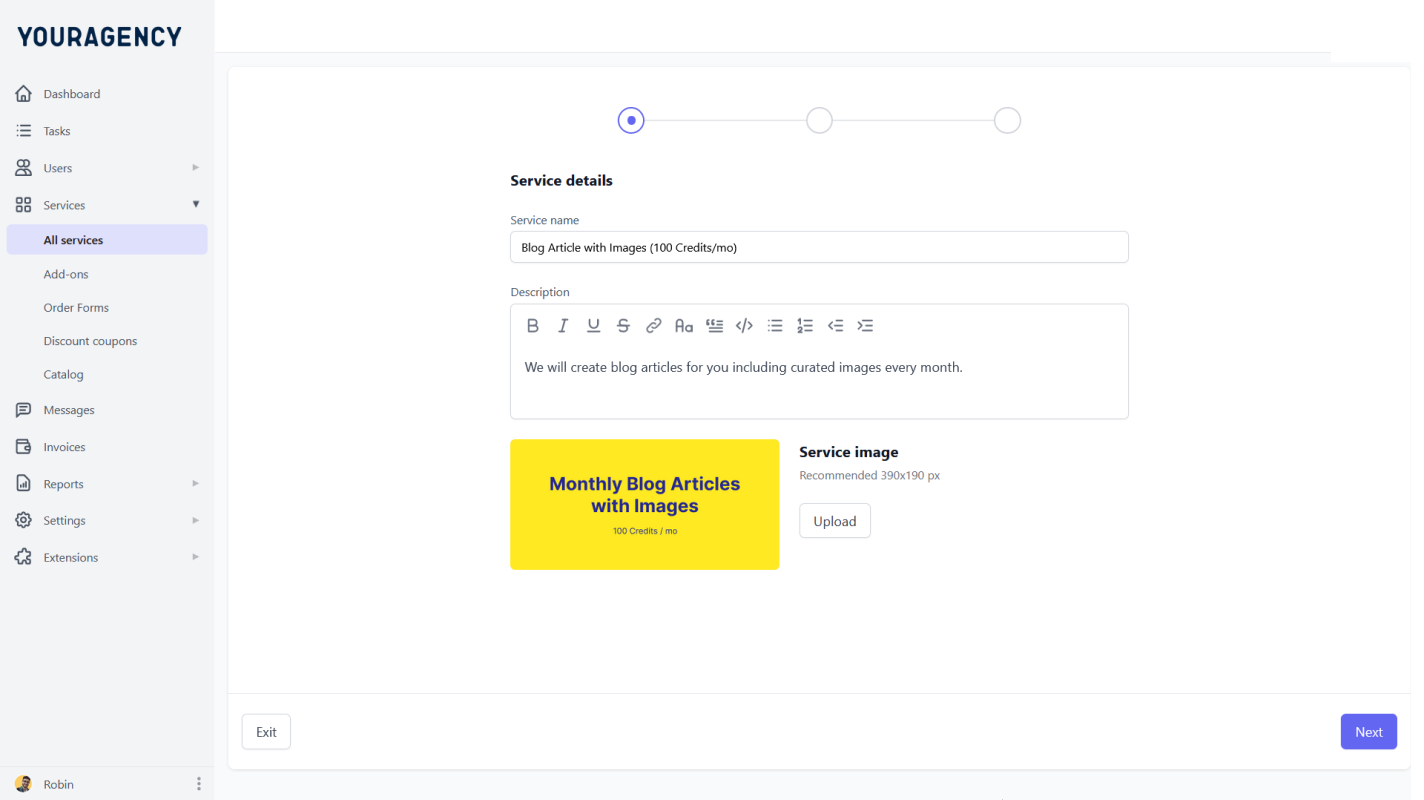
In the service builder, you can create the service, give it a name and a one-line description, set the fixed price (say $199), and mark it as a one-off rather than a subscription, with quantity capped at one per client.
ManyRequests generates a checkout link you drop on your site or paste into a DM. The prospect pays through Stripe and lands in your branded client portal automatically, so there's no invite to send and no call to book.
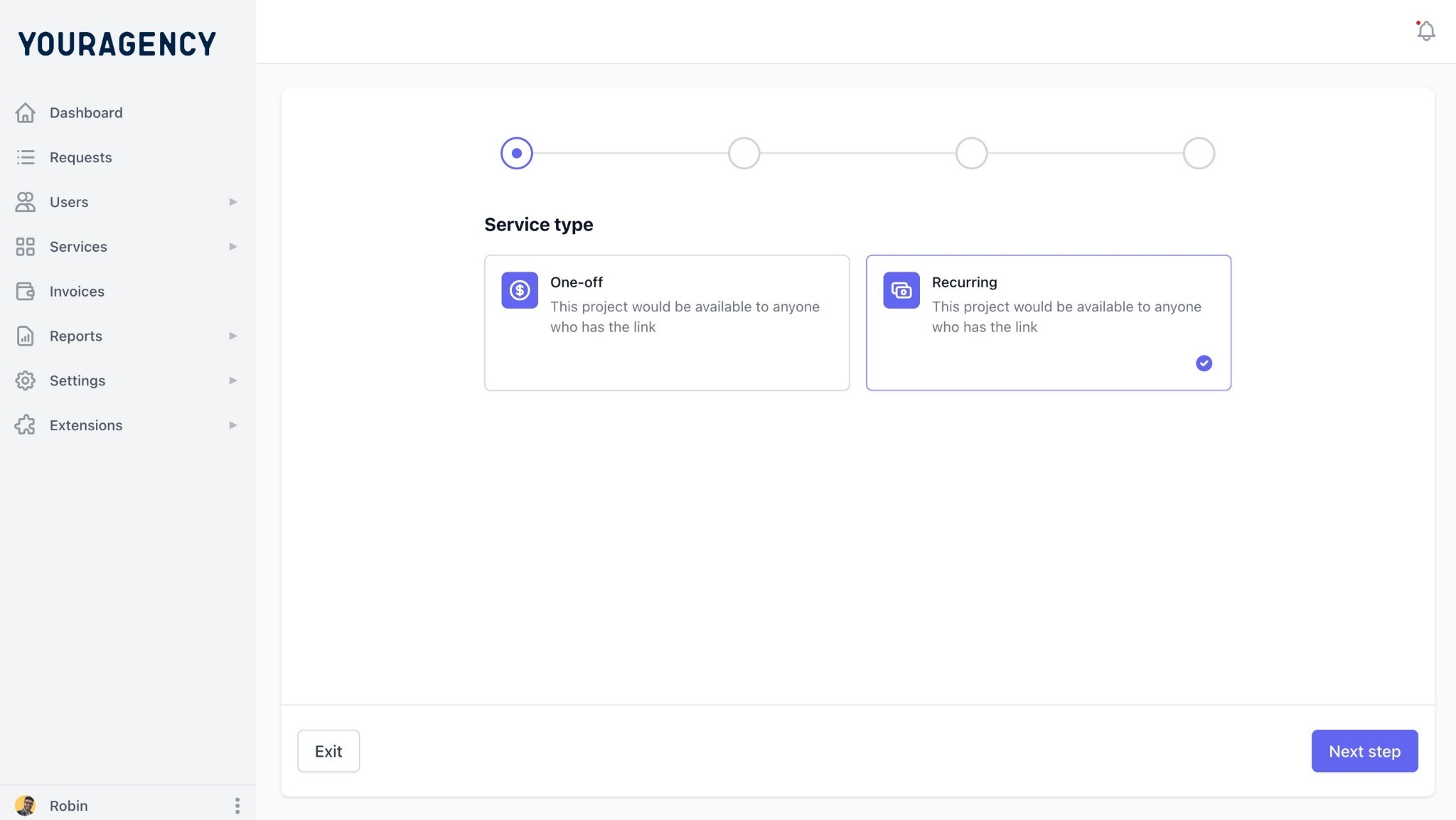
Add a request intake form with conditional logic to the service, so the form changes based on the client's answers and asks only what that deliverable needs: the single outcome the request should produce, the assets and logins you need, the deadline, and a pre-filled "this does not include" line that holds the scope.

The brief arrives complete, so your timer starts the minute they pay instead of after three follow-up emails.
Set an auto-assignment rule that routes each new order to the right person, and save a request template with your standard steps and statuses, for example In Production, In Review, then Delivered, like this screenshot from ManyRequests:
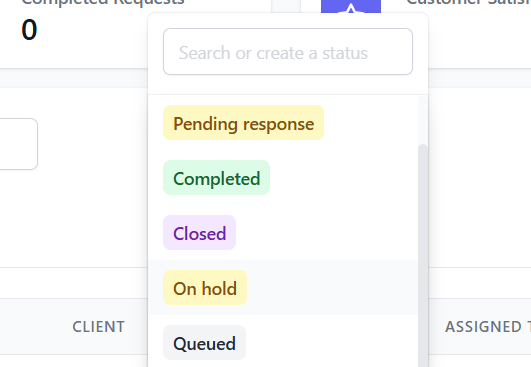
That's what lets you run the offer at volume without it eating your week, and it keeps the deliverable consistent from the first client to the fiftieth.
Schedule a message for when the request hits Delivered, or wire a Zapier or webhook automation off that status change, so the follow-up goes out while trust is highest.
List the retainer as a subscription in the same service catalog, and send a checkout link with the plan pre-selected and the offer credited toward month one, so the client upgrades in one click instead of signing a new contract.
Here's a follow-up you can use the day you deliver:
"Your [audit/deliverable] is ready, and it surfaced a few things worth fixing: [top two findings]. The fastest way to handle them is our [retainer name] at [price]/month, and I'll credit your [$X] [offer] toward your first month. Want me to switch it on?"
If they don't reply within 48 hours, follow up once with the single most important finding and the credit offer. After that, let it sit. Clients who don't convert immediately aren't lost. They're warm. Re-engage them when your next offer goes live or when their top finding becomes urgent enough that they circle back.
Price the offer to cover your time, and don't be all focused on making a huge profit. The margin lives in the retainer it sets up, so the entry price only needs to be high enough to filter out tire-kickers and low enough to be an easy yes.
For most productized services, that lands between $149 and $499. Deeper diagnostics for larger clients may run higher to $1,000 or more for a full audit. But the low-friction entry offers that convert cold prospects sit in the lower band.
P.S: Don't drop under $99. A price that low signals low value and attracts the exact clients who churn fastest.
You can do two things to make your pricing work harder. First, credit the offer toward the first month of the retainer, so the client feels no loss when they upgrade and the upsell is easier for them.
Second, put a time limit on the price to create urgency, so "let me think about it" has a cost. Set the number with your full agency pricing models in mind. Your foot-in-the-door offer is the on-ramp, and the retainer is your revenue.
Once the number is set, you can build the offer as a service in ManyRequests so clients can buy it at that price, credit and all, without a call.
Start a free trial and put your first foot-in-the-door offer live this week.
A foot-in-the-door offer works because you earn trust through delivery, not promises. The client pays a little, sees the work, and commits to the retainer with the risk already gone. The offer that proves your value closes the subscription too, which is why design and delivery matter more than the discount.
Build the offer once, scope it tightly, and let the system do the rest. Try ManyRequests free for 14-days and set up your foot-in-the-door offer as a service clients can buy, brief, and upgrade from, without a single discovery call.
A foot-in-the-door offer is a small, paid, scoped service that lets a prospect experience your agency's work before committing to a retainer or subscription.
Deliver the offer fast and at full quality, then pitch the retainer the moment the work lands and trust is highest. The cleanest path is to design the offer so it surfaces a clear next problem, credit the offer's price toward the first month, and make the upgrade a one-click move to a subscription rather than a new negotiation.
Include one recognizable slice of your core service with a tightly defined scope. The deliverable should stand on its own as something useful while pointing clearly at the larger problem your retainer addresses.
A free trial is unpaid and gives away limited access to your service, which could attract browsers. A foot-in-the-door offer is paid and delivers a complete, scoped result, so the buyer is already a paying client who has experienced your work, which makes the upsell to a retainer far easier.
1. See how ManyRequests works in real life. Start a free trial and experience how productized agencies centralize requests, reduce chaos, and streamline delivery, without changing their entire workflow.
2. Read our Implementation Guide to launch smoothly with your team and clients.
3. Follow us on LinkedIn and YouTube for practical agency growth strategies
4. Check out The Productize Blueprint to learn how to turn your services into a scalable, productized offer.
Adetola Rachael Iyanuoluwa is a B2B SaaS writer and content marketer with 4+ years of experience creating SEO, human-focused content. She writes in-depth how-to guides and comparison articles content that help SaaS companies grow organic traffic and turn readers into customers. At ManyRequests, she produces practical, well-researched content that helps agencies and service businesses streamline operations and scale sustainably.