Creative Project Management for Productized Agencies [2026]
Creative project management for productized agencies: manage client requests, feedback, revisions, approvals, and recurring delivery.

William Nzewi
Creative project management gets harder when your agency stops running one-off projects and starts managing ongoing client work.
A design agency might have 15 brand retainers running at the same time. A content studio may deliver dozens of articles every month. A marketing agency could be running campaigns for eight clients, each with different deadlines, approvals, and revision cycles. Without a clear system, requests end up scattered across email, Slack, spreadsheets, and project management tools.
The challenge is knowing what each client has requested, what your team is working on, what is waiting for approval, and what is included in the client’s plan.
That is where creative project management is different from traditional project management. Design and marketing agencies need a workflow built around recurring delivery, structured client requests, revisions, and approvals.
This guide explains how to build that system and the tools you can use to manage creative client projects.
Creative project management is the process of planning, organizing, delivering, and tracking creative work from client request to final approval.
For design and marketing agencies, that means managing work such as branding, graphic design, website assets, social media content, SEO content, ad creative, and ongoing marketing campaigns. It's not about managing film productions, events, or large media projects. The focus here is the day-to-day client work that a lean agency delivers across multiple accounts.
The difference becomes clearer when you look at how these agencies operate.
A traditional project might have a defined start and end date: a client hires a design agency to create a brand identity, the team completes the work, and the project closes.
A productized or retainer-based agency works differently. A client might pay $2,000 per month for ongoing design support or a fixed number of SEO articles. New requests arrive throughout the month, team members work on several clients at once, and completed work moves through review and revision before delivery.
Creative project management gives that recurring work a structure.
The goal is to make it clear what needs to be done, who owns it, what stage it's in, and what the client needs to do next. The agency creates a repeatable workflow that the whole team and every client can follow.
For example, a productized branding studio might receive a request for a new landing page design from a client. The request enters through a structured intake form, the project manager checks that it fits the client's plan, a designer is assigned, the first version moves into review, and the client submits feedback through the same system.
Once revisions are complete, the final files are delivered and the request is closed. That process matters when you're managing five clients. It becomes essential when you are managing 15 or 20.
Without a defined system, agency owners end up spending too much time answering questions like "What's the status of this?" or "Did the client send feedback?" With a proper agency project management system, those answers are visible without another Slack message or email.
The best system also connects project delivery with the commercial side of the agency. For subscription-based services, the work clients request should be tied to what they pay for, what's included in their plan, and how often work is delivered.
One big problem is keeping client work organized when several projects, requests, reviews, and deadlines are moving at the same time.
A design agency with 15 ongoing retainers may have dozens of active requests across those accounts. A marketing agency might be managing campaigns for eight clients while handling new ad creative, landing pages, social content, and performance reports. Every piece of work has its own deadline, owner, feedback cycle, and client expectations.
Without a clear system, small problems quickly turn into delivery problems. Here are the major challenges creative agencies face:
Creative work almost always involves feedback. The problem starts when the number of revisions is unclear.
A client asks for "one small change" to a design. That change leads to another request, which leads to another round of feedback. Before long, a task that should have taken two hours has consumed half a day.
This is especially difficult for agencies selling retainers or subscriptions because clients may assume that paying monthly gives them unlimited access to the team.
A good creative project management process defines how revisions work before production starts. The client should know what's included, how feedback should be submitted, and when a request falls outside the agreed scope.
Scope becomes harder to control when work arrives through informal channels.
A client sends a request through email. Then they mention another task in Slack. Their marketing manager adds something during a meeting. A team member starts working on all three without checking whether they're part of the client's plan.
Now the agency has no reliable record of what was requested, when it was requested, or whether the work is included.
For productized agencies, structured intake is a better approach. Clients submit requests through a defined workflow, and the agency can review each request before assigning it to the team.
This creates a clear line between what the client asked for and what the agency agreed to deliver.
Creative teams need feedback from clients, but communication can easily become the work.
When clients constantly ask for updates, designers and marketers have to stop what they're doing to answer them. A simple status question can create another message, notification, or interruption.
This is why client visibility matters. If clients can see whether a request is queued, in progress, waiting for feedback, or complete, they don't need to ask the team for every update.
A design agency project management tool should make this information easy for both the agency and the client to access.
A creative agency rarely has the luxury of finishing one project before starting another.
A designer might be creating a brand presentation for one client, social media graphics for another, and website assets for a third. Meanwhile, a content writer may be producing this month's articles for several SEO clients.
The challenge is managing capacity across the entire team without losing sight of client priorities.
A central system gives the agency one place to see active work, upcoming deadlines, blocked tasks, and work waiting on clients.
Clients and agency teams may work in different locations and time zones. If every decision requires a live meeting, delivery slows down quickly.
A better approach is to make the workflow asynchronous wherever possible. Clients submit requests in a structured format, the team communicates within the task, and feedback is attached to the relevant work.
None of these challenges are unusual. They're the natural result of running a service business where several people are producing creative work for several clients at once.
The solution isn't simply asking the team to "stay organized." The agency needs a repeatable system for capturing requests, assigning work, managing revisions, collecting approvals, and keeping clients informed.
A creative project management system doesn't need to be complicated. For a productized agency, the most useful system is usually a repeatable workflow that takes a client request from intake to delivery without relying on constant manual coordination.
The exact workflow will differ between a design agency, SEO agency, and marketing agency, but the core principles are the same.
Productized agencies should treat client requests as the starting point for delivery.
Give clients a structured way to submit requests. A design client might request a new landing page, while an SEO client might submit a topic for the next article.
The intake process should capture enough information for the team to understand the request without starting another conversation. This could include the type of work, required files, deadline, examples, and any relevant instructions.
The request can then be reviewed before it enters the production queue. This gives the agency a chance to confirm that the work fits the client's plan and clarify anything that's missing.
It also creates a single source of truth. The original request, files, feedback, status, and final delivery stay connected.
Subscription-based creative work needs a delivery rhythm.
Consider an SEO agency selling a monthly content package. The client might receive eight articles every month. The agency doesn't need to treat those eight articles as one large project. Instead, it can create a repeatable workflow for submitting topics, assigning writers, editing drafts, collecting feedback, and publishing final content.
The same principle applies to a design subscription. A client may submit requests throughout the month, but the agency still needs rules around queue position, turnaround times, active requests, and revisions.
The subscription defines the commercial relationship. The delivery workflow defines how the work gets done.
Keeping those two things connected helps prevent a recurring service from becoming a collection of random tasks.
Revisions should be part of the workflow. For example, a branding studio might include two rounds of revisions in a fixed-scope package. A design subscription might allow revisions within a defined request workflow but require a new request when the client asks for something substantially different.
The important thing is that the rules are visible before production starts.
A client portal can make this easier because feedback is attached to the relevant request. The team can see what changed, which version the client is reviewing, and whether the requested change is part of the original scope.
This is particularly useful when several people on the client side are reviewing creative work. Instead of collecting comments from different email threads, the agency has one record of the feedback.
For more complex design workflows, online proofing tools can also help teams keep review and approval tied to the work itself.
Not every creative request needs a complicated project plan. But larger pieces of work benefit from clear stages.
A website design project, for example, might move through intake, initial concepts, internal review, client review, revisions, and final delivery.
A marketing campaign might follow a similar path: brief, creative production, internal approval, client approval, launch, and reporting.
The purpose of these milestones is visibility. At any point, the team should know where the work is and what needs to happen next.
For client-facing work, approval should also have a defined step. The agency should have a clear way to record that the client has approved a deliverable.
Design approval software becomes useful here, particularly for agencies handling a high volume of creative reviews.
A scalable creative agency can't run every request through a meeting.
Meetings shouldn't be required just to submit a design request, check a task status, or provide feedback on a deliverable.
An async-first workflow puts the information where the work happens. The client submits the request, the team updates its status, feedback stays with the task, and the final files are delivered through the same system.
This becomes increasingly important as the agency takes on more clients or works across time zones.
The result is a simple operating loop:
Request → Review → Production → Client feedback → Revision → Approval → Delivery.
Once this process is standardized, the agency can repeat it across clients without rebuilding its project management process every time a new request arrives.
A creative project management system should make growth easier.
When an agency has five clients, the founder may be able to keep track of requests through memory, Slack messages, and a spreadsheet. At 20 clients, that approach breaks down. There are too many requests, deadlines, approvals, and team handoffs to manage manually.
The answer is to turn the way you already deliver work into a repeatable system.
Start by identifying the work your agency delivers repeatedly.
If a design agency creates social media graphics every month, create a standard workflow for that service. If an SEO agency delivers monthly articles, create a workflow that covers topic intake, writing, editing, client review, revisions, and delivery.
Templates reduce the number of decisions your team has to make for every new request.
Your project management system should work alongside simple standard operating procedures.
An SOP might explain how a designer handles a new branding request, how an account manager checks whether a request fits a client's plan, or how the team handles a revision that goes beyond the agreed scope.
Document the decisions and steps that need to happen consistently. This makes it easier to onboard new team members and maintain the same level of service as the agency grows.
Clients don't need to see every internal discussion or project-management detail.
Give them a simple way to submit requests and check progress. Your team can then turn those requests into tasks, assign owners, set priorities, and manage internal deadlines.
This separation keeps the client experience simple while giving your team the control it needs to manage delivery.
It also prevents the common problem where clients effectively manage the agency's task list through Slack or email.
A scalable system should answer basic questions without requiring someone to send an update.
What is waiting to be started? What is currently in production? What is waiting for client feedback? What has been approved? What is overdue?
When those statuses are visible to the team and, where appropriate, the client, fewer messages are needed to keep everyone aligned.
This is especially important when one account manager is responsible for several clients. Instead of checking multiple inboxes and conversations, they can work from a central view of active requests.
Your first workflow won't be perfect.
At five clients, you may discover that a certain approval step is unnecessary. At 12 clients, you may find that client feedback is becoming a bottleneck. At 20 clients, you may need better capacity planning or clearer rules around active requests.
Treat the workflow as an operating system that improves with the agency.
The goal is to build enough structure that the agency can handle more client work without adding the same amount of administrative effort.
That is the difference between simply using a project management tool and building a project management system around the way your agency sells and delivers its services.
The right project management software should do more than give your team a place to create tasks.
This matters even more for productized agencies. If your business runs on subscriptions or retainers, your project management system should connect client requests with the service you sell.
Here are the main things to look for.
Client visibility should be built into the workflow. Clients should be able to see the status of their requests without having to message your team for an update. A client-facing portal is more useful than simply inviting clients into your internal project management workspace.
Structured request intake is another key requirement. Your software should give clients a clear place to submit work and provide the information your team needs to get started. This is much easier to manage than requests arriving through email, Slack, and meetings.
Revision and approval tracking matters because creative work rarely ends with the first draft. Feedback should stay attached to the relevant request or deliverable so your team can see what needs to change and what has already been approved.
Subscription and retainer management becomes important when recurring services are your business model. The software should make it easier to connect client work with the plan they're paying for, rather than forcing you to manage delivery and billing as completely separate processes.
For agencies built around recurring creative services, these features can matter more than advanced internal task-management features.
ManyRequests is built specifically for agencies that sell and deliver recurring services.
Instead of combining a general-purpose project management tool with separate systems for client communication, request intake, and subscription management, ManyRequests brings these parts of the client delivery workflow together.
The core workflow is straightforward. Clients use a branded portal to submit requests, your team manages those requests through internal workflows, and clients can follow progress and provide feedback without relying on scattered email or chat conversations.
That makes it particularly useful for productized design and marketing agencies.
Imagine a design agency managing 15 ongoing brand retainers. One client needs a landing page design. Another needs five social media graphics. A third needs revisions to an existing presentation.
Instead of receiving those requests through different channels, each client submits work through the agency's portal. The team can review each request, confirm that it fits the client's service, assign it to the right person, and move it through the delivery workflow.
The client can then see what is happening without asking the account manager for a status update.
ManyRequests also supports the commercial side of this model through subscription billing. That matters because a productized agency isn't simply selling project management. It sells a defined service on a recurring basis.
For example, a client might subscribe to an ongoing design service. Their subscription determines the service they've purchased, while the request workflow determines how individual pieces of work are submitted and delivered.
This distinction helps agencies avoid turning every incoming request into a new custom project.
ManyRequests also gives agencies a client-facing portal, structured request intake, file sharing, feedback, chat, and reporting in the same platform. That makes it possible to build a delivery process around the client relationship.
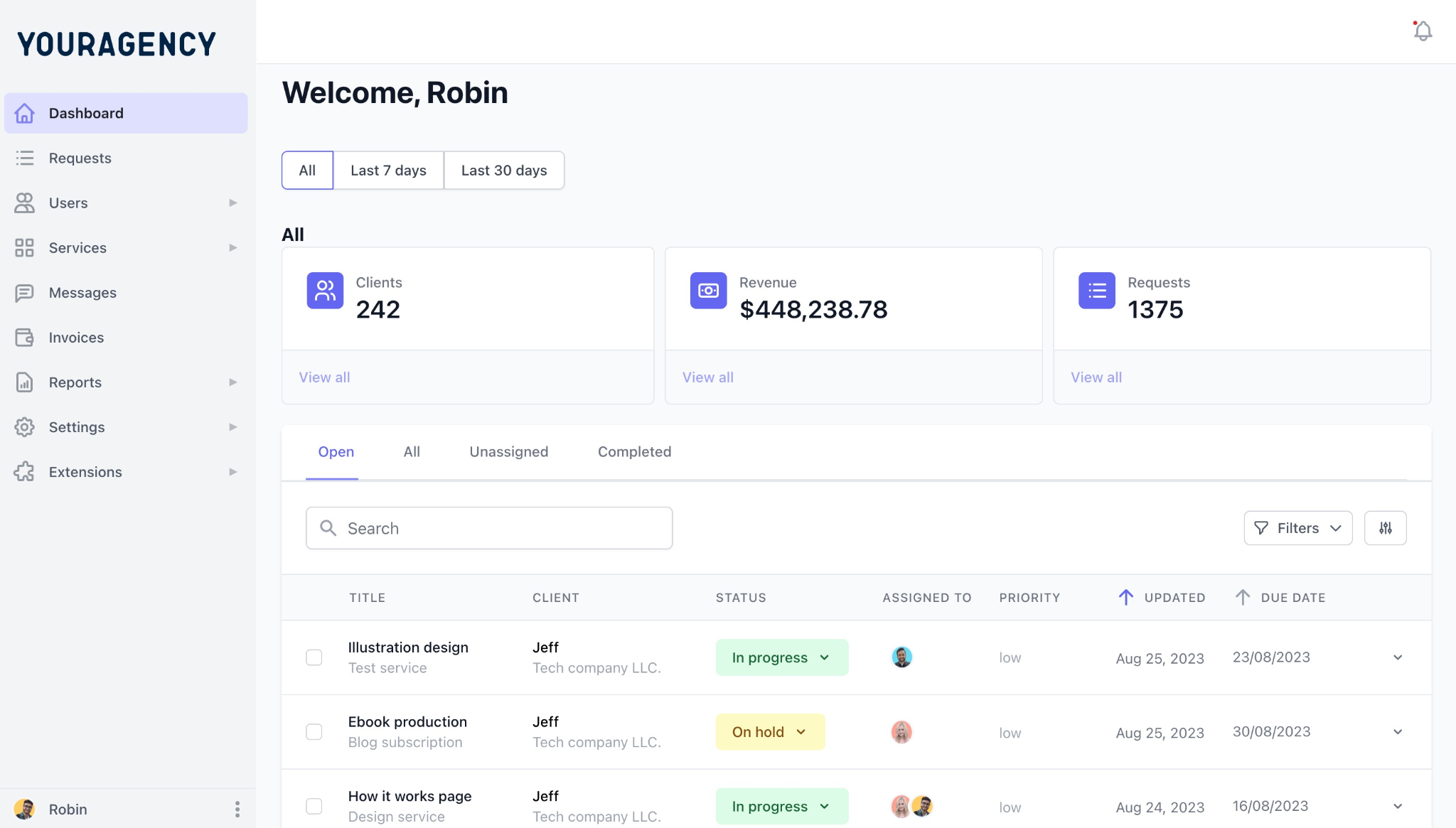
ManyRequests client portal (admin view)
The result is a workflow designed around the realities of productized services. The agency can standardize that workflow across different clients while still giving each client a branded experience.
If you run a design or marketing agency on retainer, ManyRequests is built for exactly this kind of work. Start your free trial.
Asana is a general-purpose project management platform that works well for organizing internal tasks, projects, deadlines, and team collaboration.
For a creative agency, it can help manage production work, but agencies may need additional tools or processes for client-facing request intake, branded client portals, and subscription-based service delivery.
ClickUp combines project management, tasks, documents, collaboration, and other productivity features in one platform.
Its broad feature set can work for agencies with complex internal workflows. Agencies running productized services may still need separate systems or workarounds for a client-facing service portal, structured creative request intake, and recurring retainer billing.
Teamwork is designed for client work and includes project management, task tracking, collaboration, and client-focused features.
It can be useful for agencies managing traditional client projects. But for a productized agency where recurring subscriptions, standardized requests, and repeatable service delivery are central to the business model, a platform built specifically around that workflow can be a better fit.
There's no shortage of project management software. The important question is whether the tool matches how your agency sells and delivers work.
A traditional project-based agency may need detailed project plans, dependencies, and resource scheduling. A productized design or marketing agency needs to process a steady stream of client requests while keeping scope, communication, feedback, and recurring delivery under control.
If your agency runs on retainers or subscriptions, your project management software should reflect that model.
ManyRequests combines the client portal, request intake, delivery workflow, and subscription billing that productized agencies need to manage recurring creative work in one place.
Magier, a design subscription service, uses ManyRequests to service 100s of customers and a team of 21+ team members. Co-Founder, Maximilian Fleitmann, says:
“With the help of ManyRequests, we grew our customer base to 50+ businesses and are seeing no sign of slowing down. The platform handles our customer service workflows from top to bottom and is fundamental to our daily operations.”
If you run a design or marketing agency on retainer, try ManyRequests for free.
Creative project management becomes much easier when your agency stops treating every client request as a separate project.
For design and marketing agencies running on retainers or subscriptions, the goal is to create a repeatable delivery system. Clients should know where to submit requests and check progress. Your team should know what to work on, what's waiting for feedback, and what's included in each client's plan.
The right system gives you that structure without adding unnecessary admin work.
If you run a productized agency and need a better way to manage client requests, delivery, feedback, and recurring services, ManyRequests gives you the tools to run the entire workflow from one platform.
Creative project management is the process of planning, organizing, and delivering creative work while managing deadlines, client feedback, revisions, approvals, and team capacity. For design and marketing agencies, it covers the workflow from client request and briefing through production and final delivery.
Creative work is often iterative rather than linear. A design may go through several rounds of feedback and approval before it's finished, while client priorities can change during delivery. Creative project management therefore needs to account for revisions, approvals, visual feedback, and changing priorities alongside deadlines and scope.
Start with a structured client intake process, then move each request through clear stages such as production, review, revision, approval, and delivery. Keeping requests, files, feedback, and status updates in one system makes it easier to manage multiple clients without relying on email or chat threads.
Look for features that support the way creative work actually happens: client visibility, structured request intake, proofing and approvals, revision tracking, resource or capacity planning, and integrations with the tools your team already uses. For productized agencies, subscription and client billing features can also be important.
The right software depends on your agency's workflow and business model. General tools such as Asana and ClickUp can manage internal projects and tasks, while agency-focused platforms can add client-facing workflows. For productized and retainer-based agencies, ManyRequests combines project management with client portals, request intake, proofing, invoicing, and recurring services.
Not necessarily, but the software needs to support creative workflows. A general project management tool can work for a small team with simple requirements. As client volume grows, features such as client portals, visual approvals, structured intake, and recurring-service management can become more important.
1. See how ManyRequests works in real life. Start a free trial and experience how productized agencies centralize requests, reduce chaos, and streamline delivery, without changing their entire workflow.
2. Read our Implementation Guide to launch smoothly with your team and clients.
3. Follow us on LinkedIn and YouTube for practical agency growth strategies
4. Check out The Productize Blueprint to learn how to turn your services into a scalable, productized offer.
William Nzewi is a data scientist and a writer. He likes to read and learn new things, especially about tech, business and life.