How to Get Retainer Clients [The Productized Agency Playbook]
Learn how to get retainer clients with proven strategies that turn one-off projects into steady monthly revenue.

Peace Akinwale

The fastest way to get retainer clients is to convert existing clients into monthly agreements, then layer in targeted outreach once your offer is productized.
Knowing how to do this is one of the most important things you can do for your agency's growth. It helps you go to bed at night without the fear of running out of work.
You can stop hustling for new projects every month, hire new talent on-demand, and spend time learning your client's business well enough to do good work for them.
Retainers are how agencies build recurring revenue without starting from zero every month. And while pitching retainer clients can feel like a headache, let's take a step back and look at the structure you need before selling your retainer service.
Before diving in, here's the simple framework this article is built around:
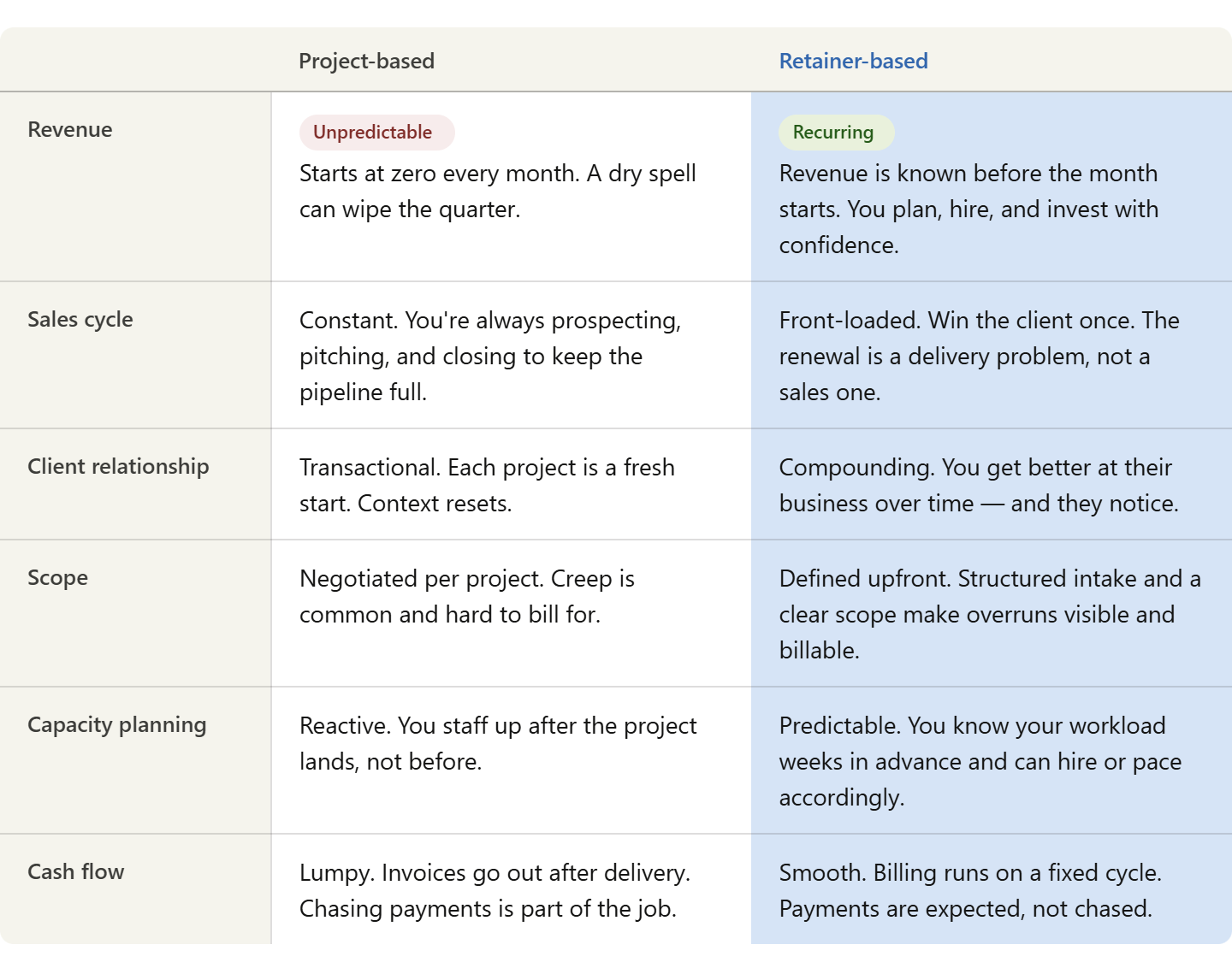
The first step to having a reliable retainer service structure is to figure out
Once you can articulate this, you can break your services into tiers, explain the deliverable for each tier, and place a price tag on it. If your service isn't productized, retainers will be hard to sell. Clients don't commit monthly to something they can't clearly see the value of upfront.
📌Read more: Free Retainer Agreement Template.
Retainer Pitch Template
We’ve seen strong results from [project].
The next step is maintaining that momentum.
We can do this through a monthly retainer where you get:
- [deliverable 1]
- [deliverable 2]
We can start with a 3-month period and review from there.
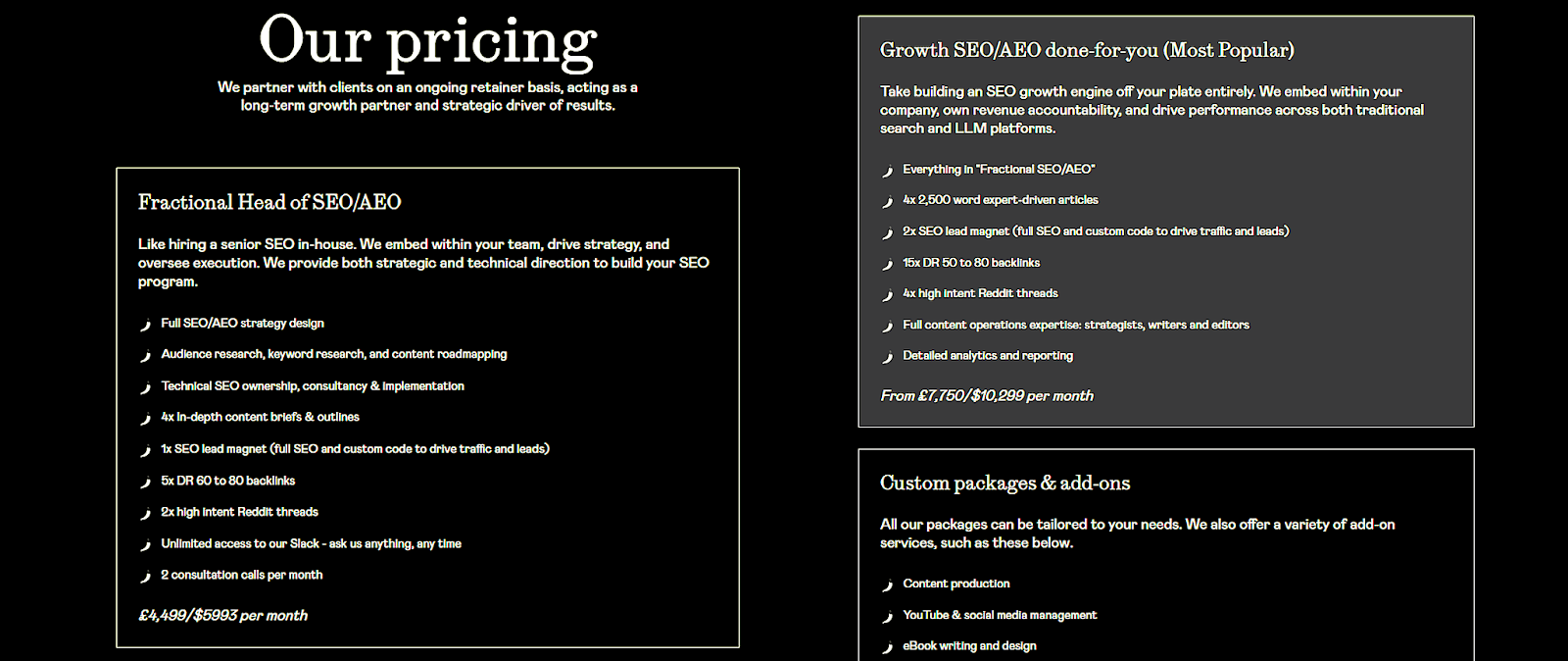
A simple starting structure looks like this:
The productized service can look like this:
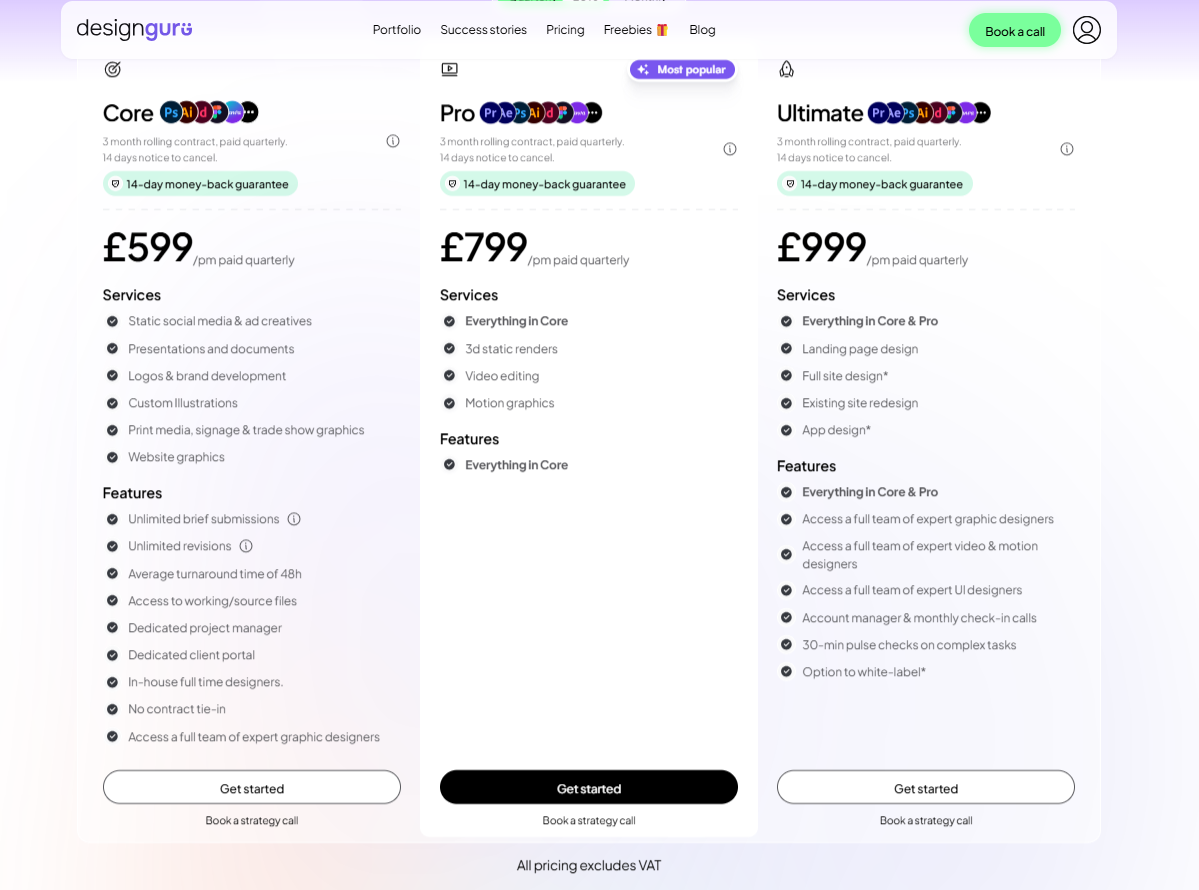
You can structure this in a different way too. If you’re a design service, you can make it quarterly-based pricing like DesignGuru:
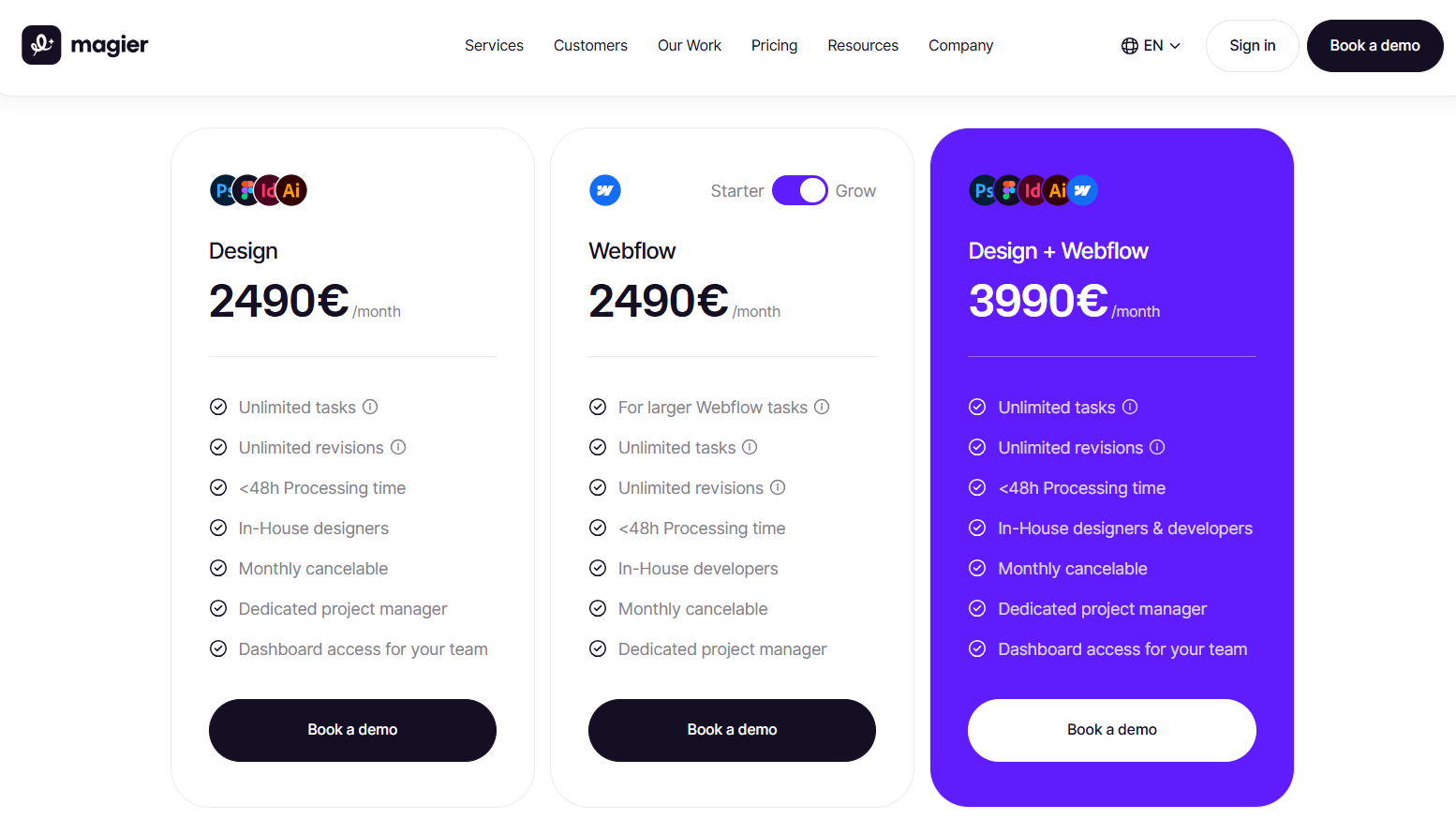
Or structure it like magier’s. They provide unlimited designs per month with specific turnaround time:
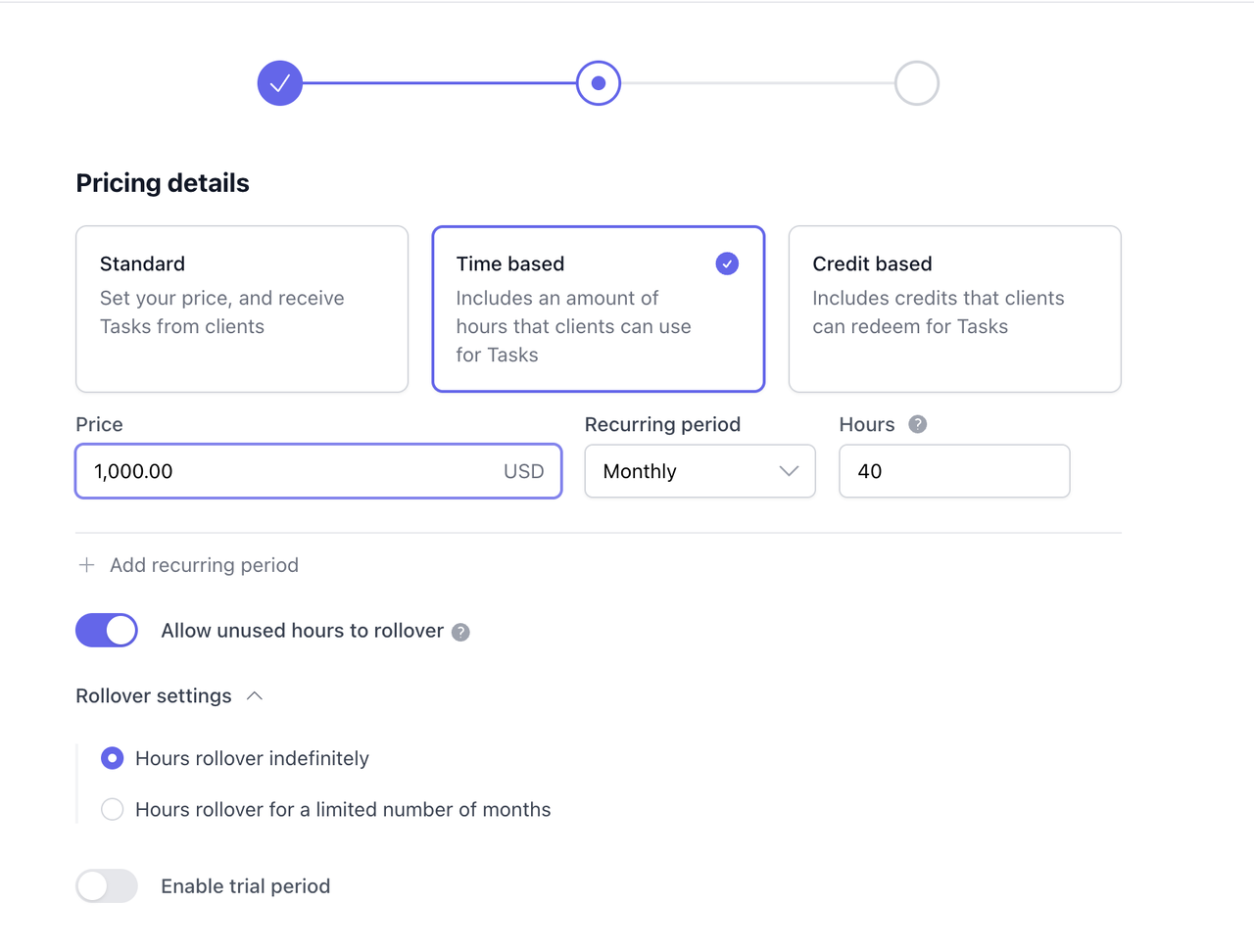
By the way, you can also use an hourly retainer model like many ManyRequests users do. Once clients pay for specific hours, they can roll over unused hours to the next month. This way, they don’t feel cheated when they pay for 20 hours but only assigned work that took 15 hours.
So to get started, break down your services into logical categories companies would need. The cleaner your offer, the easier retainers are to sell, and the easier they are to deliver without scope creep eating your margins.
Check these 10 pricing models to decide what to charge for your services, and analyze the pricing page of agencies like yours for how they categorized their services.
Six years ago, someone asked if it would be easier to find 50 clients and charge them $100/month for basic SEO or find five clients and charge $1,000/month for SEO or paid ads.
“I’ve found success working with fewer clients at a higher monthly rate,” someone replied. “I keep 5 clients at ~$2000/month each. It allows me to control a lot more of their overall brand and marketing strategies,” he adds.
“As long as we keep that going, it’s a win-win situation that keeps getting better.”
And this is how you should price your service too. Cheap retainers attract cheap clients. Price-sensitive clients expect more work, negotiate constantly, and churn fastest.
Charging “high” may be uncomfortable at the beginning, but if you deliver a high ROI, you can justify charging clients higher retainers.
For example, Ben Poss, founder of Edit Crew, a video editing service, started at roughly $550/month. “And then, two or three price raises later we were where we are now” ($1,599/m).
He said raising prices helped his business filter out those who didn't really have a large budget and churned quickly.
Maximilian Fleitmann (Max), co-founder of magier, a design agency that hit $1M ARR in 12 months, was also priced at around $2,000/month when they started. The goal was to make theirs cheaper than hiring an in-house designer so it would be a no-brainer offer for prospects.
But he didn’t want to be too cheap either. During early customer discovery, he tested lower prices and found that “price-sensitive clients expected more work and negotiated constantly. Higher-paying clients were usually just happy to find a working solution."
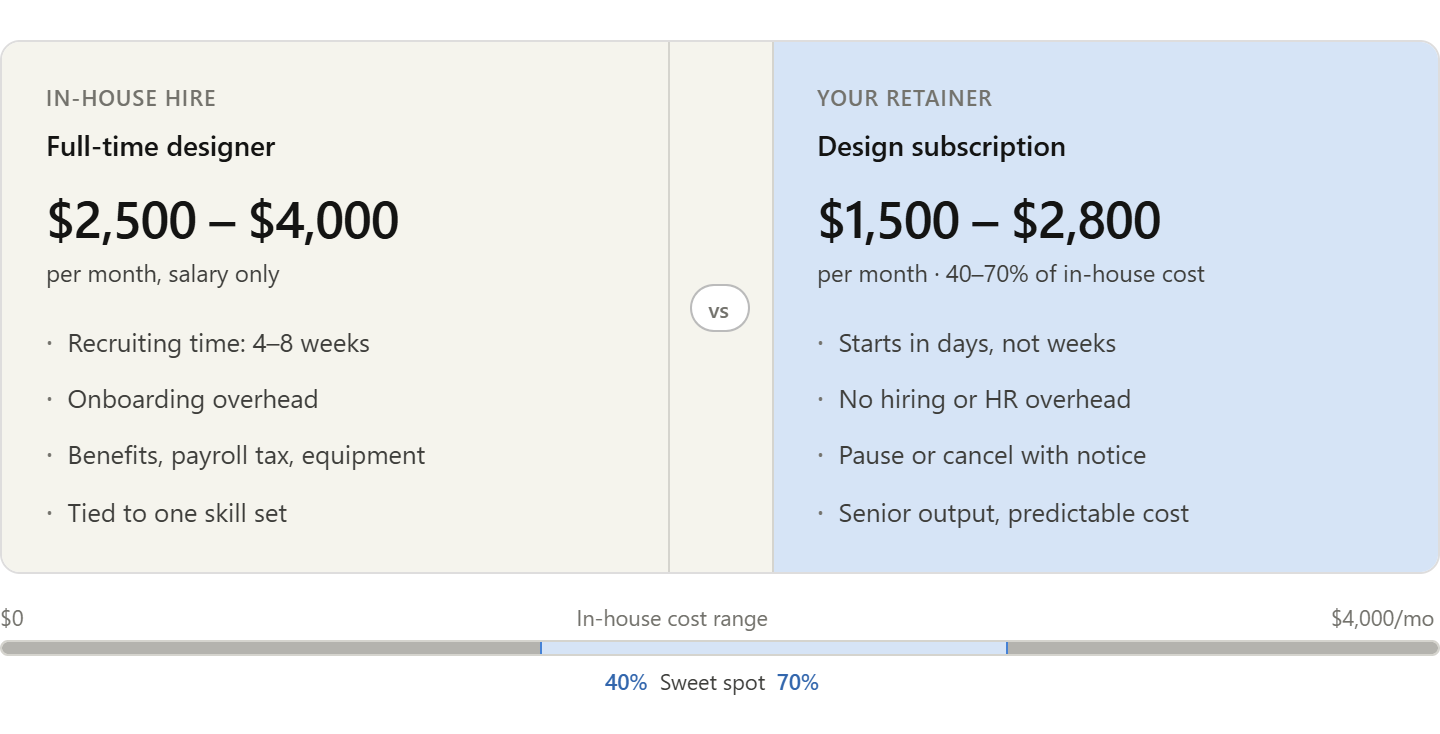
A practical way to anchor your pricing is to look at what it costs to hire in-house for the work you deliver.
If a full-time designer would cost $2,500 - $4,000/month for the work you do, a $2,000 retainer is a good number.
This is typically a 40-70% cost of hiring in-house for the same role, which is a good pricing anchor. It is what allows agencies to move from unpredictable project revenue to stable monthly income they can actually plan around.
📌Read more: How To Price Your Agency Services
A lot of advice on how to get retainer clients starts with pitching strangers. It’s good advice, but the best retainer clients for agencies like yours are people you've already worked with. So, which ones are worth approaching?
1. Look for clients with recurring, predictable needs. This way, you won’t run out of work for the foreseeable future, especially if you demonstrate the ROI of your work.
2. Look for clients who already treat you like an extension of their team. Some clients write emails, approve the deliverable and ghost you.
Another type loops you into essential calls, shares context before you start a project, and asks for your opinion on things outside your typical scope. This is the type of client worth talking to because they already consider you more of a partner and less of a vendor.
3. Look for clients who respect your process. These are not clients who constantly change the scope of work or those who are generally not easy to work with.
4. Look for clients who are already getting results from your previous work. These are the best clients to work with because you already proved what you are capable of doing. Asking them to have you on a retainer ensures they can have you on speed dial.
Don't pitch a retainer when you need the money. Pitch it when they're already happy, that's the only moment where it doesn't feel like an upsell. So, how do you do it?
Every project has a natural "what happens now?" moment.
Could be after a successful PPC ads campaign (where you can pitch SEO services to maintain momentum) or after a successful company-wide rebrand and they would need consistent, wickedly-good designs.
Whatever “that moment” is for you, talk to them about it. It can be a line as simple as:
"Hey (client), we've seen strong results from (project) and I'd love to keep that momentum going. Through a monthly retainer, you get (X deliverables) for (price), and we can start with a three-month commitment to see if we’re a great fit to continue for much longer."
You can attach a detailed proposal or retainer agreement contract when they’re onboard:
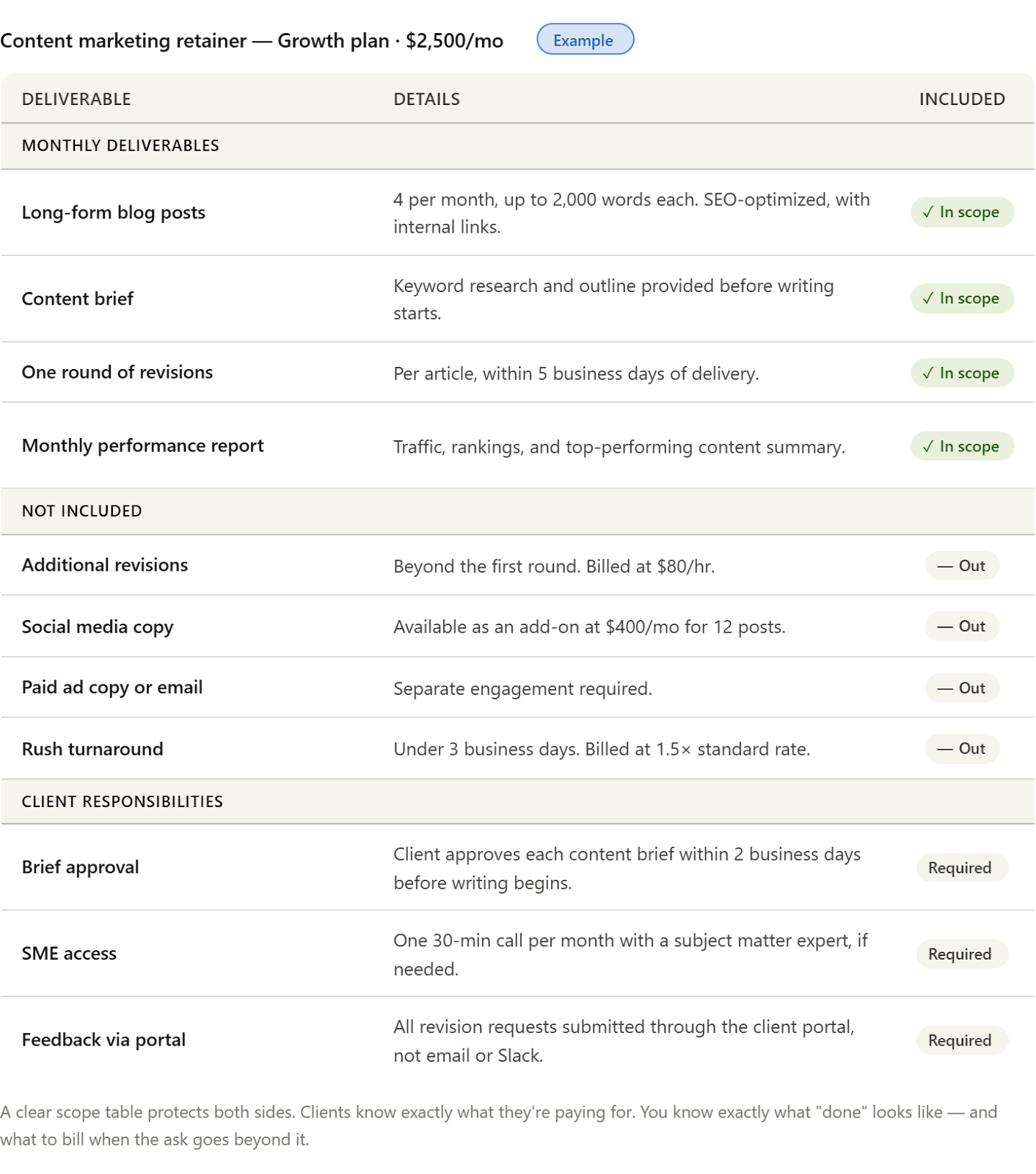
This is self-explanatory. You can circle back to the section about how you should structure your productized service agency for more context.
This structure will give them more clarity about what to expect based on the amount they pay.
Some clients won't object to the retainer but will hesitate on the commitment. It’s not usually a no, so you can reduce the risk for them.
What if none of these current clients want to get into a retainer (or you need more retainer clients)? In the next section, I explain how six agency owners got their earliest retainer clients.
A lot of agency owners have been where you are right now. Here is what they did to figure out how to get retainer clients when they started:
Chances are, given your years as a freelancer or an in-house person, you’ve met a few people who can benefit from your services. Or at least, refer you.
For Max, co-founder of magier, it was the fact that every company he built or acquired “struggled with graphic design at some point.” They always needed to create assets for social ads, newsletters, organic content…and “hiring an in-house design team is really hard.”
So when he started his design agency, he reached out to his network for discovery calls. In these calls, he asked those companies how they solved their design needs. “Through those interviews,” he said, “we got our first customers because they realized (our) solution was interesting."
You can do the same. Even if your experience was in-house or as a freelancer, your network is your biggest asset. As you read this, there are probably a few people you can talk to.
Gabe Murillo, who founded the now acquired Podcast Press, also used his connections from his web agency. “I remember I put together a landing page and I did something that was pretty unique. We offered a free trial for the first podcast episode."
If you don’t have a landing page yet and don’t have the budget to hire a team, you can vibe-code your way through it. I wrote in detail about how to build a website with Claude Code.
When that’s out of the way, “(entrepreneurship is) the groundwork that you lay when you have a full-time job and you can just go meet people and build connections (that) can be really valuable when you start your own thing,” says Karl Hughes, founder of draft.dev, a technical content marketing agency.
“That's what happened to me. I had met a lot of people in developer relations when I was speaking at conferences as an engineer in previous years. So I already knew a lot of people who would be good target customers. As I started to write, I reached out to them, and then I started to operationalize it and build it into a real business."
So if you have established good relationships with people in the past, reach out to them. They might either recommend you or need your services.
Yeah, I hate cold emailing too. And every month I promise to write 20 cold emails, I write two.
But according to Robin Heyden, co-founder at ManyRequests, it helped him close their earliest clients when he co-founded ManyPixels, a design agency.
The trick here is to write relevant emails.
When many agency owners write emails, they say “Hey Robin, I saw that you went to this specific school or that you launched this specific business.”
“But the content is not relevant at all to me,” Robin said.
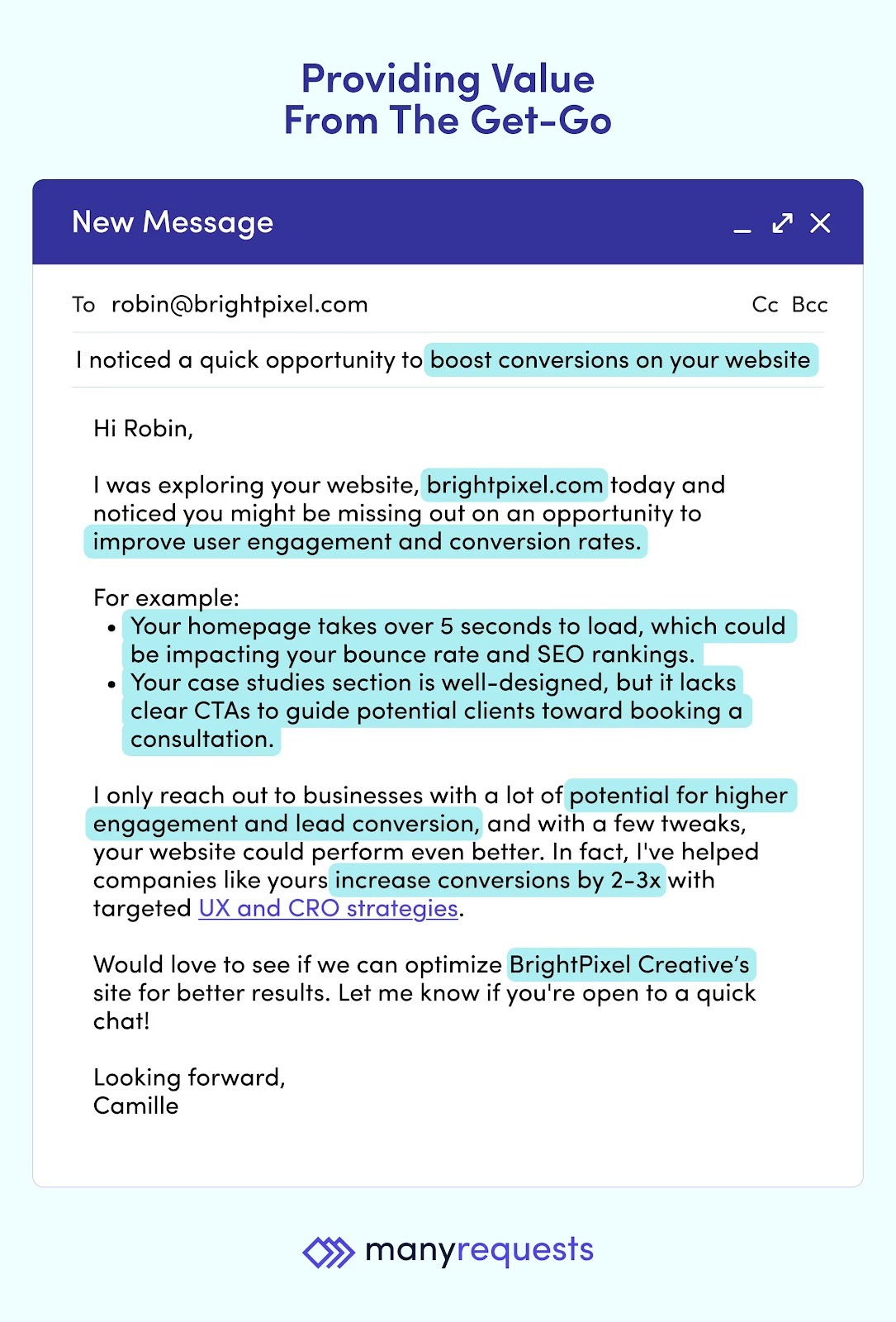
“Sometimes however I receive emails that are just like, 'Hi there. We saw that you run a SaaS company and we've done a Webflow website for (xyz company) and improved conversion for (the company) in a similar niche in the agency space. Would you like to learn about our service?'”
This, he says, “is way more relevant to me." To write relevant emails,
Other signals that a team (or someone) is in-market is when they announce a recent funding round, are a new marketing hire, or just made a public post asking for recommendations.
You can also add Loom videos to your emails specifically recorded for that company. This is a spin Max added to close some of their first deals through cold emails.
Your emails or videos don't have to be long but they must be relevant, personalized.
Other cold email tips to land your first few retainer clients include:
In his words, “Then we took everything that we could out of that client to provide all the support but also get all the testimonials, testimonial by testimonial. That's how we ended up getting the second client and so on."
Not every prospect will respond. But those that do may be your first few clients.
📌Read more: 7 winning email scripts.
Ryan Golgosky, CEO of 180 Sites, a productized web design service, grew to 650+ active clients and roughly $130K MRR back in 2023.
His primary growth channel in the early days was Facebook groups where home service contractors chatted about their work.
“I didn't spam the groups, but I tried to be as helpful as I could. If anybody was talking about making flyers for their business, I would offer to make flyers for those people for free, or make yard signs for free, make a logo for free, try to help them with their website, give audits to their website for free, and just look for those opportunities organically. I'd be scouring through those Facebook groups all day trying to add to the conversations rather than just soliciting, and that got the ball rolling."
The quality of his work created interest and it snowballed efforts that made his agency more successful.
So if your ideal clients hang out on Reddit, you should be in Reddit threads contributing where it most naturally fits. If they are on X (ex-Twitter), that’s where you should be.
Robin also did bits of this by posting their design samples on Facebook groups for entrepreneurs and SaaS founders. Some of those who wrote comments later became paying clients.
Of course, you can't just post these days. You need to engage in communities (or people’s posts) so you can be as visible as possible.
Asking someone to commit to $2,000/month before they experience your work may be a hard sell.
A smaller ask lets the prospect evaluate your work and how easy you are to work with before making the commitment.
And this doesn’t mean you should offer free work or charge peanuts. How?
If they liked the quality, they subscribed to his monthly podcast services.
The 100% money upfront goes away. And after the first 24 months, most of his clients stayed at a discount because they have a working relationship with him already.
This is exactly what Ben Goodey from Spicy Margarita, a content marketing agency, does a lot now. See slides below:
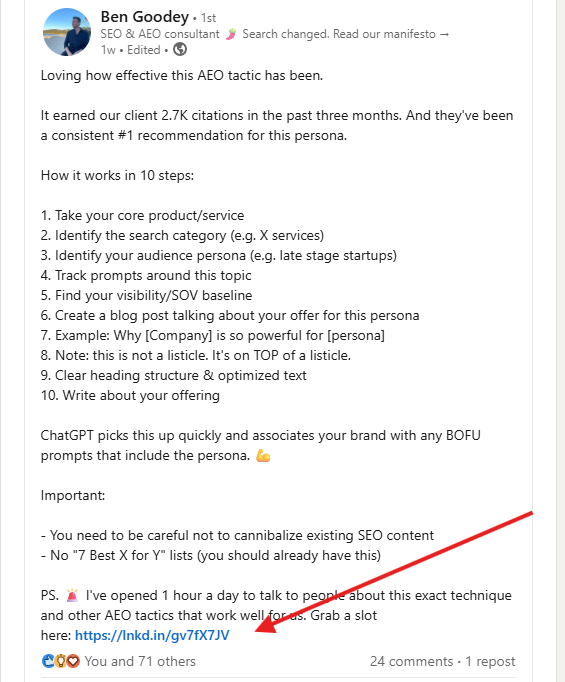
You’d also see it here:
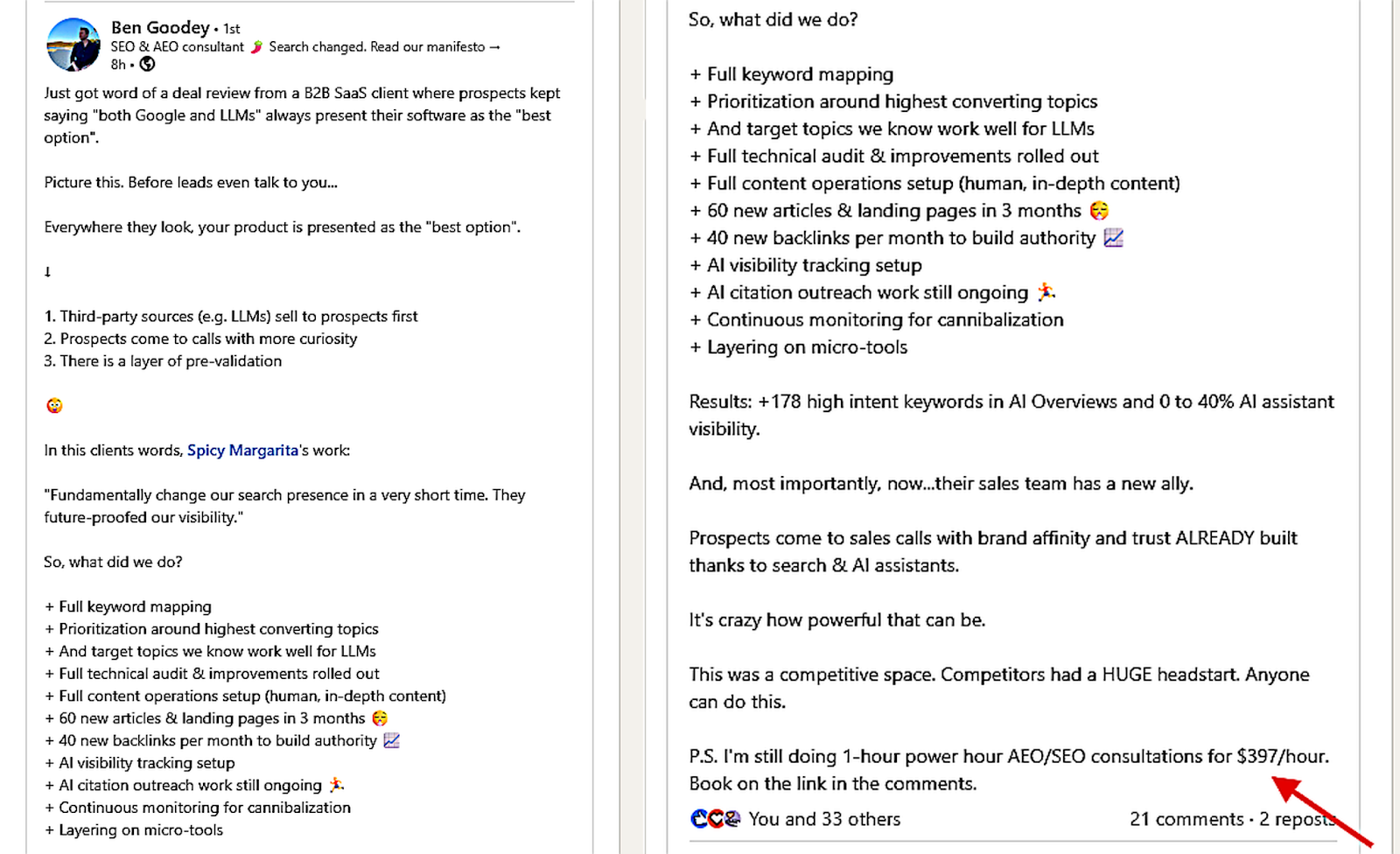
You can do the same, especially after you have offered value through LinkedIn or X posts.
Gabe’s biggest growth lever at Podcast Press was a partnership with John Lee Dumas, a major podcasting influencer who ran a training program.
Gabe’s pitch was something like “you teach people how to podcast, what if we help them do it, because the main roadblock is the editing and the production."
He loved the idea, they did a pilot, and ended up with a few solid clients. After that, John mentioned Podcast Press in his newsletter, and Gabe had “a ton of clients in just a few weeks.”
You can use a similar playbook if there are influencers in your circle you can speak to.
This worked because the relationship was genuine. Choose partners who actually want to help their community, not just chase a referral fee.
Ryan Golgosky still uses this approach till date by building partnerships with other agencies and software providers his clients use.
“We try to provide extra value to them, and in return they refer clients to us. Other marketing agencies, logo designers, and other business services refer work to us, and we refer work back to them."
To him, the focus isn’t on “affiliate marketing. It's just having good relationships with other people in the industry that sell similar products and services to the same customer base."
His tip to finding the right partners is to identify businesses that sell to your target client but don’t compete with your service. If you’re a design subscription agency, this might mean talking to link building, marketing, and video design agencies or web developers.
You can also start by referring a client to them. Over time, they’ll reciprocate.
Content marketing takes longer than other outreach methods, but it compounds. Especially if you start with case studies.
Writing a case study of your past success is one of the most underrated answers to how to get retainer clients. Case studies help prospects understand what you have done in the past. They use that context to visualize what you can do for them and what the ROI would be like.
Grow and Convert, a marketing agency, has a bunch of case studies on how they helped SaaS brands increase organic traffic and generate leads.
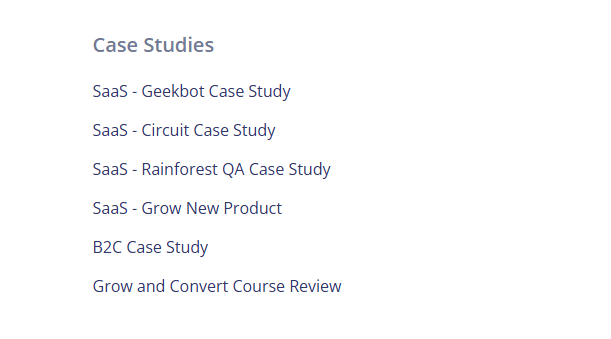
magier also has more than 20 solid case studies on the work they’ve done in the past.
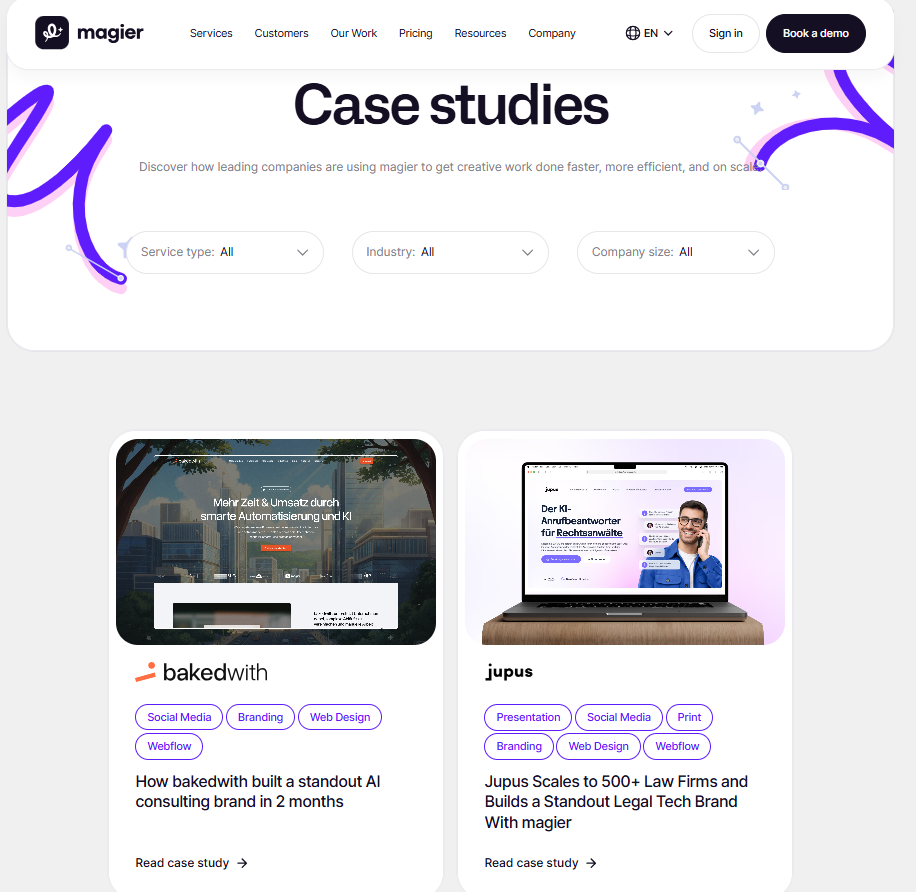
So when prospects reach out and want to have an idea of the quality of work they’ll get, these case studies are the context.
Another tactic for your website is to create a free tool or resource.
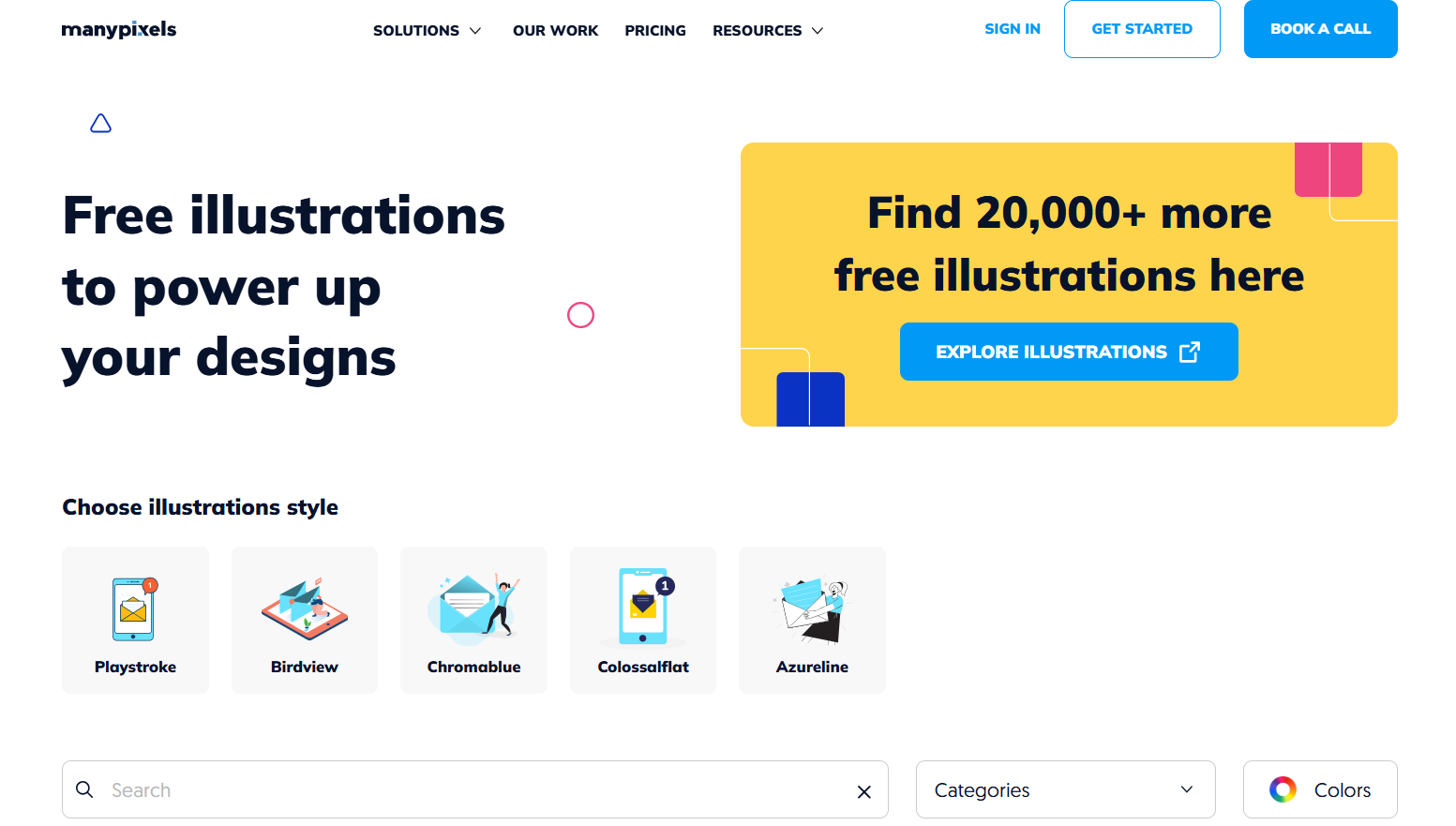
Robin’s team at ManyPixels created a free illustration gallery, posted it on Product Hunt, their email list, basically everywhere they could. In return, they earned backlinks that gave their website enough authority to rank, and the resource helped them get more customers to patronize their services.
Max from Magier also shares free design templates on LinkedIn. They have dedicated pages for these on their website:
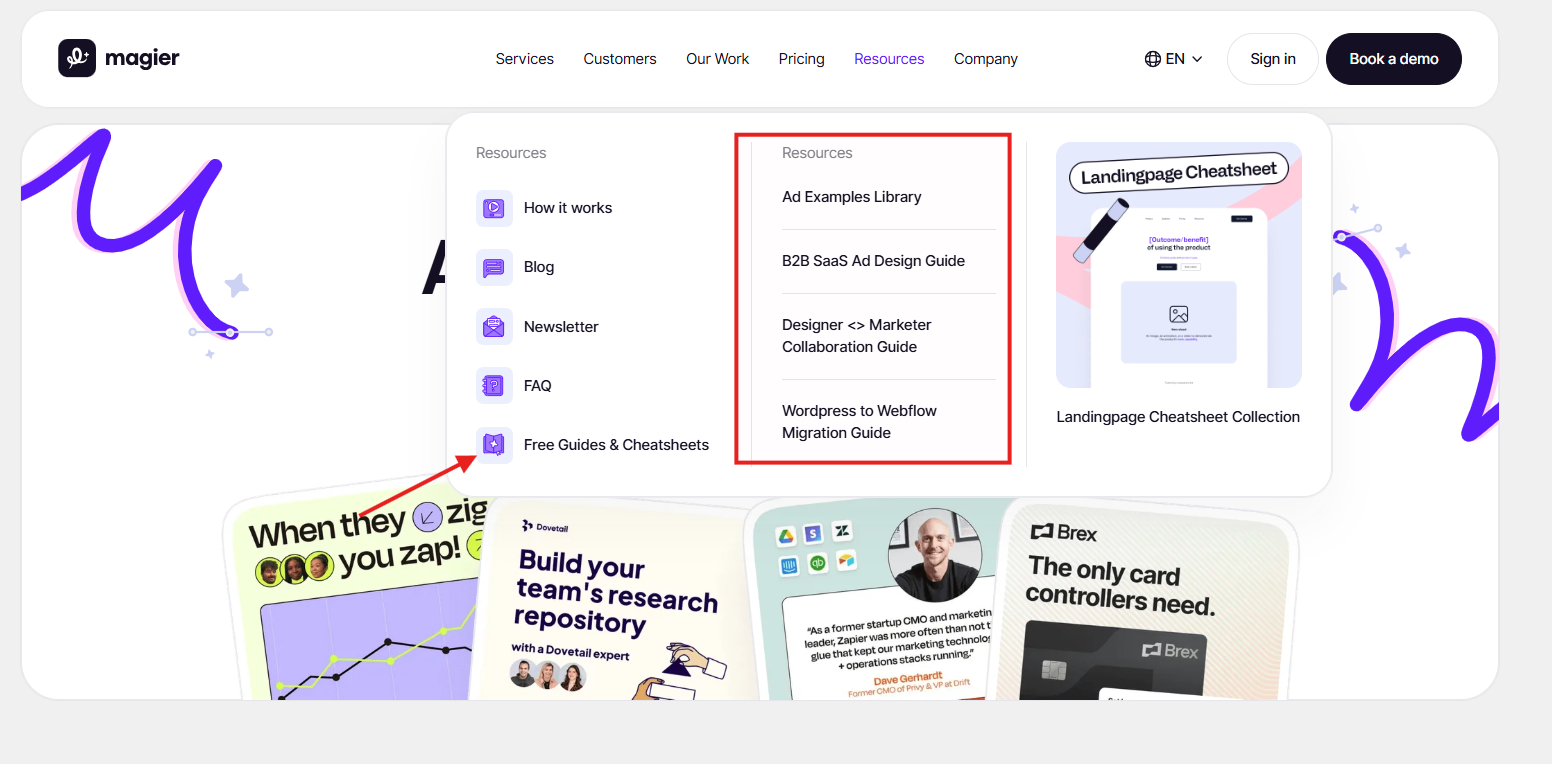
These are the kind of assets that demonstrate your credibility without having to show slide decks on what you can do (or have done in the past).
A month to three months is usually what a client needs before they decide whether or not you’re a fit for them. Agencies that nail onboarding retain clients longer, generate more referrals, and spend less time replacing churned accounts.
It’s also enough opportunity for you to have proved yourself and at least, get a testimonial.
The onboarding flow is an important part of this, which is why many agencies use ManyRequests client portal.
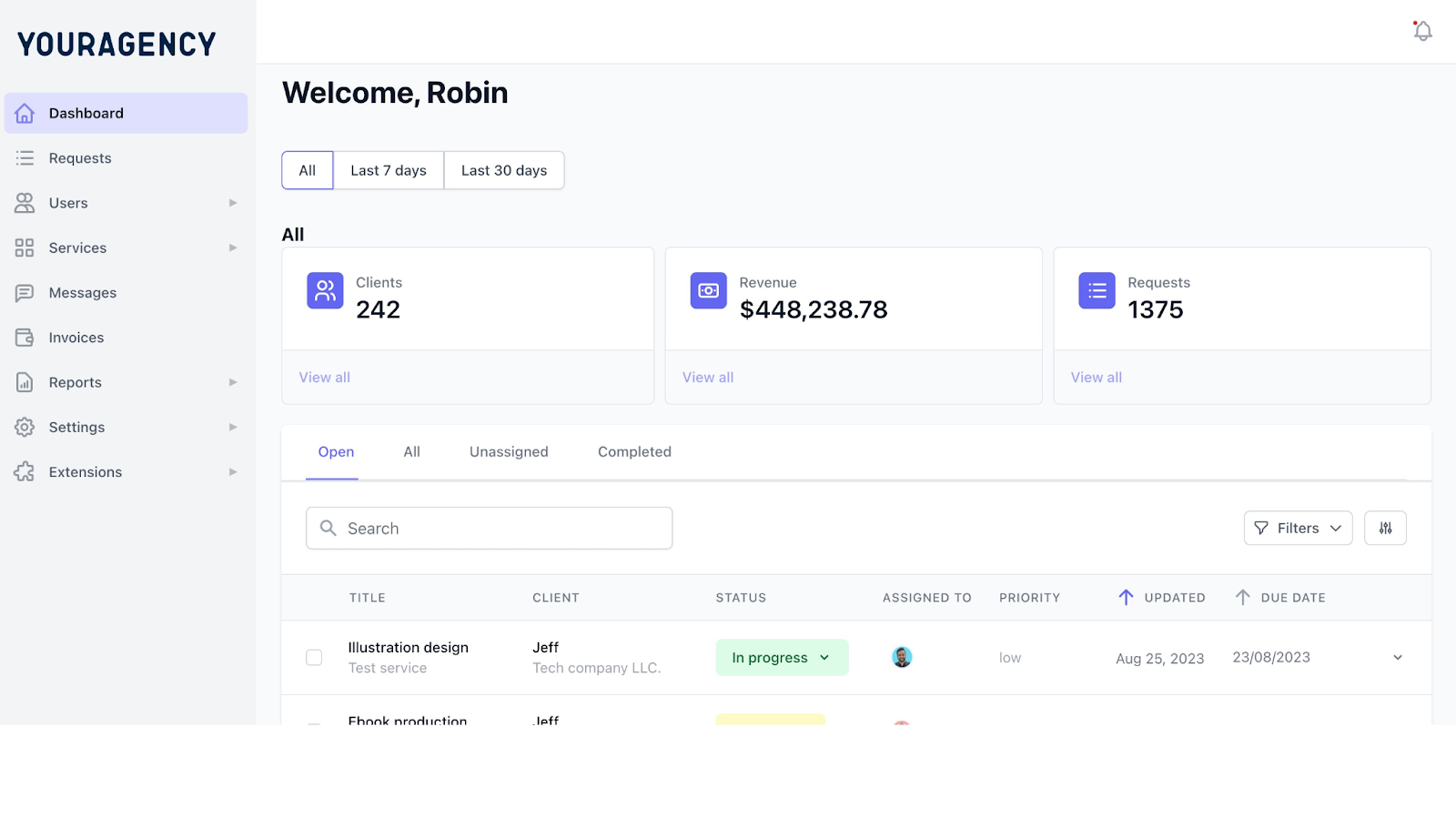
Once a client decides to purchase your service, they do so on a page that has the same UI as your brand. They can also make new requests, track active projects, and communicate faster with you.
As you can see below, there are sections for Requests, (your) services, messages, and even invoices (which are automatically created from the projects) in your client portal:
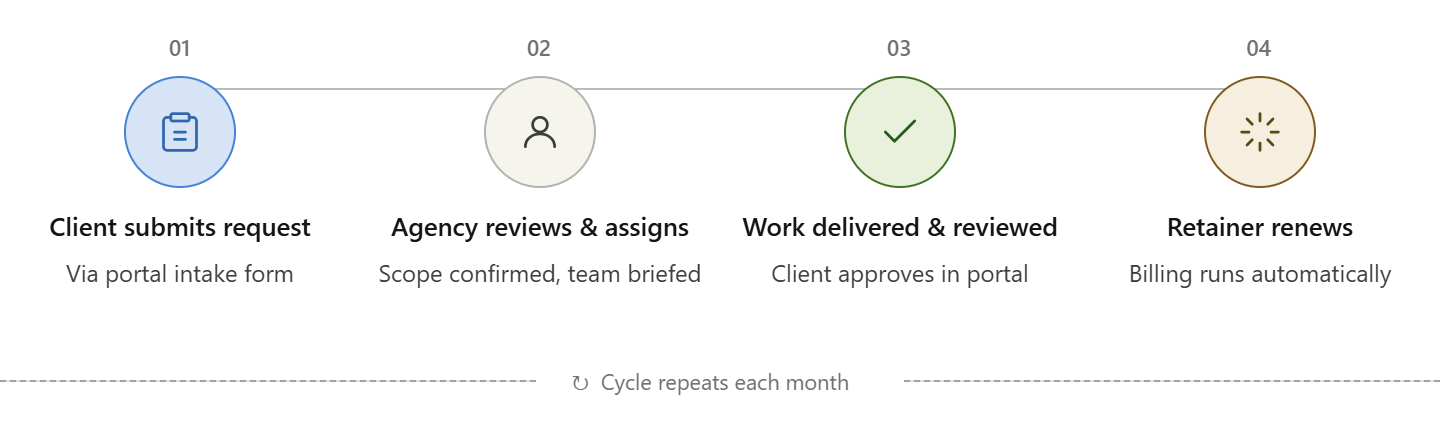
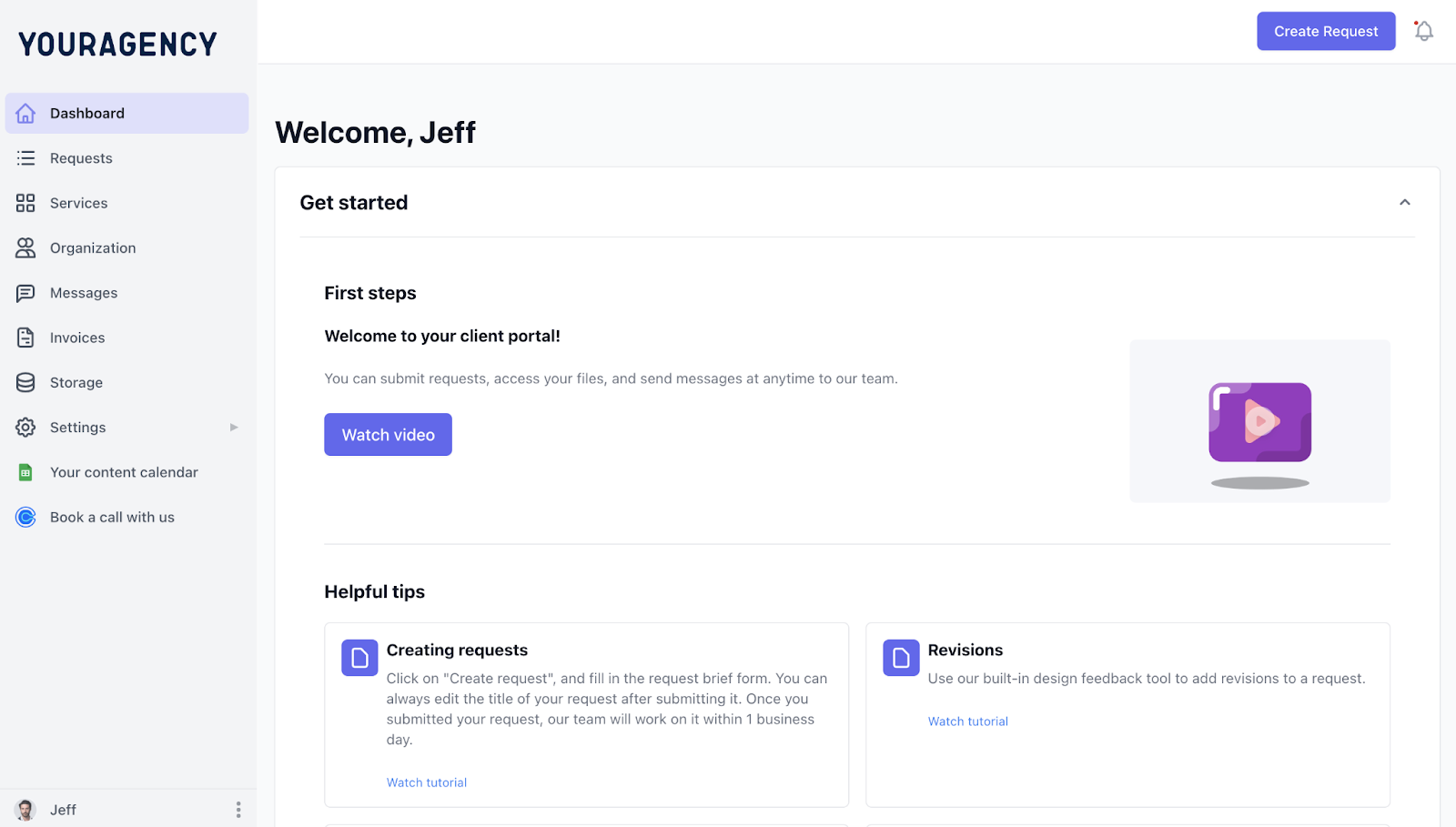
Before you invite a client to your portal, make sure you set up an onboarding flow that looks like the image below. This way, when they log in, they understand what to do first (including how to make new requests or who their account managers are, if any):
And if clients prefer Slack, that's fine. You can create requests on their behalf directly in your portal, so you can manage all their projects stays in one place regardless of how they reach out.
You can also integrate Slack with ManyRequests to avoid platform-switching if they don't want to use your client portal.
When you work with retainer clients (or clients you want to put on a retainer), every d-mn thing matters.
Trish Seidel Startsman, head of marketing at a B2B SaaS company says the difference between creators that get booked and those that don’t is “being easy to work with.” This is because “when two creators produce equally great content, the one who's easy to work with wins every single time.”
This is why she says that creators (and every service based founder) must be thorough when they work companies. This means:
“Send complete drafts every time. No missing hashtags, no missing CTA, captions included, link in the caption. It sounds SO small. It makes a massive difference.”
“Being responsive,” she adds, is another important factor for recurring work. “You don't have to respond instantly. But a quick ‘Got this, travelling, back to you tomorrow’ goes SO far.”
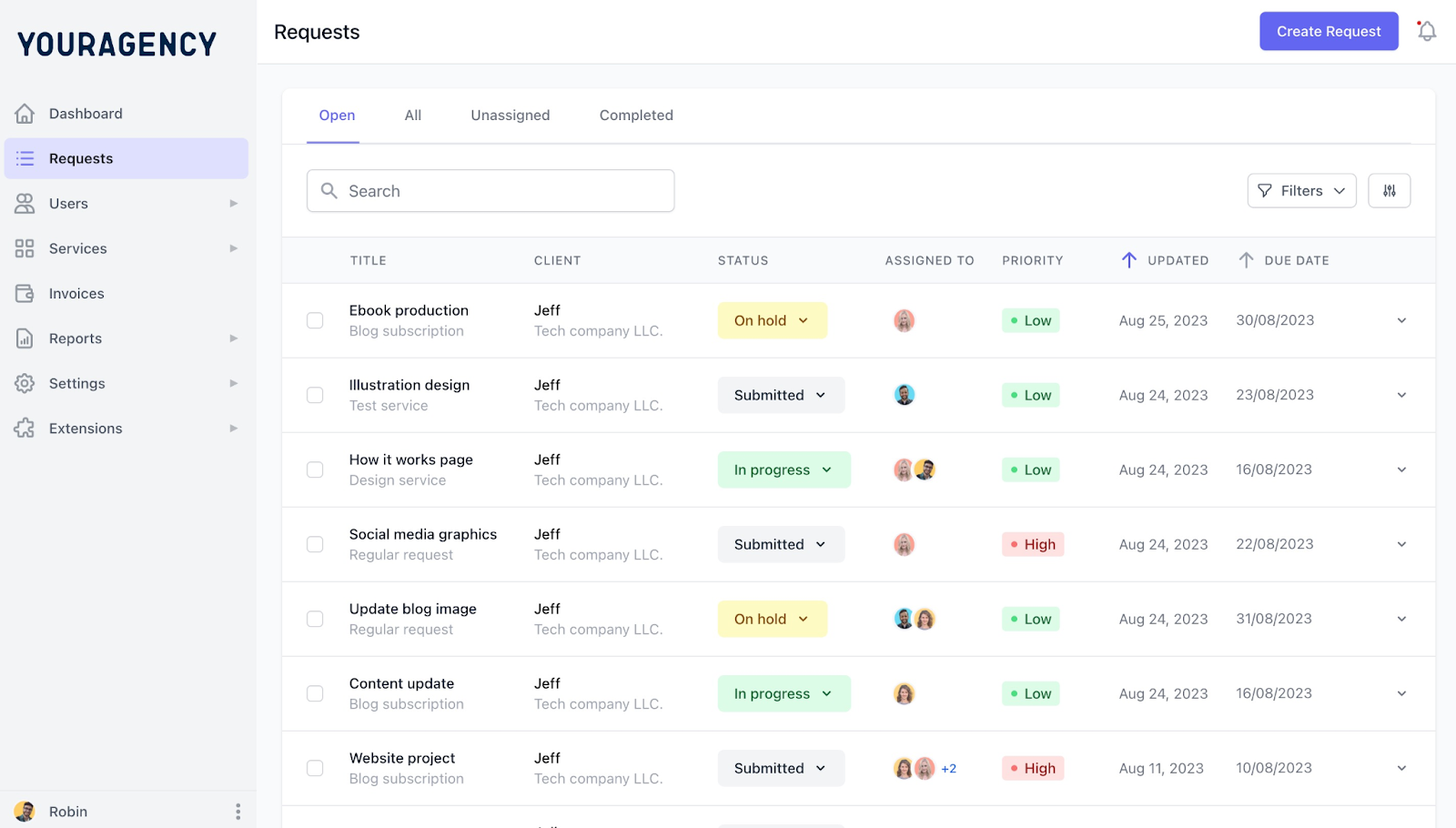
You can manage the client side of communication and delivery through the ManyRequests client portal. It doubles as your project management software, so you can sync with your team of two or 50 all in one place, as seen below.
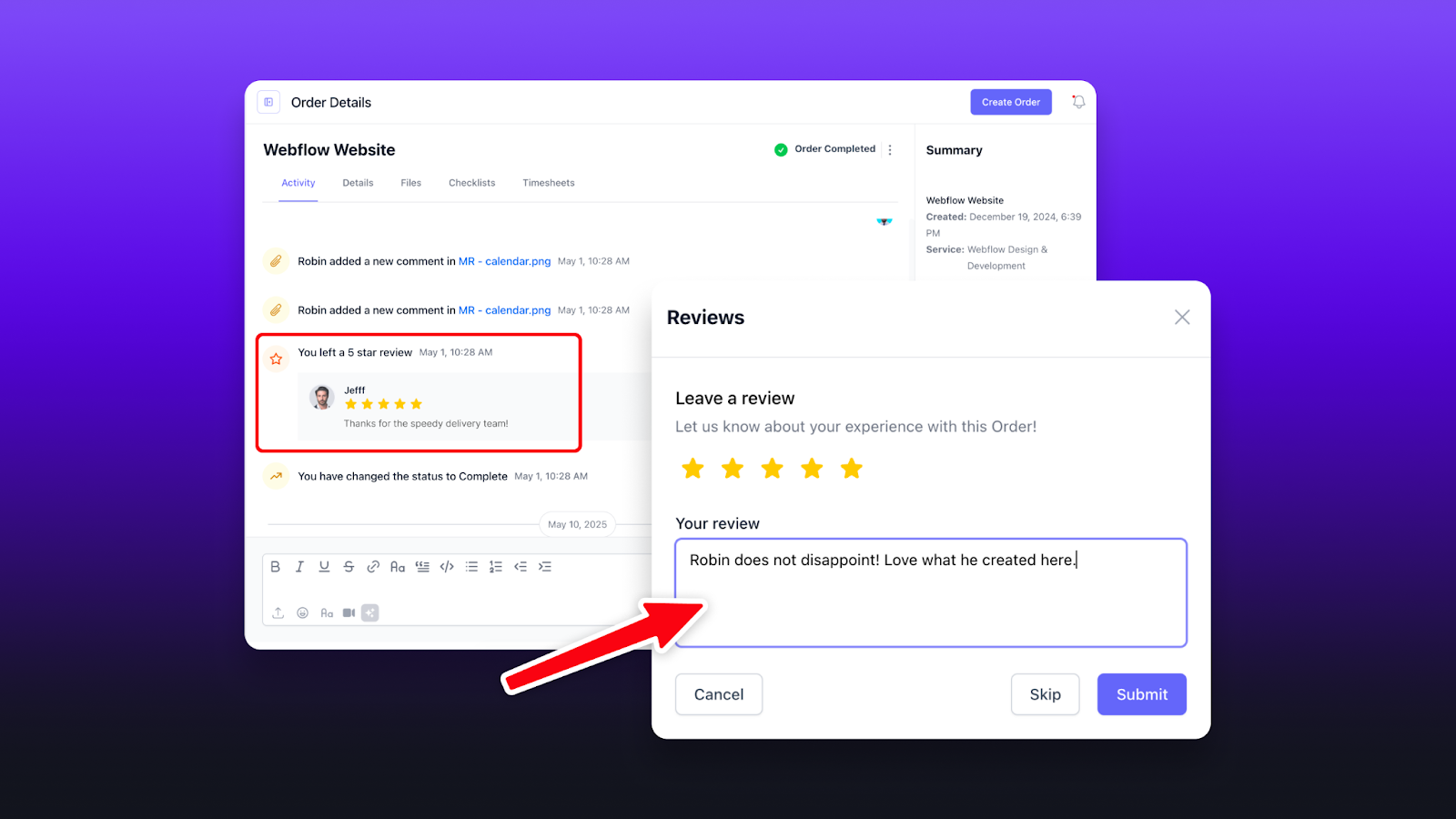
You can also collect feedback automatically in the portal, such that when you mark a project as complete, a feedback modal pops up so clients can rate your service and write a review.
This feedback loop is one of the simplest retention tools available. It helps you spot unhappy clients before they churn so you can improve their experience.
You can then monitor these reviews to know where to improve your processes (or quality of work) and whether the client is satisfied (especially if you are yet to convert them to retainer clients).
If you're losing retainer clients faster than you'd like, here are 8 ways to reduce subscription churn.
📌Next step: Create a service catalog on ManyRequests and use it for 14 days to see how it can help you manage retainer clients in a faster, nuanced way.
And if you're still building out your stack, here are the 10 tools you need to set up a productized service business.
11 and 20 is a good number for maximum profits and minimum headaches, according to a study. However, you can have as much as 40-50 clients. Provided you have enough account managers for each.
The most reliable ways to get retainer clients for your agency are through your existing network, targeted cold outreach, and engaging a community where they hang out. I wrote all about it in this article.
It works, but it's not the fastest path. Converting existing clients into retainers is easier, faster, and has a higher success rate. Use cold outreach to fill gaps once your offer is already proven.
The average monthly retainer ranges from $1,800 to $6,000, but it really depends on your services and who you serve. A good rule of thumb is to charge 40-70% of what it’ll cost to hire in-house for the same role.
Check in regularly, demonstrate value consistently, and communicate proactively. The primary reasons clients leave are poor communication, unmet expectations, and reactive account management. Avoid these so you can retain clients longer.
At minimum: monthly deliverables, client responsibilities, out-of-scope billing terms, payment terms, and a cancellation notice period.
Right after a win. When they're satisfied with a result, a retainer pitch feels like a natural next step rather than an upsell.
1. See how ManyRequests works in real life. Start a free trial and experience how productized agencies centralize requests, reduce chaos, and streamline delivery, without changing their entire workflow.
2. Read our Implementation Guide to launch smoothly with your team and clients.
3. Follow us on LinkedIn and YouTube for practical agency growth strategies
4. Check out The Productize Blueprint to learn how to turn your services into a scalable, productized offer.
Peace Akinwale is a B2B SaaS content writer and strategist who creates BOFU content and how-to articles that drive measurable growth for software companies and agencies. Over six years, he's worked with clients like Marker.io, Pangea.ai, Spicy Margarita agency, and HigherVisibility to turn technical topics into content that converts, and has helped a client achieve 233% organic traffic growth within six months of taking over their blog.