Branding Questionnaire for Clients: 35 Questions + Free Template
Use this branding questionnaire for clients to collect better project information and streamline onboarding. Includes 35 questions and a free template for agencies.

William Nzewi

Most clients struggle to explain exactly what they want. They'll describe their ideal brand as "modern but classic," or "bold but not too loud." Without clear direction, branding projects quickly turn into endless revision cycles.
A branding questionnaire helps you collect structured, actionable information about the client's business, audience, positioning and visual preferences before a single design decision is made.
This guide gives you 35 branding questionnaire questions you can use immediately, plus how to turn them into a structured intake form which fits seamlessly into your agency's onboarding workflow. We also made a questionnaire template which you can download and use as you wish.
Don't want to build your own from scratch?
Download our free Branding Questionnaire Template and customize it for your agency.
👉 Download the template (Google Docs / Word)
A branding questionnaire helps crystalize vague ideas before any design work begins.
This is even more important for productized design agencies. When you're managing multiple clients at the same time, you need a repeatable process which helps your team collect the right information every time.
Without a structured questionnaire, designers often have to make assumptions about the client's goals, audience, preferences and positioning. Those assumptions usually lead to feedback like:
A branding questionnaire forces important discussions to happen before design work starts. You learn what the client likes, what they dislike, who they're trying to reach, and how they want their brand to be perceived.
The more clarity you have upfront, the fewer revision rounds you'll need later.
Branding projects often expand beyond their original scope.
A client may initially ask for a logo but later mention social media graphics, presentation templates, brand guidelines or packaging design. These expectations can create confusion and extra work if they're not discussed early.
A branding questionnaire helps define the project's requirements from the start.
By asking questions about deliverables, goals, timelines, and brand usage, you create a clear picture of what needs to be delivered.
If client information is scattered across emails, meeting notes, Slack messages and PDFs, finding the right details becomes difficult. Team members waste time searching for answers instead of doing the actual work.
A standardized branding questionnaire creates a consistent onboarding process for every client.
Whether you have one designer or a team of ten, everyone can reference the same information and work from the same source of truth.
This becomes especially valuable as your agency grows.
Successful productized agencies rely on systems.
A branding questionnaire ensures every client goes through the same onboarding process. You collect the same key information, ask the same important questions and set the same expectations every time.
This creates a smoother experience for clients and makes it easier to train new team members as your agency scales.
Instead of reinventing your discovery process for every project, you follow a proven workflow.
Many agencies still send branding questionnaires as PDFs or email attachments.
The problem is that these files often get lost in inboxes. Responses are difficult to search and team members may not know where to find them later.
A better approach is to turn the questionnaire into a structured intake form.
When clients complete the questionnaire inside your onboarding workflow, the information is stored alongside their project details and requests. Designers can quickly reference answers whenever they need context.
For agencies using a client portal, the questionnaire becomes part of the entire delivery process rather than a separate administrative task.
That means fewer missed details and a smoother experience from onboarding to project delivery.
Below is a complete branding questionnaire organized into six sections. We made a free template for you. You can download it here. [input the link to the template]
You can copy it as-is or customize it for your agency's workflow.
The first step is understanding the business itself. These questions help you learn the business’ positioning. What it does, who it serves and what makes it different.
1. What does your business do?
2. What products or services do you offer?
3. What problem does your business solve?
4. What makes your business different from competitors?
5. What are your primary business goals for the next 12 months?
Great branding speaks to the right people. You need to understand who the brand is trying to attract before creating any visual assets.
6. Who is your ideal customer?
7. What industries or markets do you serve?
8. What are your customers' biggest challenges?
9. What motivates customers to choose your product or service?
10. What objections do customers commonly have before buying?
11. How do you want customers to feel when they interact with your brand?
This section helps define how the brand should feel and present itself.
12. How would you describe your brand in three to five words?
13. What values are most important to your company?
14. What tone of voice should your brand use?
15. What tone of voice should your brand avoid?
16. What brands do you admire and why?
17. If your brand were a person, how would you describe them?
18. What emotions should your brand create?
Visual preferences can be difficult for clients to explain. These questions help uncover what they like and expect from the final design.
19. Do you have existing brand guidelines?
20. What colors do you want associated with your brand?
21. Are there any colors you want to avoid?
22. What type of typography feels right for your brand?
23. What style of imagery best represents your brand?
24. Can you share examples of brands whose visual identity you like?
25. Are there any visual styles or trends you dislike?
26. Where will the branding primarily be used? (website, social media, packaging, print, etc.)
Understanding the market helps you create a brand that stands out instead of blending in.
27. Who are your main competitors?
28. What do competitors do well?
29. What do competitors do poorly?
30. How do you want customers to perceive you differently from competitors?
31. What position do you want your brand to own in the market?
The final section focuses on project timelines and deliverables.
32. What branding deliverables do you need?
33. Is this a new brand or a rebrand?
34. What is your desired project timeline?
35. Are there any additional requirements or preferences we should know about?
Build these questions directly into your client onboarding process using an intake form. This makes it easier to collect responses and give your team access to client answers throughout the project.
A branding questionnaire is only useful if the information actually gets used.
Many agencies make the mistake of treating the questionnaire as a standalone document. They send a PDF, collect responses, save the file somewhere and rarely look at it again.
A better approach is to make the questionnaire part of your client onboarding and delivery process.
And let it guide every stage of the project, from discovery to final delivery.
Instead of sending a PDF or Word document, build your branding questionnaire into a structured service intake form.
Get clients to complete the form online and move directly into onboarding.
This way, you won't have to deal with:

ManyRequests Intake Form
The best time to collect branding information is before any design work starts.
Make the questionnaire a required onboarding step inside your client portal. Use a client portal for agencies.
The process is simple:
1. Client signs up.
2. Client gains access to the portal.
3. Client completes the branding questionnaire.
4. The project begins.
So every project will start with the information your team needs.
It also creates a more professional onboarding experience compared to emailing documents back and forth.
ManyRequests provides an advanced client portal built specifically for agencies.
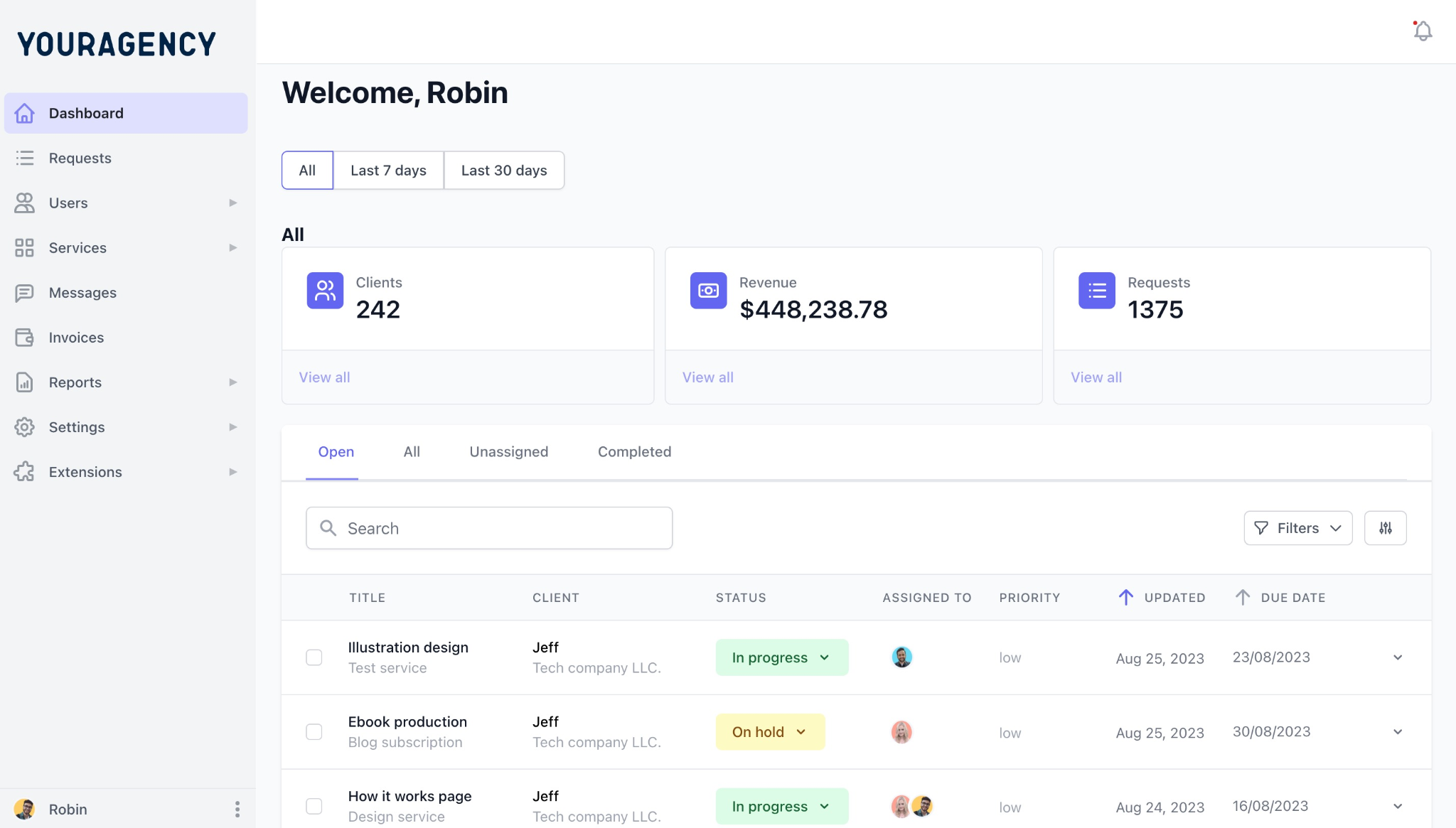
ManyRequests Client Portal
Not every client needs the same questionnaire.
For example, a client requesting a rebrand may need additional questions about their existing brand and current audience.
A client launching a completely new company may not need those questions.
So conditional logic is necessary.
You can show additional questions based on a client's answers.
For example, if the client selects "Rebrand," show questions about existing brand assets.
This keeps the questionnaire focused while still collecting the information you need.
One of the biggest benefits of using an intake form is that responses stay attached to the client profile.
Designers can review the information before starting work. Project managers can reference it during reviews. Account managers can use it when discussing feedback with clients.
Nobody has to search through old email chains or shared folders.
The information remains available throughout the entire project.
ManyRequests makes it easy to turn your branding questionnaire into a structured intake form.
You collect client information directly inside your branded client portal.
No PDFs, no missing files.
Clients complete the questionnaire during onboarding and their answers remain attached to their account for future reference.
Your team can access the information whenever they need it, making onboarding smoother and helping projects move faster.
For agencies managing multiple branding clients at once, this creates a repeatable process which scales without creating extra admin work.
A branding questionnaire is only as good as the answers you receive.
Even the best questions won't help if clients rush through the form or provide one-word responses. The quality of your branding work depends heavily on the quality of the information collected during onboarding.
Here are a few practical ways to get more useful answers from clients.
This is essential in managing client expectations. Specific questions produce specific answers, which makes it easier for your team to make design decisions.
Many branding questions are too broad.
For example, asking "Tell us about your brand" often leads to vague responses that don't provide much direction.
Instead, ask specific questions that are easier to answer:
Some branding topics are difficult for clients to describe.
Questions about brand personality or visual style can leave clients unsure of how to respond.
Providing examples makes these questions easier to answer.
For example:
“How would you describe your brand personality?”
Examples:
Or:
“What brands do you admire?
Please include links and explain what you like about them.”
Some clients provide answers that are technically correct but not very useful.
For example:
These answers create more questions than they solve.
Encourage clients to provide details whenever possible. Ask them to explain their reasoning.
For example:
The extra context often reveals valuable insights which influence the final design.
Onboarding delays often come from incomplete questionnaires. Clients sign the agreement, receive the questionnaire and then forget about it.
To avoid this, make the questionnaire part of your project timeline.
Let clients know that work cannot begin until the questionnaire is completed.
Never assume that completed answers are good answers.
Before assigning the project to a designer, review the responses carefully.
Look for:
It's much easier to clarify questions before work starts than after the first design concepts are delivered. A short review step can save hours of revisions later.
Sometimes a client's answers raise new questions or reveal areas that need more discussion.
When that happens, schedule a quick 15-minute discovery call.
Use the call to clarify anything that seems unclear.
For example:
This is one of the key client onboarding best practices. Many agencies rush into projects because they want to move quickly.
The result is usually more revisions and more frustration for everyone involved.
If important questions remain unanswered, pause the project and gather the information you need.
A few extra days spent clarifying requirements can save weeks of unnecessary revisions later.
A branding questionnaire should cover the client's business, target audience, competitors, brand personality, visual preferences and project expectations. The goal is to gather everything needed to build a strong brand identity.
Most branding questionnaires contain between 15 and 30 questions. It should be detailed enough to gather useful information without overwhelming the client.
Tools like forms and client portals make it easier to collect and review client responses.
A branding questionnaire is a list of questions used to gather information from the client. A brand brief is a document created from that information which outlines the brand strategy, goals, audience and direction.
Many agencies use client onboarding systems and client portals to automate the process. Clients complete questionnaires online and the responses are stored in one place for the design team to review and use throughout the project.
A well-structured branding questionnaire shouldn't live in a PDF buried inside an email thread.
With ManyRequests, you can turn your branding questionnaire into a branded intake form that clients complete directly inside your client portal.
Click here to get started for free.
1. See how ManyRequests works in real life. Start a free trial and experience how productized agencies centralize requests, reduce chaos, and streamline delivery, without changing their entire workflow.
2. Read our Implementation Guide to launch smoothly with your team and clients.
3. Follow us on LinkedIn and YouTube for practical agency growth strategies
4. Check out The Productize Blueprint to learn how to turn your services into a scalable, productized offer.
William Nzewi is a data scientist and a writer. He likes to read and learn new things, especially about tech, business and life.