Managing Scope Creep in Project Management [2026]
Managing scope creep in project management starts with clear boundaries. Learn how agencies prevent extra work from eating into profit.

William Nzewi

Scope creep rarely announces itself. It starts with a simple request. "Can you just adjust this one thing?" Then the client asks for another version, a different format, or an extra page.
Before long, your team has delivered far more work than you originally agreed to, without charging anything extra.
It is one of the most common ways agencies lose profit, and it often happens so gradually that no one notices until the project is finished.
The good news is that scope creep is usually preventable.
In this guide, you'll learn what scope creep is, why it is especially costly for productized agencies, and how to prevent it with structured intake forms, clear service packages, written approvals, and workflows that keep every project on track.
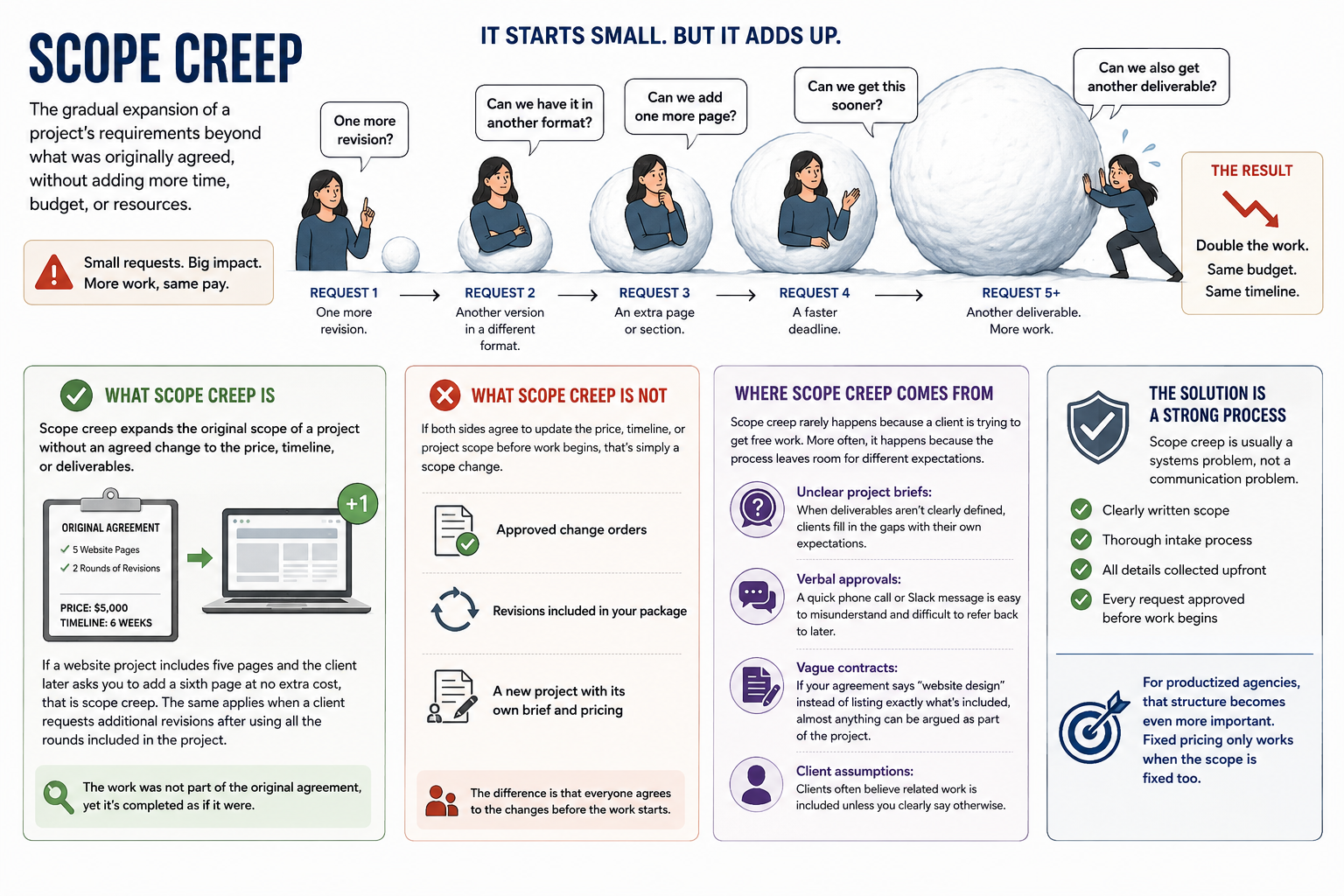
Scope creep is the gradual expansion of a project's requirements beyond what was originally agreed, without adding more time, budget, or resources.
In agencies, it usually happens through small requests that seem harmless on their own but add up over the life of a project.
A client asks for one more revision. Then they want another version in a different format. Later, they ask for an extra page, a faster deadline, or another deliverable.
None of these requests seems like a big deal by itself.
Buy together, they can double the amount of work you deliver without increasing what you get paid.
Scope creep expands the original scope of a project without an agreed change to the price, timeline, or deliverables.
For example, if a website project includes five pages and the client later asks you to add a sixth page at no extra cost, that is scope creep. The same applies when a client requests additional revisions after using all the rounds included in the project.
The key point is that the work was not part of the original agreement, yet it's completed as if it were.
If a client requests additional work and both sides agree to update the price, timeline, or project scope before work begins, that's simply a scope change. It's a normal part of project management.
The same is true for:
The difference is that everyone agrees to the changes before the work starts.
Scope creep rarely happens because a client is trying to get free work. More often, it happens because the process leaves room for different expectations.
Common causes include:
This is why scope creep is usually a systems problem, not a communication problem. If your scope is clearly written, your intake process collects all the details upfront, and every request is approved before work begins, there's far less room for misunderstandings.
This is closely tied to managing client expectations from the very first interaction.
For productized agencies, that structure becomes even more important. Fixed pricing only works when the scope is fixed too.
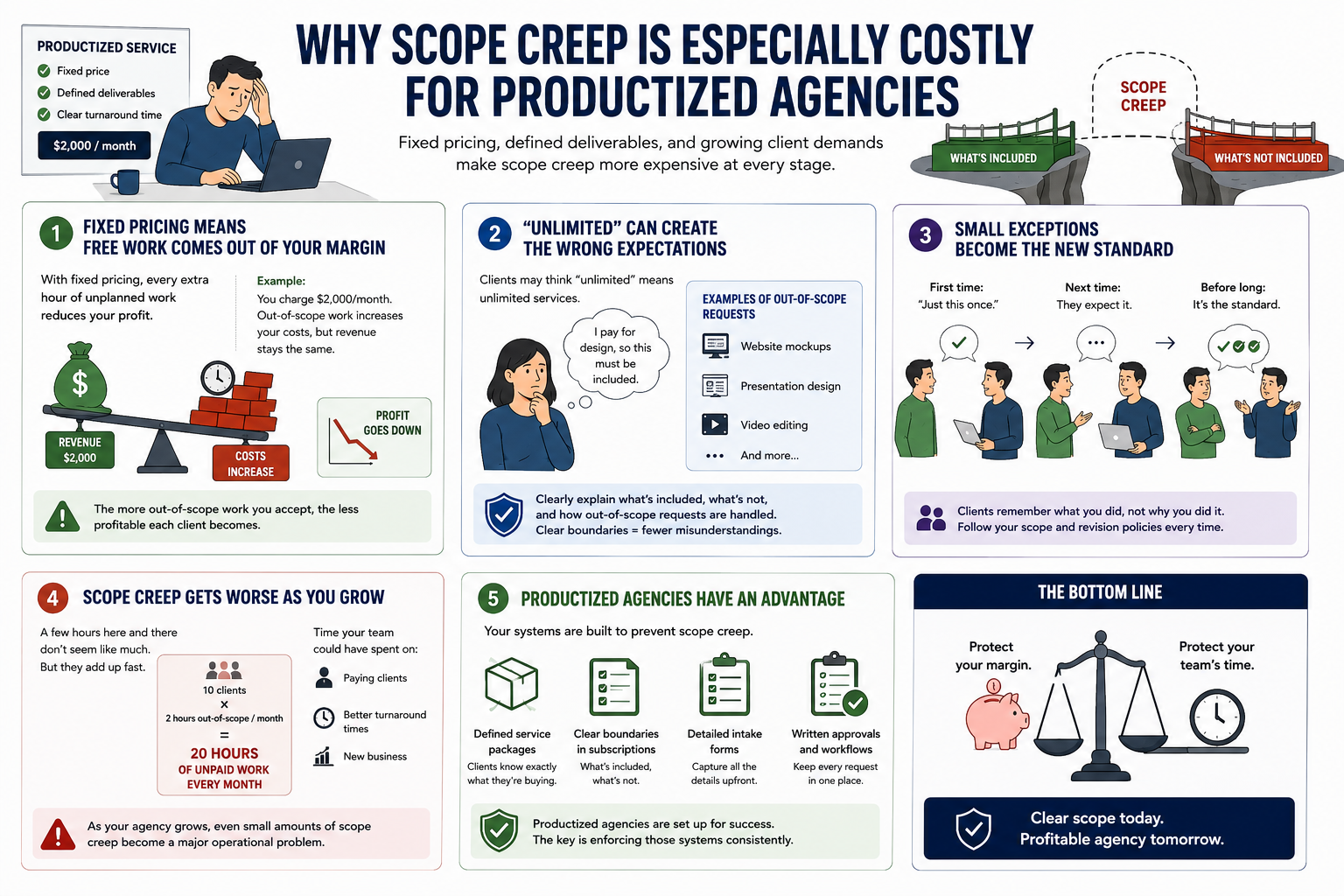
Every agency loses money when work expands beyond the original agreement. For productized agencies, the impact is even greater (if you're new to this model, check out our full productized service guide) because pricing is fixed and every service has defined deliverables.
With a fixed-price or subscription model, every extra hour of unplanned work reduces your profit.
Let's say you charge a client $2,000 per month for unlimited design requests with a defined turnaround time. If the client regularly asks for work that falls outside the agreed package and your team completes it anyway, your revenue stays the same while your costs increase.
The more out-of-scope work you accept, the less profitable each client becomes.
Some clients mistakenly take unlimited requests or unlimited design to mean unlimited services.
For example, a client who signed up for graphic design may later ask for website mockups, presentation design, or video editing because they assume everything creative is included.
This is why every service package should clearly explain what's included, what's not, and how out-of-scope requests are handled. When clients can easily see these boundaries, there's much less room for confusion.
Many agencies allow one extra request because they want to be helpful. The problem is clients remember what you did, not why you did it.
If you add an extra landing page for free once, the client may expect the same treatment next time. Before long, the exception becomes the standard, and saying "no" gets much harder than it did the first time.
Consistently following your scope and revision policies protects both your team and your client relationship.
A few hours of unpaid work may not seem like a big problem when you have only a handful of clients.
But those hours add up quickly.
If 10 subscription clients each receive just two hours of work outside their plan every month, that's 20 hours of unpaid work. That's time your team could have spent serving paying clients, improving turnaround times, or bringing in new business.
As your agency grows, even small amounts of scope creep become a major operational problem.
The good news is productized agencies are also better equipped to prevent scope creep.
Your service packages define exactly what clients are buying. Your subscription sets clear boundaries and your intake forms capture the details before work starts. Even your workflow helps by creating written approvals and keeping every request in one place.
In other words, the productized model is already built around clear expectations. The key is enforcing those systems consistently and not making exceptions whenever a client asks for "just one more thing.”
Here are some of the most common examples of scope creep in agency projects.
Your design package includes two rounds of revisions, and the client has already used both.
Then they ask for one more version in a different style. After that, they want another variation for social media. Then another for print.
Each request may only take 20 or 30 minutes, but together they become hours of unpaid work. Once the included revision rounds are used, any additional changes should be treated as a new request or a paid add-on.
The project brief clearly lists five website pages. After development begins, the client asks if you can add a sixth page because it's "pretty similar" to the others.
Adding a page usually means extra design, development, testing, and revisions.
If the page was not part of the approved scope, it should be priced and scheduled separately.
You agreed to create marketing assets for one brand.
Halfway through the project, the client asks if you can also create versions for another product line with different colors, logos, and messaging.
Although the deliverables look similar, they require extra work. Different brands often need new layouts, updated copy, and additional reviews. That makes it new work, not a simple revision.
Your service promises delivery within five business days.
A client suddenly needs the work in two days because of an unexpected event. Meeting that deadline means changing your team's schedule and delaying other client work.
A faster turnaround is a change to the original agreement. If rush delivery isn't included in the client's plan, it should be treated as a premium service or a separate add-on.
A client asks if you can create one extra social media graphic this month. You agree because it seems like a small request.
Next month, they expect it again. Soon, it becomes part of your regular monthly work even though it was never included in the original package.
This is one of the most common forms of scope creep in retainer and subscription services. Temporary favors quickly become permanent expectations unless you clearly explain that they're one-time exceptions.
The best way to deal with scope creep is to stop it before the project begins.
Here are five ways to build those protections into your workflow.
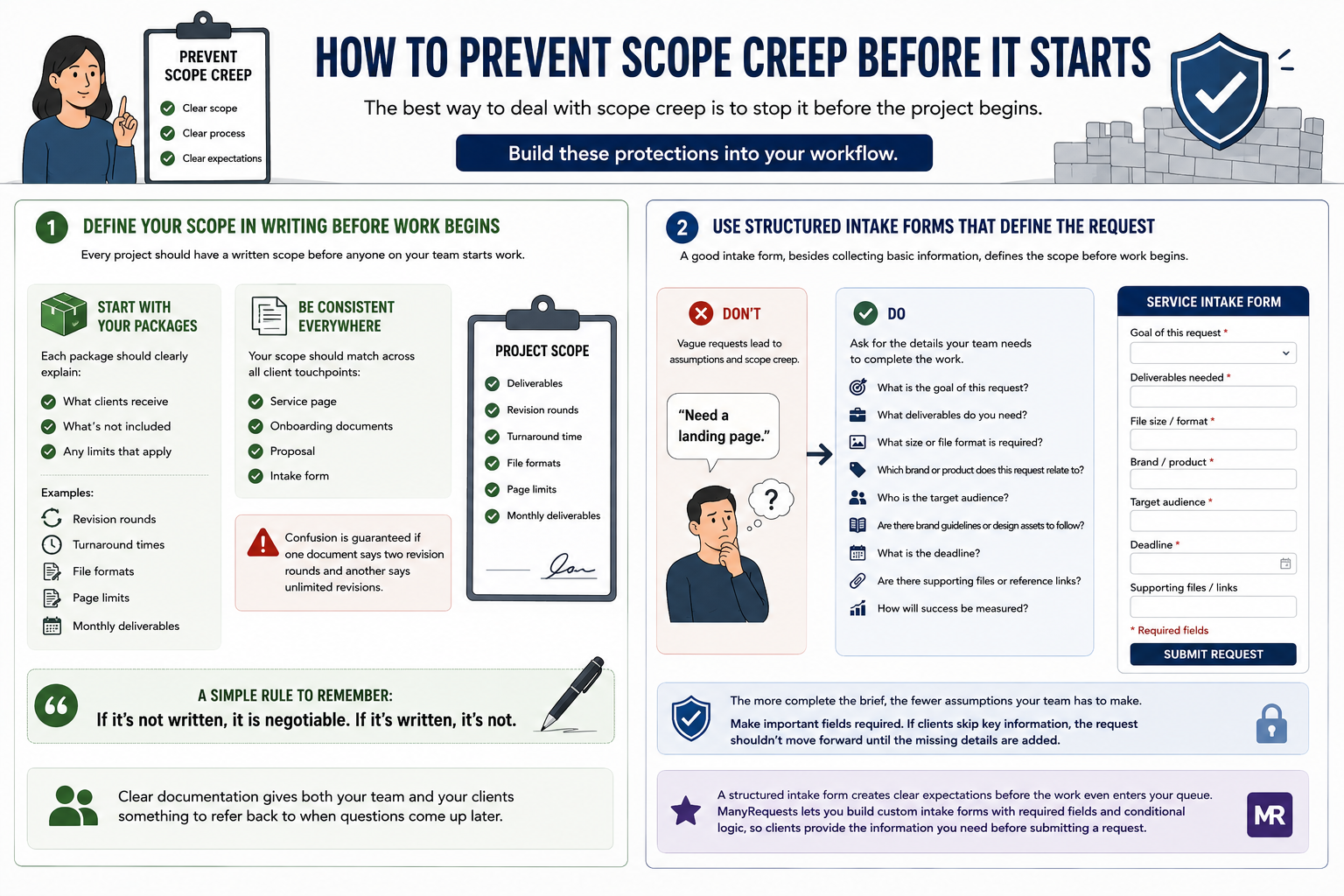
Every project should have a written scope before anyone on your team starts work.
For productized agencies, this begins with your service packages. Each package should clearly explain what clients receive, what's not included, and any limits that apply. This includes things like revision rounds, turnaround times, file formats, page limits, or monthly deliverables.
Your scope should also be consistent everywhere clients interact with your business. This starts with a consistent project intake process across your service page, onboarding documents, proposal, and intake form. The information on your service page, onboarding documents, proposal, and intake form should all match.
Confusion is guaranteed if one document says two revision rounds and another says unlimited revisions.
A simple rule is worth remembering:
If it's not written, it is negotiable. If it's written, it's not.
Clear documentation gives both your team and your clients something to refer back to when questions come up later.
A good service intake form, besides collecting basic information, defines the scope before work begins.
Instead of asking clients to write a short description like "Need a landing page," ask for the details your team really needs to complete the work.
Your intake form should include questions such as:
The more complete the brief, the fewer assumptions your team has to make.
It also helps to make important fields required. If clients skip key information, the request shouldn't move forward until the missing details are added.
This highlights the importance of a structured service intake form in preventing scope creep. It creates clear expectations before the work even enters your queue.
ManyRequests lets you build custom intake forms with required fields and conditional logic, so clients provide the information you need before submitting a request.
Even a detailed brief should be confirmed before work begins.
A simple message such as:
"Here is our understanding of your request. Please confirm everything looks correct before we begin."
can prevent hours of unnecessary work later.
This approval gives both sides a shared understanding of the project. If the client wants to add something after approval, it's much easier to identify it as a scope change instead of treating it as part of the original request.
ManyRequests makes this easier by allowing you to build approval steps directly into your request workflow, so every project starts with a confirmed brief.
If your package includes two rounds of revisions, make that clear on your service page, during onboarding, and in your welcome email. Clients should never have to guess how many revisions they receive.
When the included revisions have been used, respond consistently.
For example:
"We have completed the revision rounds included in your package. Additional revisions can be submitted as a new request or added as a paid add-on."
Avoid making exceptions every time someone asks. While saying yes may feel like good customer service, it often creates bigger problems later. Clients quickly come to expect the same exception on future projects.
Clear policies are easier to respect when they're applied the same way every time.
A big advantage of the productized model is that the subscription itself defines the scope. This is one reason subscription-based agency pricing models work so well for productized agencies.
Clients are buying a clearly defined service package with specific deliverables, turnaround times, and rules.
Instead of asking, "Can you do this?" the question becomes, "Is this included in my plan?"
That shift makes scope discussions much easier because the answer is based on the package, not on personal judgment.
If a request falls outside the client's subscription, you have several options.
You can treat it as a new request, offer it as a paid add-on, or recommend upgrading to a higher plan.
This approach protects your margins while giving clients a clear path forward. Instead of negotiating every request, you simply follow the system you already have in place.
Even with clear service packages and a strong intake process, scope creep will still happen from time to time.
How you respond is important.
Here's a simple process you can follow.
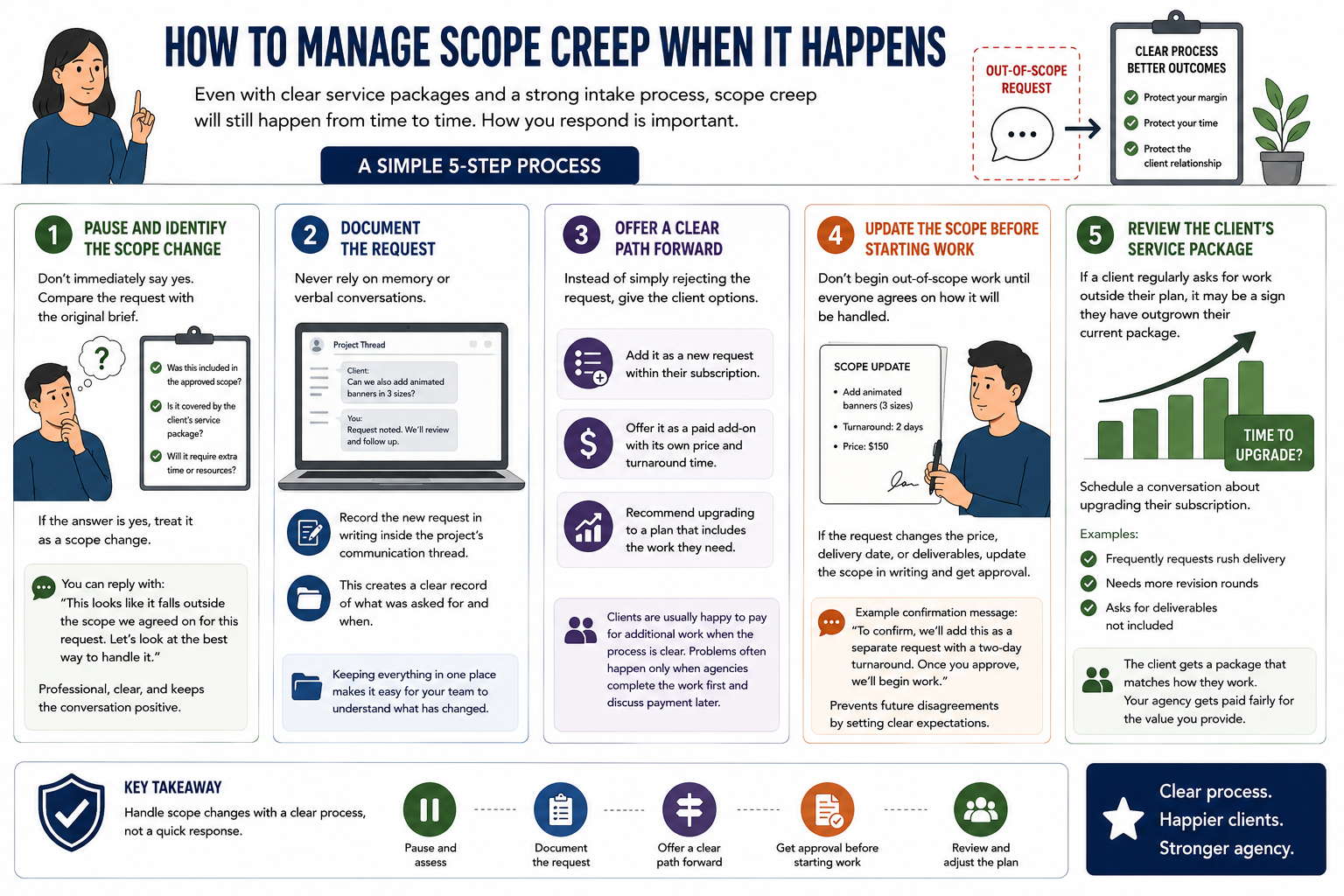
When a client asks for something new, don't immediately say yes.
First, compare the request with the original brief. Ask yourself:
If the answer is yes, treat it as a scope change.
You can reply with something like:
"This looks like it falls outside the scope we agreed on for this request. Let's look at the best way to handle it."
This keeps the conversation professional without making the client feel like they have done something wrong.
Never rely on memory or verbal conversations.
Record the new request in writing inside the project's communication thread. This creates a clear record of what the client asked for and when they asked for it.
Keeping everything in one place also makes it easier for your team to understand what has changed.
Instead of simply rejecting the request, give the client options.
Depending on your workflow, you might:
Clients are usually happy to pay for additional work when the process is clear. Problems often happen only when agencies complete the work first and discuss payment later.
Don't begin out-of-scope work until everyone agrees on how it will be handled.
If the request changes the price, delivery date, or list of deliverables, update the scope in writing and ask the client to approve it.
A short confirmation message is often enough:
"To confirm, we'll add this as a separate request with a two-day turnaround. Once you approve, we'll begin work."
This simple step prevents future disagreements because both sides have agreed to the same expectations.
If a client regularly asks for work outside their plan, it may be a sign that they have outgrown their current package.
Instead of handling every request as a one-off exception, schedule a conversation about upgrading their subscription.
For example, if a client frequently requests rush delivery, additional revisions, or deliverables that aren't included, a higher plan may better fit their needs.
The client gets a package that matches how they work, and your agency gets paid fairly for the value you provide.
Scope creep is difficult to stop if your team relies on scattered emails, vague briefs, and manual follow-ups.
ManyRequests, as a client request management software, helps solve the problem by giving agencies a structured workflow from the moment a client submits a request. Instead of relying on memory or informal conversations, every request follows a clear process with defined boundaries.
Here is how it helps.
Most scope problems begin with an incomplete brief.
ManyRequests lets you create custom intake forms that collect the information your team needs before work begins. You can make important fields required and use conditional logic to show additional questions based on the client's answers.
For example, instead of receiving a request that says, "Design a flyer," you can require clients to provide:
Because every request starts with a complete brief, there's less room for misunderstandings later.
ManyRequests lets you present clear service packages during signup so clients understand exactly what they’re buying.
Whether your plans include specific deliverables, revision limits, turnaround times, or monthly request limits, those expectations are set before work begins.
That makes it much easier to answer questions like, "Is this included in my plan?" without starting a negotiation.
Every request moves through a defined workflow, from submission to completion.
You can add approval steps before work begins or before a project moves to the next stage. This gives clients a chance to confirm the brief and review key milestones before your team continues.
Those approval points help catch misunderstandings early, when they are easy to fix instead of after the work has already been completed.
Subscription pricing works best when every plan has clearly defined services.
ManyRequests connects your client portal with your subscription plans, making it easy for clients to see what's included in their package.
When a request falls outside that scope, your team has a clear reason to recommend a new request, a paid add-on, or a plan upgrade instead of completing the work for free.
Important details are easy to miss when you're dealing with back-and-forth emails with clients, Slack messages, and phone calls.
ManyRequests keeps communication inside each request, so your team and your client always have one place to review the brief, approvals, feedback, and scope discussions.
That creates a complete record of every decision and makes it much easier to resolve questions about what was agreed.
ManyRequests makes scope protection part of your daily workflow. Clients submit complete requests, service packages define clear boundaries, approvals happen before work starts, and every conversation is recorded in one place.
Scope creep is the gradual expansion of a project's requirements without an agreed change to the budget, timeline, or resources. It usually happens through small requests that seem minor on their own but add significant work over time.
Start with a clear written scope, use structured intake forms, get written approval before work begins, enforce your revision policy, and document any changes to the project. The more structured your process is, the less likely scope creep becomes.
A common example is when a client asks for additional revisions after using all the revision rounds included in their package. Other examples include adding extra website pages, requesting rush delivery, or asking for new monthly deliverables that were never part of the original agreement.
Subscription pricing works best when each plan has clearly defined deliverables and limits. Instead of debating every request, you can simply check whether it's included in the client's plan. If it's not, you can offer it as a paid add-on or recommend a plan upgrade.
Pause before starting the work. Explain that the request falls outside the approved scope, document it in writing, and offer clear options, such as creating a new request, adding a paid add-on, or upgrading the client's plan. Always get written approval before moving forward.
Focus on the process instead of making it personal. Refer back to the agreed scope, explain why the request falls outside it, and offer a clear path forward. Clients are more likely to accept scope boundaries when they're applied consistently and communicated professionally.
The best way to prevent scope creep is to build a system where the scope is clear before work begins.
Clients know exactly what their plan includes, and every request follows the same structured process.
ManyRequests takes care of this. With structured intake forms, clear service packages, built-in approval workflows, and subscription billing, scope protection becomes part of your daily operations instead of something you have to enforce manually on every project.
Stop giving away free work. Build a more profitable agency instead. Start for free with ManyRequests.
It gives your agency the tools to protect your margins, keep projects on track, and build a delivery process that scales.
1. See how ManyRequests works in real life. Start a free trial and experience how productized agencies centralize requests, reduce chaos, and streamline delivery, without changing their entire workflow.
2. Read our Implementation Guide to launch smoothly with your team and clients.
3. Follow us on LinkedIn and YouTube for practical agency growth strategies
4. Check out The Productize Blueprint to learn how to turn your services into a scalable, productized offer.
William Nzewi is a data scientist and a writer. He likes to read and learn new things, especially about tech, business and life.