The Productized Marketing Agency Business Plan Template [2026]
Creating a coherent business plan for your agency takes a lot of time, and traditional methods aren't always worth it. Here's a simple template to help you start.

Peace Akinwale

I’ve read a few marketing agency business plans and they read like consulting firm plans. They assume you’ll scope and quote each client engagement differently, and they don’t understand that you need recurring clients who will pay for a specific number of deliverables, without getting into a new sales call every month.
This marketing agency business plan template is built for agencies that want predictable recurring revenue (it’s not a new proposal for every client). Use it to define your service packages, pricing, MRR targets, delivery workflow, client acquisition plan, hiring triggers, and the tools you’ll use to run the agency.
A productized agency business plan should make your model clear on paper:
Copy each section into a doc and replace the placeholders with your own numbers. Start with your service packages and target market. Then define your delivery workflow, because that will shape the revenue model.
Keep the executive summary to one page. It should explain the agency model quickly enough that a partner or future hire understands what you sell and how the business makes money.
(Agency Name) is a productized (service type) agency serving (ideal client) with (number) fixed monthly service packages. We deliver (core outcome) for (market) at a monthly price of ($X to $Y). We currently run ($X) in MRR across (number) active clients and are targeting ($X) MRR within (timeframe). Our advantage is (the one thing you do faster, better, or more consistently than a custom agency).
The point isn’t to impress anyone though; we’re trying to make your business model clear here, so it’s easy to understand.
Your packages are the product. A client should be able to read each tier and understand the price, what they get, what’s out-of-scope, and when you’ll submit each deliverable.
For each package, define:
Here is a simple three-tier structure:
In ManyRequests, these packages can become a service catalog clients can browse and buy from. Each service can have its own description and price. You can also add the checkout page, intake form, and request rules behind it. Your service catalog can look like this:
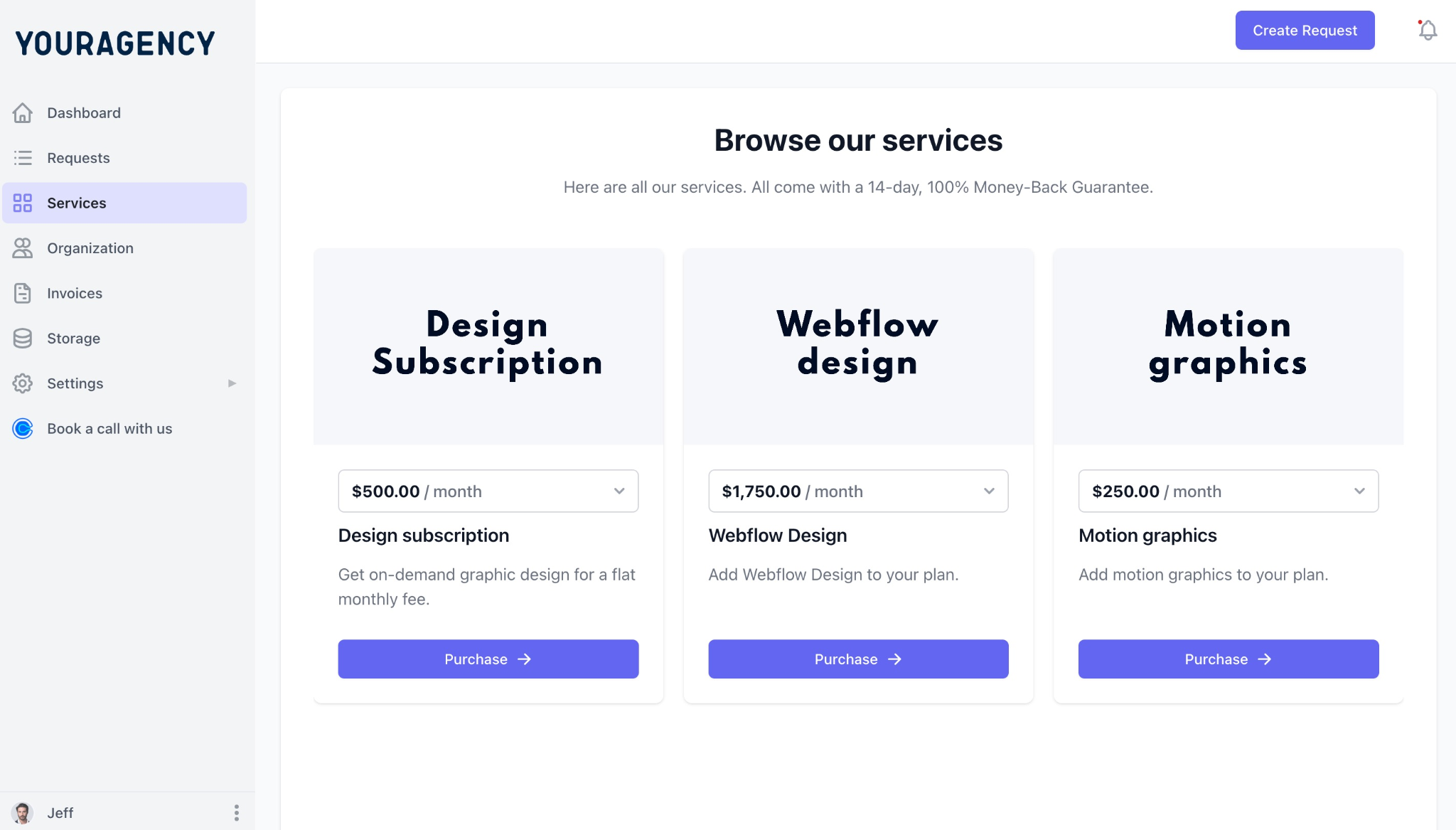
Note: If clients keep asking for the same extra service (or add-on), that’s usually a sign it should become a package.
Define your ideal client in a way that you can easily target and market to them.
“Small businesses that need marketing” is too broad. “Series A SaaS companies that need weekly ad creative but don’t have an in-house design team” is much better.
Your agency marketing template should cover the ideal client’s industry, size, pain point, buying trigger, and reason for choosing a subscription instead of a custom project.
HeyDesign is a good example here. The agency serves SaaS brands, including PostHog, Hotjar, Pitch, Sprig, Wiza, and Polar Analytics, and built subscription packages around ad creative and landing page work. See their pricing:
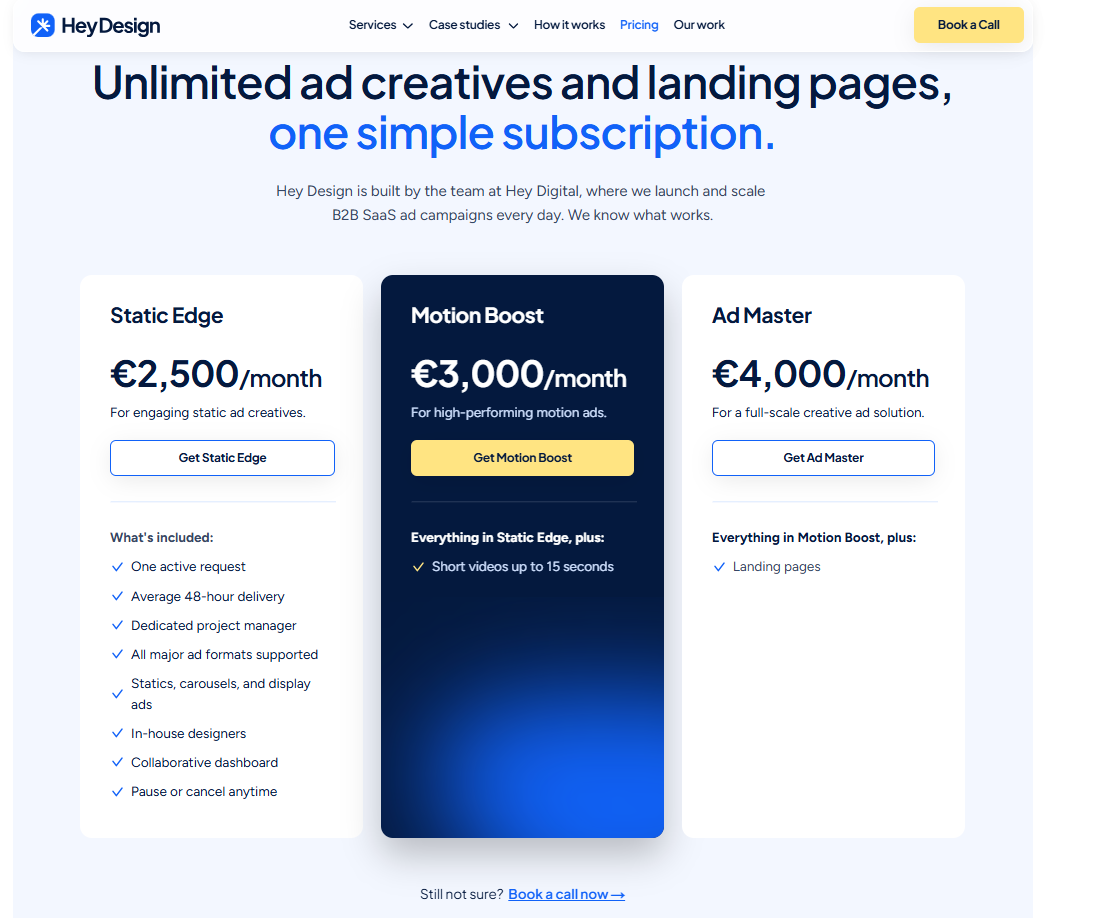
This is for a design subscription agency though, but you get the point.
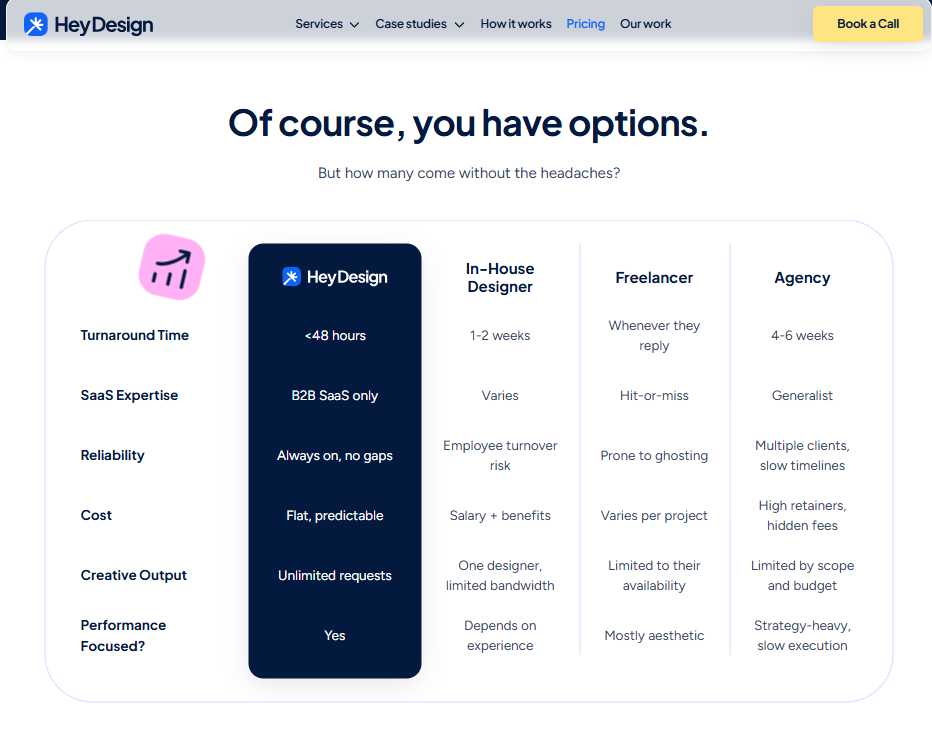
You can also take from their playbook of what they did below and compare your agency to other services. This way, you’ll show how your agency is much faster, affordable (for the quality you’re promising), and also more efficient.
A productized agency doesn’t plan revenue project by project. It plans around MRR, capacity, churn, and break-even.
Use the package prices from Section 2 to build the model. If your average client pays $3,500/month and your fixed costs are $18,000/month, you need six active clients to cover the base cost of the agency.
Your financial plan should also include churn, customer acquisition cost, and client lifetime value. These numbers help you know:
We wrote more about pricing in our agency pricing guide and you can also read this breakdown of agency pricing models.
This is about how the client’s work moves through your agency.
You need to start with the delivery loop:
The client submits a request → you (or a PM) assigns it → someone works on it → you edit → you send to client → client gives feedback → you or the team member edits it → you submit → you get paid at the end of every month.
So you need to find a system to support that workflow, so that you can handle it with ease.
ManyRequests supports that workflow with request forms, delivery queues (so you can clearly handle one task at once) and a client portal for agencies. You can onboard clients into this portal so they can fill your form to send a brief, send private DMs without using emails or Slack (so every agency operation is in one place), and also manage billing.
This is what a request queue looks like with ManyRequests:
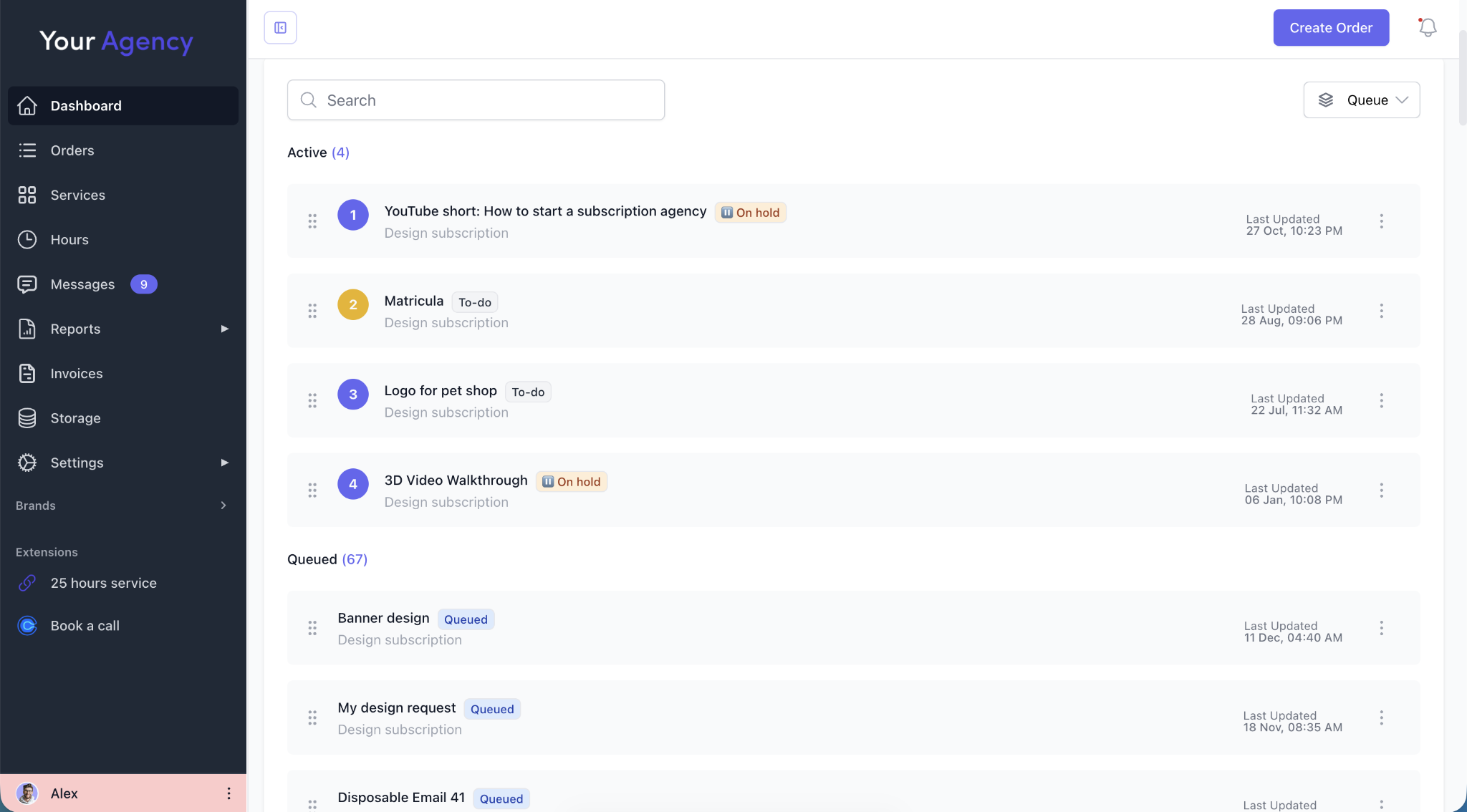
You can turn the delivery model in this section into an actual operating system inside ManyRequests:
That matters because a productized agency only works when the process is repeatable. If every brief is sent to you via Slack or email, you have more tools than one to manage. Plus, it’s not well productized yet. A real productized agency can go through an end-to-end subscription, first brief, down to the billing process, without a lot of manual work to do.
Your marketing plan should be specific about how you’ll get clients and what it’ll cost you (in terms of effort and money) to win each client.
For a productized agency, the offer does part of the selling. Brett Williams built DesignJoy around that idea: “You can niche down in your industry by finding the things you're good and fast at, and build a package around those services and add pricing.”
Copy this into your plan:
“Our primary acquisition channel will be (channel). We will use this channel to promote (specific package) to (ideal client).
Our entry offer will be (audit, setup project, sample deliverable, or trial package). The goal is to help the client understand the value before moving into a monthly subscription.
Our target is (X) new clients per month. Our estimated CAC is ($X).
We will measure this by tracking leads and calls booked. Then we will track checkout starts and paid clients.”
If your offer is simple enough, you can make part of the sales process self-serve. ManyRequests lets agencies create checkout pages and custom order forms. That means clients can choose a service and submit intake details without waiting for a proposal.
So, include the primary marketing channel in your marketing channels so the potential client can see the value upfront. A foot-in-the-door offer works because the first sale only needs to create enough trust for the client to move into a recurring package.
Your hiring plan should be tied to capacity. You need to write down the people in charge of each task right now, how much each person can handle, and when you need to bring on more folks in your team.
A useful trigger could be:
We will hire our next content strategist when we reach (X) active clients or ($X) MRR, whichever comes first.
This makes sense, and is practical.
Keep the technology stack short. A productized agency needs tools that connect the work, not more tools to manage.
See how we didn’t say communication = Slack while project management = Notion or ClickUp. That’s because ManyRequests can be the one source of truth for all your agency operations. You can manage your clients in the portal, they can send new briefs directly to the portal (where you can also reassign them without moving the files from one system to another) and you can then track what’s in progress.
The goal isn’t to use fewer tools for the sake of it though. The goal of this tech stack section is to keep the client workflow connected.
For a productized agency, the important handoffs start with when the client buys a service and during client onboarding. Then they continue through request intake and delivery. After that, the workflow still needs feedback and billing; you’d also need to work on clients renewing their subscription and report on what you get detailed reports on your agency’s progress.
If each step happens in a different tool, someone on your team has to connect the workflow manually.
ManyRequests keeps those steps in one branded client portal. Clients can buy services and submit briefs. They can also track requests and leave feedback.
Your team can manage the queue and assign work. They can also track time and review files. This keeps delivery performance visible without rebuilding the workflow across Slack, ClickUp, Stripe, and email.
Writing the plan gives you the model. Running the agency requires the system behind it.
Once you know your packages, pricing, delivery process, and MRR targets, the next step is to make those decisions usable for clients and your team. Clients need a place to buy, submit requests, review work, and manage their subscription. Your team needs one place to see what is due, who owns it, and how the work connects to revenue.
That is what ManyRequests is built for. You can create service packages, sell them through checkout, collect client briefs, manage requests, handle proofing, and run subscription billing in one platform.
Download the template first, fill in the business model, then try ManyRequests free to build the client portal and delivery workflow your plan describes.
Download the Productized Marketing Agency Business Plan Template.
Yes. Use the template even if you have no clients yet. Fill it with your planned niche, starter packages, target prices, and first 90-day acquisition plan. You can replace assumptions with real numbers once clients start buying.
Keep it short enough to use. For a productized agency, 5-10 pages is usually enough: offer, target market, pricing, delivery process, client acquisition method, hiring triggers, and basic financial projections. If the plan is too long to revisit every quarter, it becomes a document you ignore.
Yes. Pricing is one of the most important parts of the plan because it affects positioning, capacity, and profit. A $2,000/month package creates a different agency than a $6,000/month package, even if the service sounds similar.
Update the plan every 90 days. Your first version is built on assumptions. After a quarter, you should know which package sells fastest, which clients are easiest to serve, how long delivery takes, and whether your pricing protects your margin.
1. See how ManyRequests works in real life. Start a free trial and experience how productized agencies centralize requests, reduce chaos, and streamline delivery, without changing their entire workflow.
2. Read our Implementation Guide to launch smoothly with your team and clients.
3. Follow us on LinkedIn and YouTube for practical agency growth strategies
4. Check out The Productize Blueprint to learn how to turn your services into a scalable, productized offer.
Peace Akinwale is a B2B SaaS content writer and strategist who creates BOFU content and how-to articles that drive measurable growth for software companies and agencies. Over six years, he's worked with clients like Marker.io, Pangea.ai, Spicy Margarita agency, and HigherVisibility to turn technical topics into content that converts, and has helped a client achieve 233% organic traffic growth within six months of taking over their blog.