Productized Service Revenue: 2026 Guide
See real productized service revenue benchmarks and learn what it takes to grow from your first $100K to $1M+ ARR.

Adetola Rachael Iyanuoluwa

Productized service revenue in this data runs from roughly $100,000 a year to $3.6 million. What separates the bands is rarely the service itself, since many of them don't even offer the same services. What they have in common is a delivery system that runs without the founder running after every process.
The revenue benchmarks below come from productized agency founders who shared them publicly or directly with us, plus live public revenue dashboards. These are real businesses selling productized services on subscriptions, credit packs, and one-off packages.
Productized agencies commonly land between $100,000 and $1 million in annual revenue, with a handful past $3 million.
You may argue that you need quite a number of people to hit these revenue, but team size isn't really what's producing the revenue in some of these agencies. In the $100,000 to $500,000 band, headcount ranges from one person to eight for roughly the same revenue. Hatchly does about $300,000 with six. WithContent does about $360,000 with 11. Hilvy has just two employees.
The most profitable agencies here are not the biggest, they're the ones with the tightest delivery systems.
Now, let's see some tips on how to do that:
Getting to $100,000 ARR means landing two to five clients on one core service, delivered mostly by hand. At roughly $8,300 a month, three clients at $2,800 gets you there.
But it's not that simple. You have to prove that your offer can sell repeatedly before you even have to build a company. Founders could lose years trying to do both at once.
So work on these seven priorities to create an offer that can sell repeatedly:
Focus on one clearly defined service in a specific market. For example, Hilvy offers only Webflow builds to UK clients, and content agency WithContent serves only Singapore-based tech companies.
Work out what you're narrow about, and write it down before you write a word of sales copy. Marc Thomas has a formula that forces the issue:
“Competitors believe [x] but we believe [y] so we do [z]”
Try filling in [y]. If what you write also describes every other agency in your niche, you don't have a position yet. You have a service.
Use a single, fixed-price package that clients can buy without needing a custom proposal. 180Sites pricing plan starts at $195 per month, and Hatchly sells from £950 a month. Both of them keep their scope narrow and simple enough that a client can self-qualify from their website and buy without a call.
Read more on how to price your services in our productized service guide and guide to agency pricing models.
Source these leads from places your ideal clients already congregate (forums, social groups, referrals, etc.). Run experiments on outreach, paid ads, content, or referral partnerships, and judge each channel on fit rather than volume.
Focus on just a few high-fit prospects that you can build relationships with while you scale.
Document how one job gets delivered while you're still the one delivering it. As you fulfill the first projects, write down every step. Create simple SOPs (“how to process a client request,” “onboarding checklist,” etc.) so the work isn’t locked in just your head.
Repeatable workflows (content requests, ad setups, design tasks) helps you create a system that you can standardize for every other client that needs that service.
Instead of immediately outsourcing or employing staff, audit your tasks. Delegate or automate whatever you can using tools (forms, templates, scripts). List what you did last week, mark what should be delegated and what should be automated, and hire against the delegated column only once you know how many clients one person can serve.
The first bottleneck you may experience is the back-and-forth to find out what the client wants, then copying that brief into wherever the work happens.
A structured intake form fixes it: your client fills in the project scope, assets, and deadlines before work starts. This way, you have a consensus on how you want the project to run before you even start. ManyRequests runs intake, delivery, and Stripe billing in one system, so you don't have to string 3 platforms together to get the job done.
Make it easy for early clients to refer you. Build partnerships with complementary agencies and explicitly request introductions.
Ryan Golgosky runs 180Sites on this. He built relationships with agency partners who send him web design work while he sends them the SEO and ads work he doesn't touch, and neither side pays the other. "We're trying to be the very best at what we do and we don't do what the other person does," he told Nick Loper. "And so, it's just a no-brainer.”
Each of these priorities helps prove that your offer sells repeatably, but try to avoid these common traps:
Once you’ve proven the offer, you must systematize so you can handle more clients without blowing up.
Kenny Schumacher hit that wall early. Before Delesign, he was running an Instagram marketing service and doing every part of it himself: emails, clients, designers, the lot. So he started writing things down, and he's clear about why. "It was all about trying to separate myself from the business," he told Andrew Warner at Mixergy. "I didn't want to spend eight plus hours per day, doing everything, repeating myself, training these people to do these things."
So he documented the parts he could feel himself repeating. "The documentation process was really just kind of thinking about what I would be doing and what I would be repeating, and then putting that into texts, pretty dense instructions or video that can then be repeated by someone else besides me."
Schumacher ended up spending about two hours a day on Delesign before he sold it, and he didn't get there by hiring more hands.
Here's how to do that:
Turn your notes into formal processes. Every task should follow the same steps. For example, a design request workflow might be: client submits brief → designer works on task → internal review → client feedback. Standard Operating Procedures (SOPs) for common services like content creation, ads, site updates, etc. can help you create consistent quality over time.
Adopt a tool that puts project management and subscriptions in one place. A client portal lets customers submit requests, review work, and pay invoices without leaving it. This helps you stop tasks from leaking across email and Slack, and automates invoicing.
ManyRequests syncs intake forms, task boards and Stripe billing together. Recurring charges mean you get paid on time and clients stay longer.
Introduce 2–3 service levels to capture more revenue per client. For example, SEO Brothers’ white-label SEO comes in three package sizes: Tiny at $360 a month, Typical at $620, and Turbo at $1,010. What changes is mostly capacity. Tiny includes one backlink and 1.5 hours of SEO time each month; Turbo includes four backlinks and 5.5 hours.
The important part is what doesn't change. As SEO Brothers explains on its pricing page, clients aren't choosing from three different menus of SEO work. The package determines how much SEO time the team has to spend, not which types of work it can do.
So the model is usually one service, one delivery system, with three levels of capacity. A client who needs more can self upgrade, and you wouldn't need to onboard them or invent a new offer.
Hire only when it unlocks capacity. A common sign is when you’re still individually assigning every request. Bring on a delivery lead or project manager before customer waitlists form. For example, VideoHusky’s founder stopped doing everything himself after $1M ARR by hiring a general manager. Hilvy also hired a project manager last year after hitting $318.8K in 2024.
Keeping clients is as important as winning new ones. Every client who churns must be replaced (often at high acquisition cost). But some clients are just not worth retaining.
Jeremy Haynes found this when he audited his agency's accounts by retainer, margin, and time spent. Roughly a third of his clients were taking more than half of his team's time while producing only a small share of profit. He responded by becoming more selective about who the agency worked with and consolidating its services into fewer, higher-value engagements. The goal, as he puts it, was to increase average contract value so the agency could do more with fewer client relationships.
You have to make sure you're keeping the right clients, and not just hoarding clients.
Common pitfalls to avoid here are:
Instead, you should double down on the marketing channels that already work, and avoid spreading your efforts too thin.
Once your offer sells and the system is in place, three levers drive revenue: what you charge per client, how many clients you have, and how long they stay. And they're not the same. Raising prices and extending retention multiply over time, but if you only bring in new clients, that means extra workload for your team.
In practice, agencies often over-focus on new clients, forgetting that selling more to existing, happy clients (via upsells or price increases) is far more efficient. For example, Hatchly and WithContent both emphasize client retention in their growth strategy. To grow profitably, ask yourself if you can charge more or lengthen contracts before adding a new lead.
Founders who broke through scale barriers share a few patterns:
They didn’t just pick a service; they chose a specific market or client type too. Hilvy sold Webflow, and only to the UK. WithContent sells content writing, and only to Singapore-based tech companies. The Match Artist sells photography, and only for dating profiles. Pick a service, then pick who you sell it to, and treat those as separate decisions.
Many top performers insist on upfront or commitment-based payment. For instance, 180Sites uses 2-year contracts (with no extra fee) so every sale is a contracted two-year revenue line. Testimonial Hero built on one-off projects rather than retainers, and Sam Shepler, the founder, has been explicit that upfront cash is more attractive for agency economics, especially because it improves cash flow and flexibility.
Justin Tan ran Video Husky for about three and a half years, from 2018 until his general manager joined in August 2021, then stepped back, wanting "the room to explore other opportunities." Kenny Schumacher also says to delegate to allow yourself to focus your time on the most valuable tasks.
Good thing is if you have a standardized system, you may not even need to hire so much people. The system can automate repeatable tasks for you.
Magier, one of ManyRequests’ clients, needed to onboard customers at scale while keeping quality, and solved it by moving intake and approvals into a portal, rather than use emails. This helped them get faster approval, which meant their team had fewer rounds per job. That's basically more capacity without more staff.
A centralized client portal (tasks, timelines, files, billing) is usually the backbone of a growing productized agency. Using a unified platform lets requests, project tracking, and invoices live together. For example, Flowout credits its rapid growth to using ManyRequests to automatically assign and manage client requests through a single system. In practice:
Keep it simple. You only need basic tools (a project board, Google Drive, Stripe link) plus a good intake form. The priority is testing your offer, not software.
Invest in an integrated solution. A client-portal app ties intake forms, conversations, project tasks and Stripe billing together. This eliminates email thread chaos and generates dashboards of revenue, utilization, and profit by client.
ManyRequests was built for this. Clients submit requests through an intake form, your team delivers in the same system, and Stripe billing runs alongside it.
Connect Stripe once, and your client's subscription renews on its billing date without you sending an invoice.
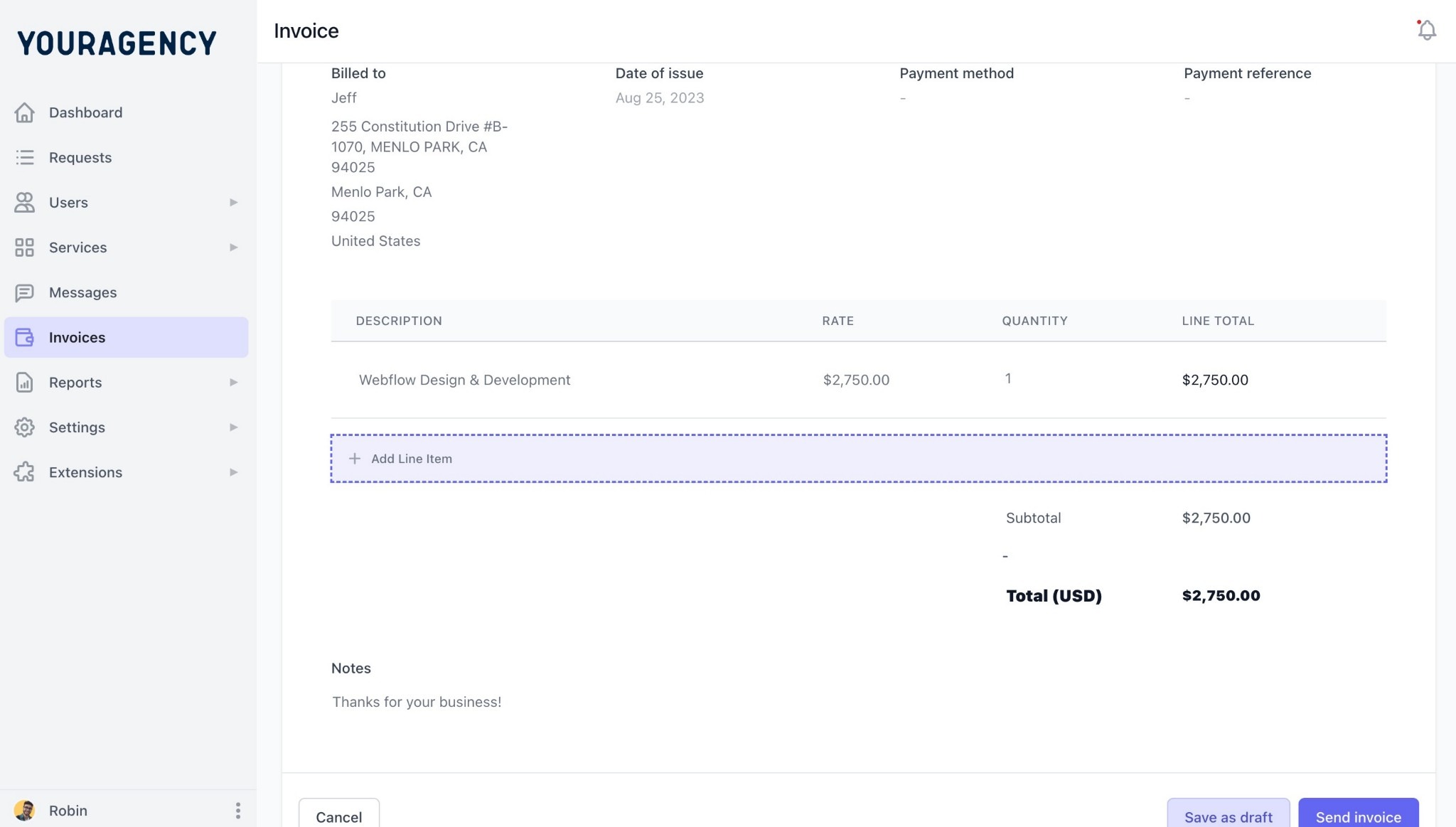
There's also a branded client portal that gives your clients a platform to check project status, ask questions, drop assets, write feedback, receive invoice, and pay.
Look to automation and delegation. Routing should happen without you. In ManyRequests, auto-assignment rules send each new request to the right team lead by service type, so you don't have to oversee everything. Workload management also shows who is carrying what, so it's easier to delegate.
Every agency on this list sells a different service, but the ones earning the most run their delivery through a system.
That system is what you're building toward, whichever band you're in. ManyRequests holds the pieces together in one portal, where your client submits a request, your team delivers it, and Stripe charges the subscription on renewal day. Nothing waits on you to move it along. You can start a 14-day free trial and set up your first service.
1. See how ManyRequests works in real life. Start a free trial and experience how productized agencies centralize requests, reduce chaos, and streamline delivery, without changing their entire workflow.
2. Read our Implementation Guide to launch smoothly with your team and clients.
3. Follow us on LinkedIn and YouTube for practical agency growth strategies
4. Check out The Productize Blueprint to learn how to turn your services into a scalable, productized offer.
Adetola Rachael Iyanuoluwa is a B2B SaaS writer and content marketer with 4+ years of experience creating SEO, human-focused content. She writes in-depth how-to guides and comparison articles content that help SaaS companies grow organic traffic and turn readers into customers. At ManyRequests, she produces practical, well-researched content that helps agencies and service businesses streamline operations and scale sustainably.