Client Acquisition for Agencies: Productized Guide [2026]
Client acquisition for productized agencies in 2026, learn how to get clients and turn them into recurring revenue with a proven system.

Adetola Rachael Iyanuoluwa
.jpg)
You struggle with client acquisition because you're not using systems that can help you acquire and retain clients regularly.
You send cold emails (everyone does), and you get some referrals from LinkedIn. So clients come in, but then after some one-off projects, you go back to square one.
You dread the whole process.
I've read, listened to, followed, and taken insights from a few successful productized agency owners on how they aced agency lead generation, and I'll share a repeatable agency client acquisition strategy that can help you get clients and keep them.
Client acquisition for productized agencies is a system, not just a set of tactics. It combines a clear offer, a focused acquisition channel, and a conversion process that turns leads into recurring clients. The goal is not just to get clients, but to retain them through subscriptions or retainers.
Before we get into channels, here's the structure that makes everything else work:
Create a repeatable loop with these steps to continuously gain and retain clients.
Now, let's start.
Your client acquisition as a productized agency depends on two things: a service offer specific enough to self-qualify prospects, and a clear picture of exactly which clients that offer is built for.
Let's see how that works:
The agencies that know how to get clients for their agency are the ones with an offer that practically sells itself.
Your offer should be specific enough that the right person immediately knows your service is what they're looking for.
Take Hatchly, an on-demand design service in the UK, for example:
They have a clear offer: "On-demand design service for a flat monthly rate."
This means the customer can ask for as many designs as they need for a flat monthly fee.
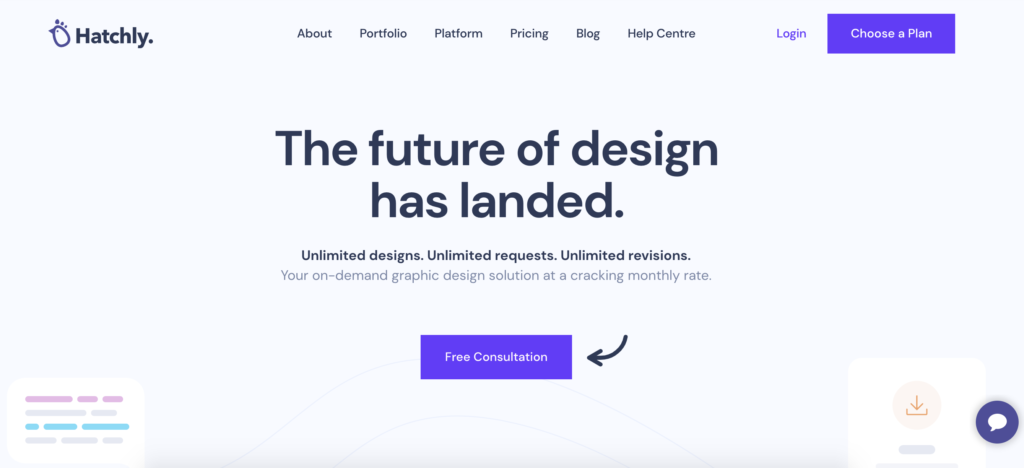
Their offer is clear, and prospects can self-qualify themselves before they even reach out to Hatchly’s team.
You can see the same thing with us. When you open our homepage, you see exactly what we offer, and who it is for.
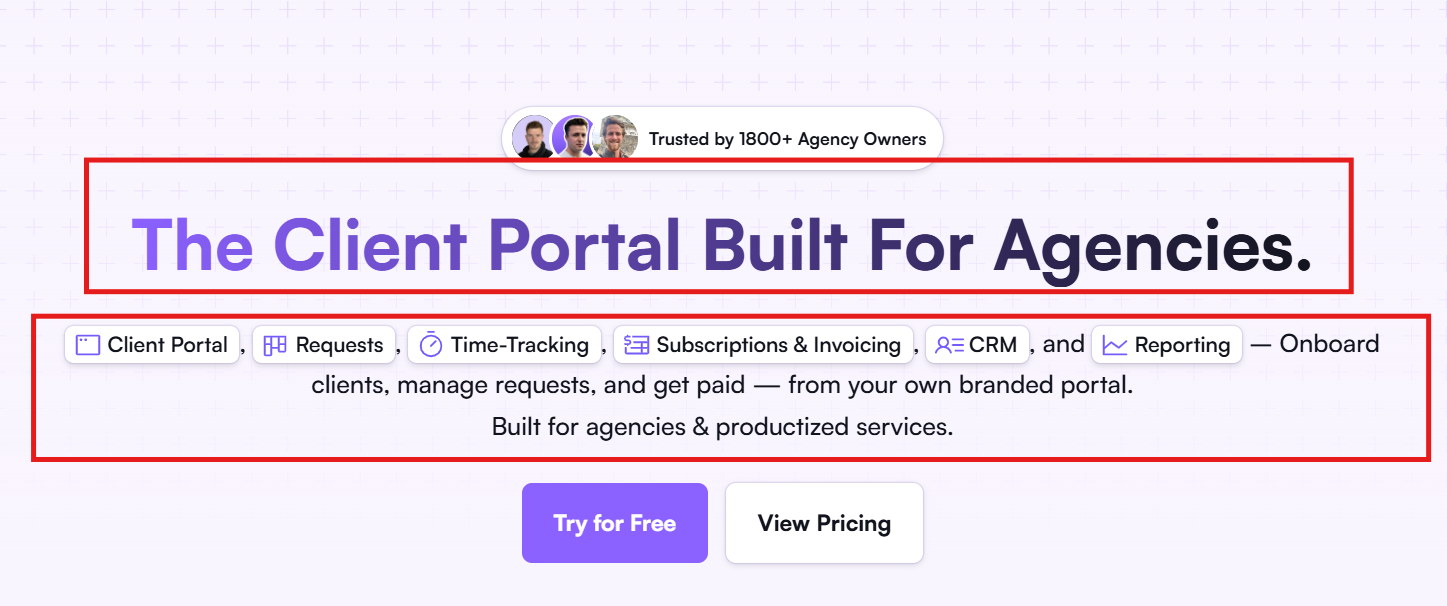
Our audience is not confused, and we get quality leads.
Someone either needs what you offer, or they don't. Make it easy for them to make that decision before they reach out to you.
Roy, who founded and later sold Jetti, a design subscription service, started where most agencies do. “My first company was a boutique agency: SEO, websites, graphic design, animations, PPC, the whole shebang. I quickly realized it was very, very hard to scale. So I picked graphic design.” he said.
“If you have one skill that’s really easy to train, you can build a lot of SOPs and systems around it, and it’s much easier to scale.”
So to improve your productized agency growth, you need to sell three things to your clients:
Here's what that looks like in practice:
"We offer unlimited graphic design for e-commerce brands at $1,500/month. You get a dedicated designer, 48-hour turnaround on all requests, and unlimited revisions. Monthly billing, cancel anytime.”
Build your ICP around the industry, company size, and trigger events your best clients share. For a design subscription agency, that might be a company that just raised a seed round and suddenly needs marketing assets at scale, or a SaaS team that's growing too fast to manage an in-house designer.
The best ICPs are built around people you already understand deeply (their problems, their language, their buying triggers.)
P.S: You can create your ICP based on the information your past clients have filled on the intake form.
Start with the channel that matches where your agency is right now, referrals if you already have happy retainer clients, LinkedIn outbound if you need traction fast, content if you're thinking six to twelve months ahead, and then build to two or three channels once the first one has infrastructure behind it.
And Roy agrees. He says:
“My biggest learning is just don’t become reliant on only one channel. You need to have at least two or three, and you need to try a lot of different things. What works now doesn’t mean it works later.”
That said, let's look at the some of the best client acquisition channels:
Referrals are the highest-converting agency client acquisition strategy, so you shouldn't leave them to chance (good work doesn't necessarily mean you’d get referred when work comes up).
You need to create a system that puts you at the top of people's mind when they see someone who needs your service. A survey by Nielsen reports that 84% of people trust word-of-mouth recommendations more than any forms of advertising.
Karl Hughes, founder of draft.dev, a technical content marketing agency, also put it well:
"I started by using my existing network to grow the business. I had a really strong personal network and I've always kept in touch with a big list of professional contacts, so when I went full-time on Draft.dev, I reached out to them."
The reason referrals work well for productized agencies is that your offer is easy to describe.
When a client refers a traditional agency, they say something vague like "they do good design work."
When a client refers a productized agency, they say "they do unlimited design for a flat monthly fee and turnaround is 48 hours." It's specific enough to pull the prospect in.
Ryan Golgosky of 180 Sites grew to 650+ active clients and roughly $130k MRR largely on the back of referrals.
How did he do it?
He consistently showed up in the right communities, and did good work in his niche. Eventually, he stopped doing active outreach entirely. His client base did it for him. That's what a referral engine looks like when it's actually running.
So what can you do?
For example, you can say something like;
"Do you know any e-commerce brands struggling to keep up with their content calendar?”
If they do know someone who needs your service, they should be able to bring it up.
You can also incentivize them. Stephanie Love, the manager of content strategy at Thryv, says to “find what will easily motivate your clients to want to refer you to their community besides your fantastic service.”
“This could be something like discounts, free services, loyalty points, or even a combination of those offers. She said.”
Try these approaches, and when you find a system that runs well, treat it like any other acquisition channel. Track where referrals are coming from, which clients are sending them, and what their conversion rate looks like.
With ManyRequests, you can track how new clients came in through intake forms. Add a simple "how did you hear about us”, or “how did you find us?” in your intake form when new clients sign up.
From there, you can track which referral sources actually turn into paying clients from your ManyRequests dashboard.
Over time, this should change how you approach referrals entirely. You can see which clients send the most business, which referrals convert best, and this tells you where to focus your relationship-building efforts.
Instead of treating every client equally, you double down on the ones who actively bring in new business.
Agency to agency partnership, is an agency or service provider that sells to the same clients you do, but doesn't compete with you.
If you run a design subscription, the right partners might be copywriting agencies, or SEO and marketing agencies. Their clients need design, and your clients may need copy or SEO work, and you both have an incentive to refer.
A 2024 report by Ebsta and Pavilion, revealed that partner referrals make up only 10% of the pipeline, but they contribute to 31% of revenue, which makes them the single largest source of revenue per lead.
The best way to start is to create a referral program with businesses that share your target audience, offer complementary services, but aren't direct competitors.
Ryan Golgosky of 180 Sites still uses partnerships as one of his primary growth channels. "We try to provide extra value to them, and in return they refer clients to us. Other marketing agencies, logo designers, and other business services refer work to us, and we refer work back to them."
You should prioritize partners who share your values about client service. You want to be confident they'll treat your referred clients with the same care and professionalism you would.
You can also create an affiliate network like Brett Williams of Designjoy does. He launched a formal affiliate network and credits it as one of the biggest levers in his growth.
"Affiliates: this one is massive for me. A few of my affiliates are responsible for a large chunk of my business." Both approaches work. What doesn't work is having no approach at all.
Don't keep partnerships informal. An informal arrangement works fine until one party starts sending more leads than the other, or until a referred client has a bad experience and nobody knows who's responsible.
At minimum, define:
Now, how do you find these partnerships?
That's the wrong first move. Instead, send them a client. If your prospect needs something outside your scope, refer them without making a big deal of it. Let the quality of who you send speak for itself.
Collaborate on a project or make one referral to see how they operate before formalizing a referral partnership. Trust is the currency of a good agency partnership, and you build that through action.
LinkedIn outbound is when you proactively reach out to people on LinkedIn to start sales or partnership conversations. But you shouldn't start with your pitch.
You connect with someone, they accept, and within 24 hours they get a paragraph about your services. They've seen it a hundred times that week, and they will ignore you.
Robin Vander Hayden, cofounder of ManyRequests, sees this a lot.
“I receive a lot of emails that are super personalized, they mention the school I went to, the specific business I launched, but the content isn’t relevant at all to me. Sometimes I receive an email that just says ‘We saw that you run a SaaS and we’ve improved conversion for a SaaS in a similar niche.’ That’s way more relevant.”
Send relevant messages first. LinkedIn DMs get open rates of over 60% and reply rates of 10–30% when the message feels personal and relevant.
You shouldn't just personalize a template with the person’s first name, and immediately pitch yourself. Build a relationship with the person first. Spend a week or two in your prospect's feed before you reach out. Comment on their posts. Ask a follow-up question. Share something useful.
This Reddit user says to “Give first, build a relationship, and then bring up what you do. Not as a bait and switch, but by way of being transparent.”
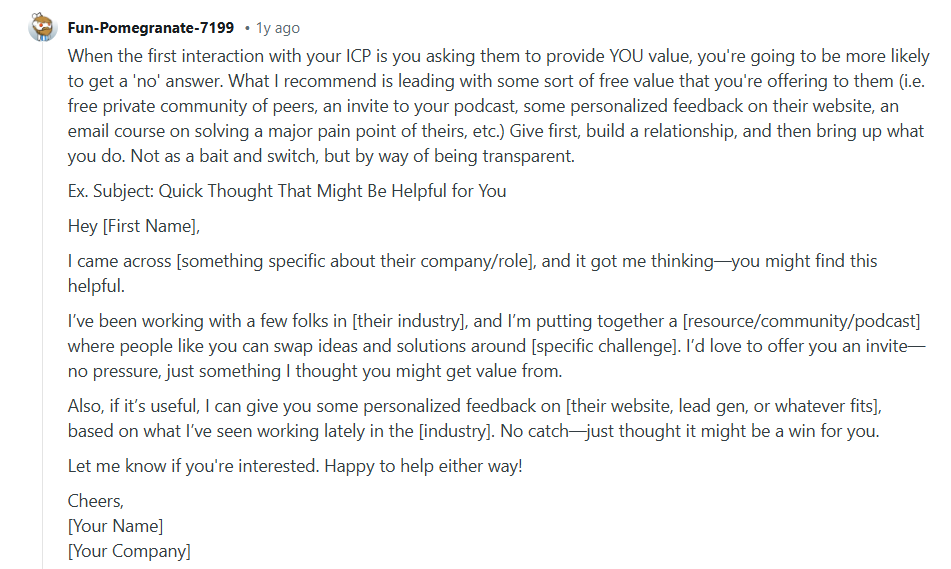
By the time you send a DM, they recognize your name, and they may reply positively.
You can say something like:
"Hey Jane, saw your post about scaling your design team, and I agree that hiring in-house too early kills margins. I run a design subscription for SaaS companies and noticed you're hiring a third designer. Worth a 20-minute chat about whether a subscription model makes more sense at your stage?”
This isn't a perfect message, but it helps you start a conversation without pitching your services.
A Salesbread survey has shown that LinkedIn outreach campaigns that combine profile warm-ups, engagement, and personalized messaging have produced positive reply rates above 48% in some documented campaigns.
You should also watch out for trigger events. Look for signals that a prospect is already in motion. If an SEO company just posted a job for an in-house designer, they probably have clients who need design work. You can reach out to them, and make the case that your agency delivers faster and at a lower cost than a full-time hire.
Neil Patel turned a version of this into a repeatable system for agencies starting out.
“Look for companies that recently raised up to $20 million, then tear down everything they’re doing wrong from a marketing perspective. The key is to be very specific: use screenshots, break down solutions, and tell them how to fix everything step-by-step, even if they decide to do it on their own without paying you. The more specific you get, the better this strategy will work.”
Sales Navigator makes this kind of targeting systematic. You can combine filters like job title, company size, industry, and geography to build a list of prospects who match your exact ICP, and then save that search so new matches surface automatically.
"We do design work for businesses" gives the prospect nothing to hold onto.
But if you offer something like: "Unlimited Webflow development for SaaS companies, starting at $3,500/month", it'll either attract the right person or turn down the wrong one.
Productized services show prospects what they’ll get, and it brings people who are already a fit to you.
Outbound only compounds when there's infrastructure behind it, or else you’d be starting from scratch every time.
You need a simple CRM pipeline with stages that show connected, replied, call booked, closed. It lets you track who actually converts and who doesn't.
You don't have to do this all by yourself. If you have an ops team, they can maintain the pipeline, set up follow-up triggers, track what's converting, and make sure nothing falls through the cracks.
Content is the slowest channel for agencies, but it's the only one that keeps working after you stop.
A well-ranked comparison page or use case article brings in qualified leads regularly without any ongoing effort.
The catch is you won't see these leads for at least six months, and most agencies either give up before it kicks in or start too broad and wonder why nothing converts.
Karl Hughes built draft.dev, a technical content marketing agency, to $2.5M in revenue in its second year. His early growth came from his existing network.
But once he had revenue to justify longer-term bets, he went all in on content. "I started pumping as much as I could afford into long-term marketing efforts like content, link-building, and community engagement. These channels take a long time to pay off, but they have staying power."
So what do you do and how do you do them?
Write for buyers, not researchers.
The content that converts for productized agencies isn't broad educational posts. It's decision-stage content written for people who are already close to a yes and just need to land on the right page.
For example, someone searching "best design subscription for SaaS companies" is about to buy. Someone searching "what is graphic design" is not.
The gap between those two searches is the gap between content that fills your pipeline and content that fills your analytics dashboard.
Four content types consistently pulls buyers at the decision stage:
Pick two or three topics your ideal clients are actively searching for and go deep on those first. You have an advantage as a productized agency with a tight niche; you know exactly who you're writing for and what they're trying to decide. That specificity is what makes content rank and convert.
Once a piece is ranking, it needs active maintenance. Add internal links to your intake form and service pages. Update pricing and package details at least once a year. Tighten the CTA so it matches what the reader is ready to do at that point in their decision.
This matters more than it used to. LLMs and AI search tools now pull from BOFU content when they generate recommendations and comparisons for buyers.
Recently, Kiran Shaid,a content writer who’s been working on BOFU refreshes for clients, sees the downstream effect of neglected content regularly.
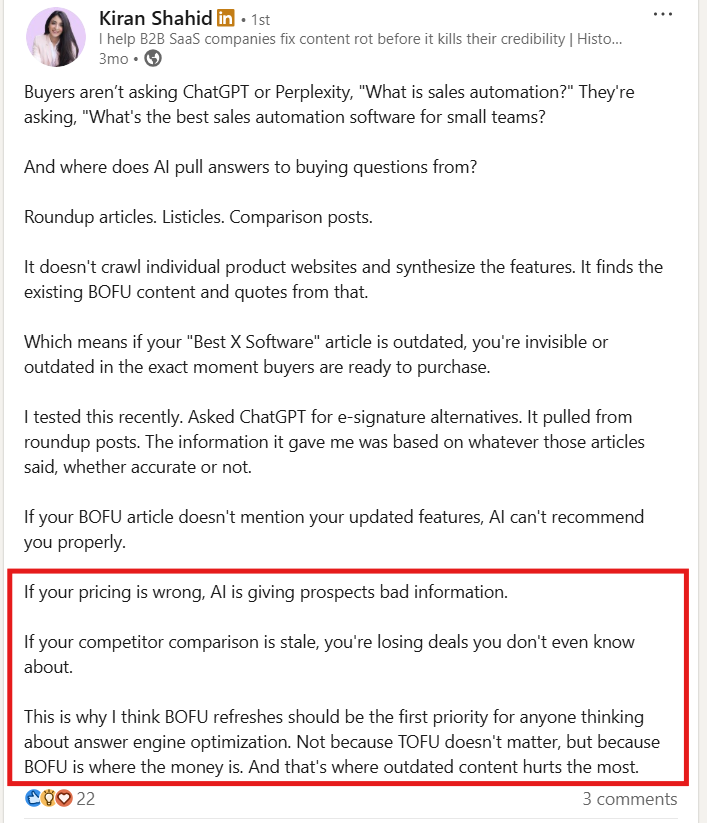
“If your pricing is wrong. AI is giving prospects bad information. If your competitor comparison is stale, you are losing deals you don't even know about.” She says.
“That is why I think BOFU refreshes should be the first priority for anyone thinking about answer engine optimisation. Because BOFU is where the money is.”
Treat your highest-intent pages like live assets. A stale comparison page misses Google traffic and misrepresents your agency to every AI tool surfacing recommendations to buyers who never click through to verify.
When someone has already decided they want to hire an agency and they're evaluating, directories and review platforms, like Clutch and G2 are where they go to shortlist. If you're not there, you don't exist in that conversation.
Clutch focuses on B2B services specifically, which means leads from the platform are often high-intent.
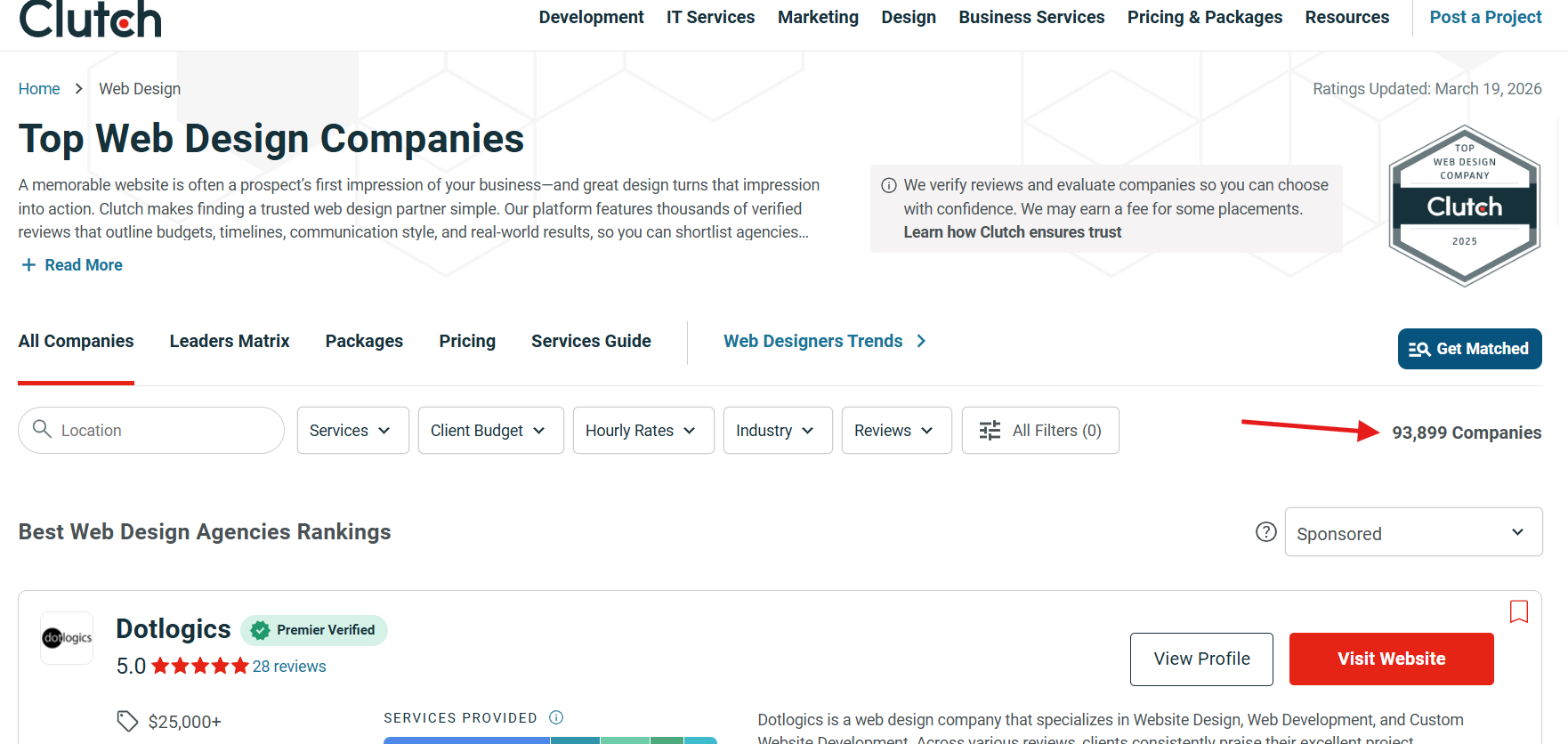
Buyers looking for a marketing or creative partner know to check Clutch, and Clutch profiles rank well on Google for service comparison searches.
The caveat is that directories don't work passively. A profile with two reviews from three years ago won't do much, and as you can see, there's over 93,000 web design companies in the web design category alone.
You need to add recent and detailed reviews from real clients who have used your service (it's even better if they are people your prospects can recognize).
So how do you find these kinds of reviews?
Besides Clutch and G2, look for niche directories relevant to your specific offer. If you run a webflow development subscription, the webflow partner directory is worth having. If you serve e-commerce brands, try Shopify Experts. You'll find better leads in platform specific directories because buyer intent is much clearer.
You probably use your client portal as an operational tool (It manages projects, communication, feedback, and requests). All true.
But if you own a productized agency, it's also a sales page. A prospect who lands on a portal with clear services and visible pricing can evaluate your offer and pay just as fast.
A polished portal is one of the most underused parts of your agency client acquisition strategy.
Here's what I mean.
When a prospect is evaluating two agencies, the one that sends a PDF proposal and a Calendly link looks like every other agency.
The one that walks them through a clean, branded portal with a structured service catalog, clear pricing, and a professional intake flow looks like a company that has its act together. It pushes a good impression of your agency before the project even starts.
ManyRequests offers a structured service catalog you can use to list your services, including every detail that you normally would overlook, and add pricing to it.
The client sees this pricing on your portal or your social media platform, and they can already pick a service that fits them before they even talk to you.
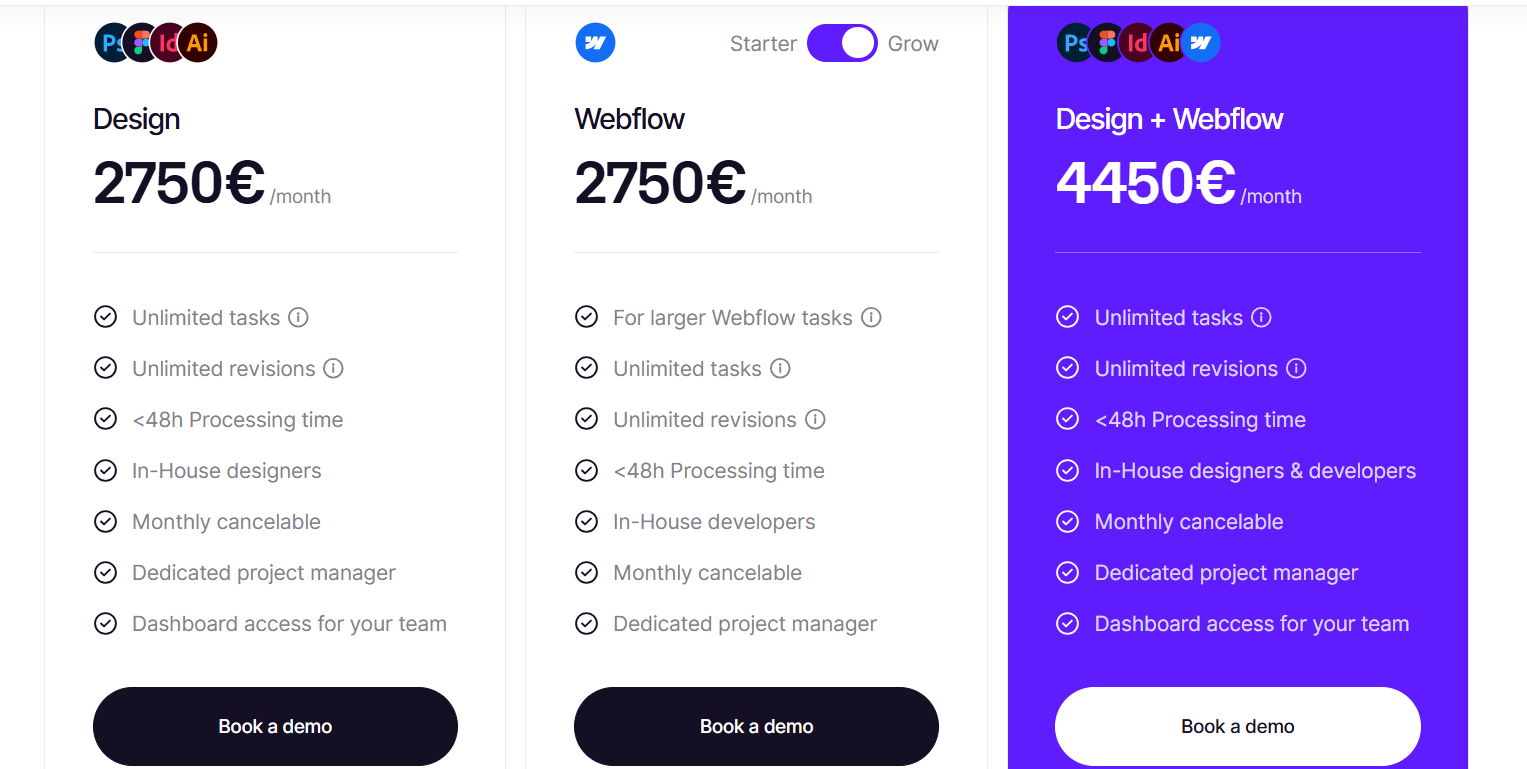
You can create a tiered productized service like Magier, one of our client does:
Or different services pulled into one, with monthly or quarterly pricing, like Flowout, our client does:
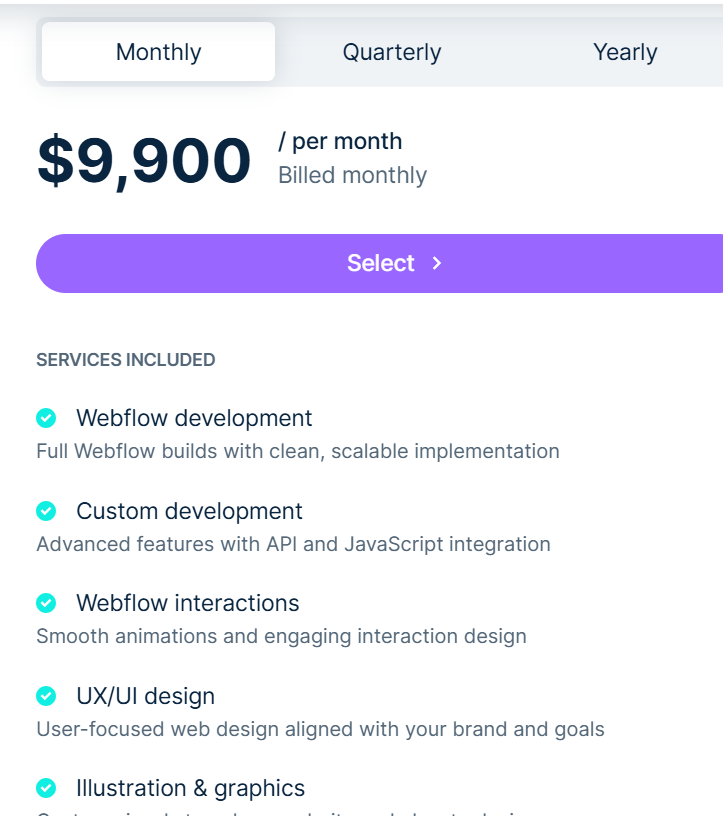
Your service catalog lays out what you offer, what's included at each tier, and what it costs.
A prospect can evaluate your offer, select a plan, and pay.
We helped Flowout do exactly this.
Flowout, a subscription-based Webflow agency, started with ManyRequests from day one and grew to over $1M ARR with a 20-person team in under two years. Their clients ranged from early-stage startups to companies like Sequoia and Jasper.ai.
The portal handled both their recurring maintenance plans and hourly packages in one place. Clients could:
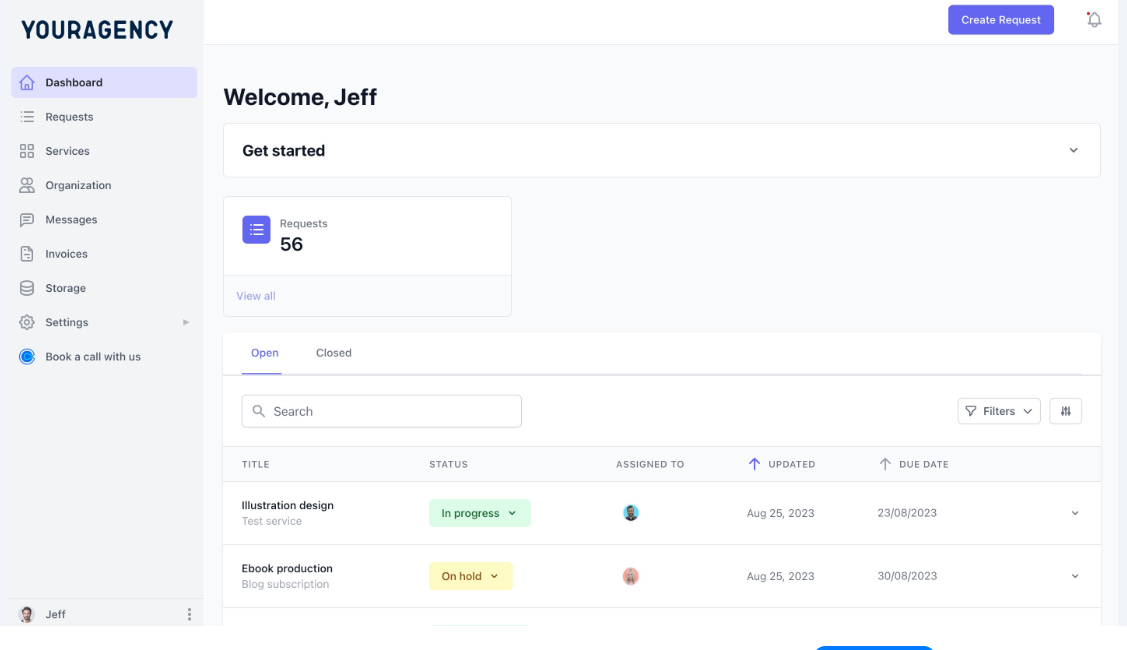
ManyRequests creates a self-service visibility that keeps your client engaged enough to stay and talk about you.
When the client reaches out to your agency, ManyRequests onboards them through a customizable intake form that has all the necessary questions you may need from them as the project goes on.
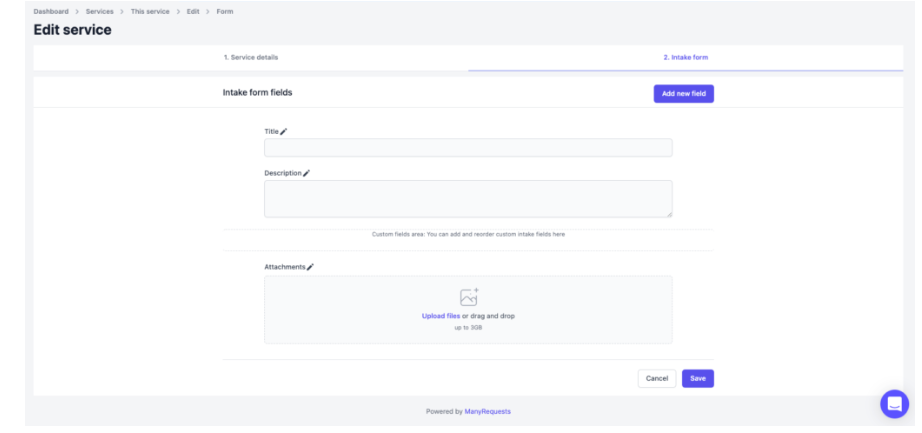
This is where to ask who referred them to you, btw. When the client fills this form, and is fully onboarded. You can set up a fully customizable white label client portal.
Already, ManyRequests lets you use your own domain, but you can also customize the color, logo, favicon, and every other trace of ManyRequests.
For example, this is what our clients see when they log in to ManyRequests:
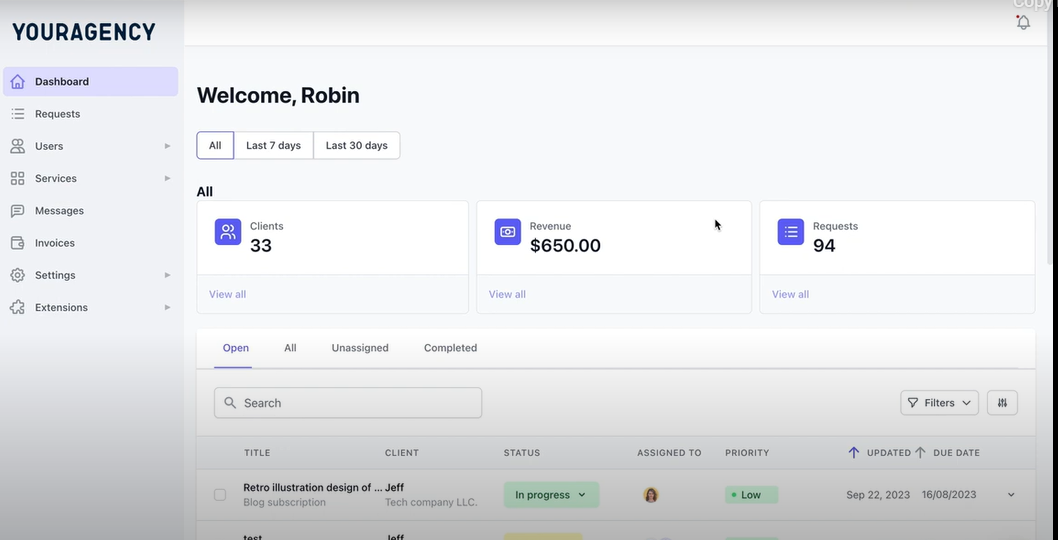
And this is what Magier’s team and clients see when they log in to the portal.
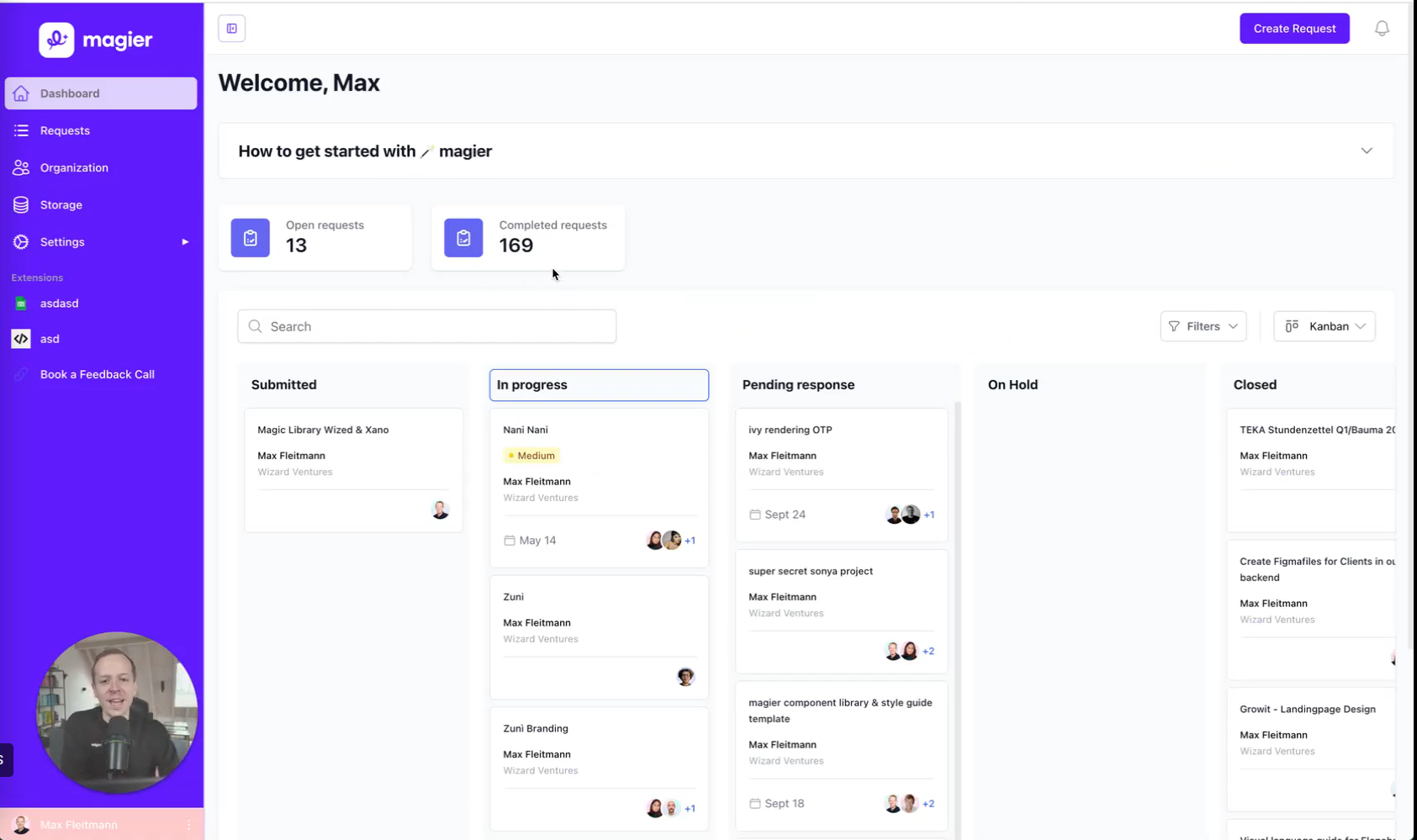
As you can see, it's completely different.
You can also share your intake form link directly in outreach. Instead of asking a prospect to jump on a call, send them your intake form.
A project-based agency is always selling. You wrap up one client and before you've caught your breath, you're already worrying about where the next one is coming from. The revenue stops when the work stops. And the longer you operate this way, the harder acquisition gets, because you're always starting from zero.
Retainer acquisition works differently. When a client signs up for a monthly plan, that revenue compounds when a project wraps up.
A client who stays with you for two years is worth significantly more than three clients who each stick around for six months, and they're far more likely to refer you.
But most retainer pitches are vague.
Let's say you finish a project, the client is happy, and you say something like "we'd love to keep working together ongoing." That sounds nice but gives the client nothing concrete to say yes to.
They don't know what they're getting each month, or how they get out if things aren't working. What you need to know is how to get clients for your agency onto a recurring model in a way that makes it easy for them to say yes.
You could say something like:
"Hey Jane, really glad this landed well. I wanted to bring up something before we wrap up. We offer a design subscription at $2,000/month that gets you unlimited design requests, 48-hour turnaround, and monthly billing with no long-term commitment. Since we already know your brand, you'd skip the onboarding entirely. Let me know if you’d be interested.”
Anchor your price against what it costs the client to hire in-house. If a full-time designer costs them $3,000 to $4,000 a month in salary alone, a $2,000 subscription is an easy decision. Same output, no hiring overhead, no notice period.
A productized service is exactly like a retainer agreement, but with pricing publicly available on your website. It removes the ambiguity that makes prospects hesitate to reach out to you.
Your existing project clients know your work, they trust your process, and they don't need convincing.
Bring up the conversation right when a project finishes and the client is happy. Come in with a specific offer, and let them know the benefits they’ll get:
ManyRequests runs recurring billing automatically once a client moves to a subscription. The system reminds the client when it's time to pay, and the client can pay through the portal via Stripe. Once you've set up your agency operations, it can run without you.
Again, you don't have a client acquisition for agencies problem, you have a systems problem.
The channels in this guide work. The only difference between productized agencies that are successful in utilizing them and you is that they have a structured infrastructure (a tight offer, a structured intake, a portal that converts, and a retainer model that compounds) underneath and you don't.
Once clients start coming in, that same infrastructure handles everything else including onboarding, delivery, communication, and billing, so you're not scrambling to keep up with growth.
ManyRequests can help you with agency lead generation. The platform gives you the operational layers you need to make that happen, including client portal, intake forms, recurring billing, and delivery tracking all in one place. Start your 14-day free trial and see how it fits your agency.
Most agencies start with their existing network, then build out channels like referrals, LinkedIn outbound, and content over time.
It depends on where you are right now. Referrals if you have happy clients, LinkedIn outbound if you need traction fast, and content if you're thinking six to twelve months ahead.
The same channels as any agency, but a specific, clearly scoped offer makes every channel work harder. It's easier to pitch, easier to refer, and easier to rank for.
Last Published: March 3, 2025
1. See how ManyRequests works in real life. Start a free trial and experience how productized agencies centralize requests, reduce chaos, and streamline delivery, without changing their entire workflow.
2. Read our Implementation Guide to launch smoothly with your team and clients.
3. Follow us on LinkedIn and YouTube for practical agency growth strategies
4. Check out The Productize Blueprint to learn how to turn your services into a scalable, productized offer.
Adetola Rachael Iyanuoluwa is a B2B SaaS writer and content marketer with 4+ years of experience creating SEO, human-focused content. She writes in-depth how-to guides and comparison articles content that help SaaS companies grow organic traffic and turn readers into customers. At ManyRequests, she produces practical, well-researched content that helps agencies and service businesses streamline operations and scale sustainably.