What Is a Creative Agency in 2026? Productized Services Guide
What is a creative agency in 2026? Learn types, pricing, and how productized services help agencies scale with predictable revenue

Adetola Rachael Iyanuoluwa
A creative agency sells creative services like design, content, video, marketing to businesses that need them but can’t hire in-house. How those services are scoped, priced, and delivered is where agencies differ.
It's also what separates an agency that scales from one that lives deal to deal, always one lost client away from a bad month.
The challenge for most agency owners isn't finding the work. It's keeping up with it when they have three channels to receive new briefs, write and send invoices manually, and also have to give project updates to different clients on different channels.
The agencies that grow past this operational chaos are the ones that build structure into how they deliver. In this guide, I explain the types of agencies that exist in 2026, the productized and subscription-based models most of them now use, and what you can learn from them.
The type of agency you run determines how you scope work, price it, and deliver it. It also determines whether you can scale it without hiring proportionally. These are the main types in 2026:
These agencies develop and execute campaigns across TV, radio, social, and programmatic channels. They typically have long-term engagements run long, often six to twelve months, which means cash flow is lumpy and they can spend more time managing stakeholders than producing work.
These agencies create or refresh business identities. Their services include logo design, brand strategy, naming, style guides, and brand storytelling.
Most of their engagements are project-based, though some agencies offer ongoing brand guardianship retainers for clients who need consistent creative oversight.
These agencies manage a business's public image and media relationships. Services include press releases, media outreach, crisis communication, and reputation management. R work is naturally retainer-based since reputation management always has to be done.
These agencies provide different kinds of creative and marketing services under one roof, including branding, advertising, digital, video, and content. The broad scope makes them attractive to larger clients but harder to systematize internally, which is why full-service agencies often struggle with profitability as they grow.
These agencies promote a business's products or services through content, social media, email, and paid channels. Many marketing agencies have moved toward packaged channel services.
The fixed-scope SEO and paid media packages make delivery repeatable; the clients also know what they're paying for early in the process.
These agencies cover web and app development, UX/UI design, SEO, and eCommerce; the technical side of a business's online presence. The core work is building something: a website, an app, a custom platform. Once that's done, many digital agencies layer on maintenance retainers (hosting, updates, performance optimization) so the client relationship doesn't end when the project does.
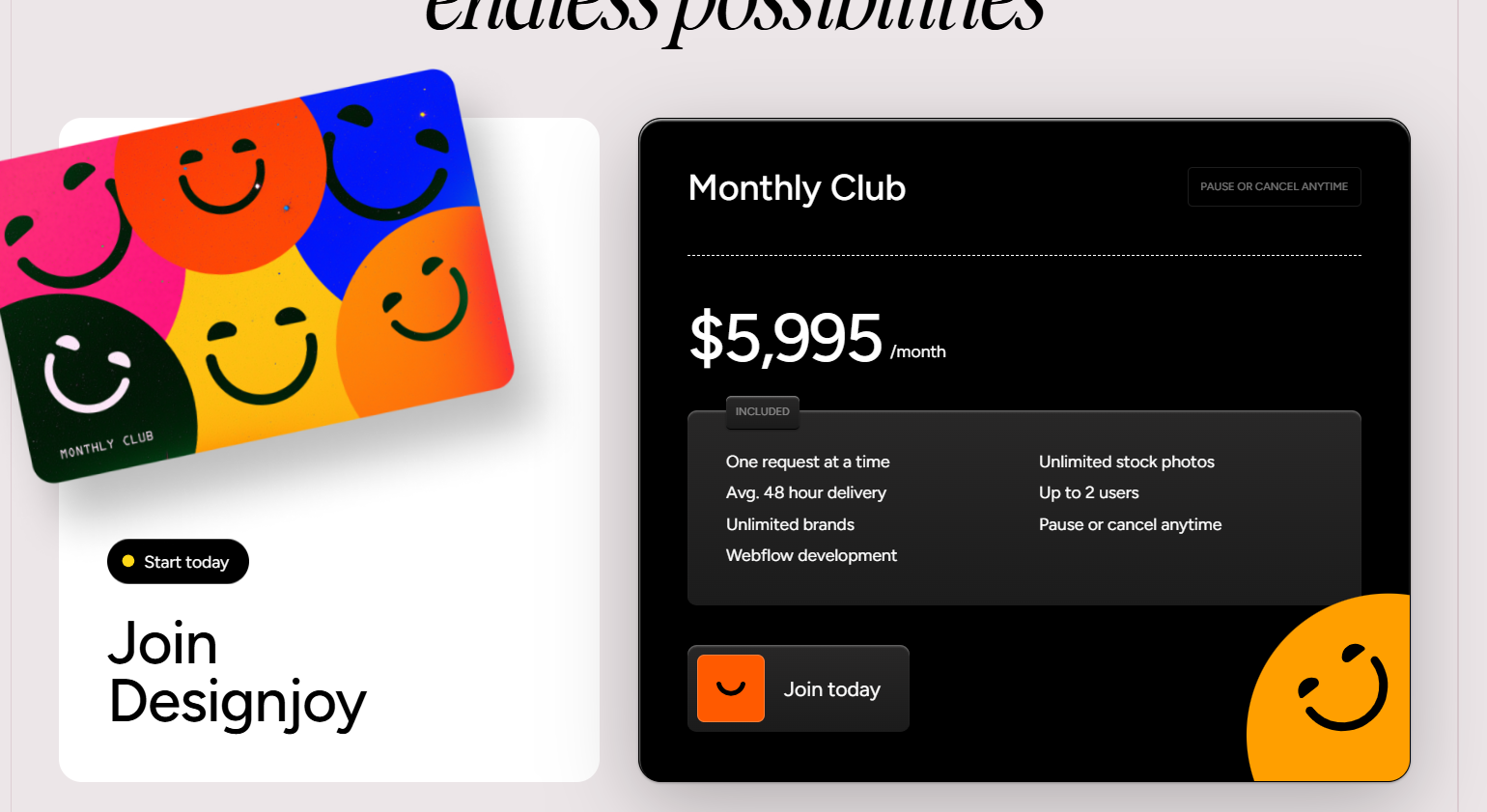
These agencies handle visual communication and aesthetic design, including print materials, digital graphics, infographics, and packaging. Graphic design is one of the most natural fits for the subscription model. Agencies like Design Joy and ManyPixels have proven that unlimited design for a flat monthly fee is a viable, scalable business.
These agencies create written and multimedia content including blog posts, SEO articles, video scripts, and social media content. Subscription content packages are increasingly common here. Agencies like Embarque and Content Cucumber package content delivery into monthly tiers with defined deliverables, fixed pricing, and no custom quoting.
These agencies produce video content for branding, advertising, and storytelling, including editing, animation, and 3D rendering.
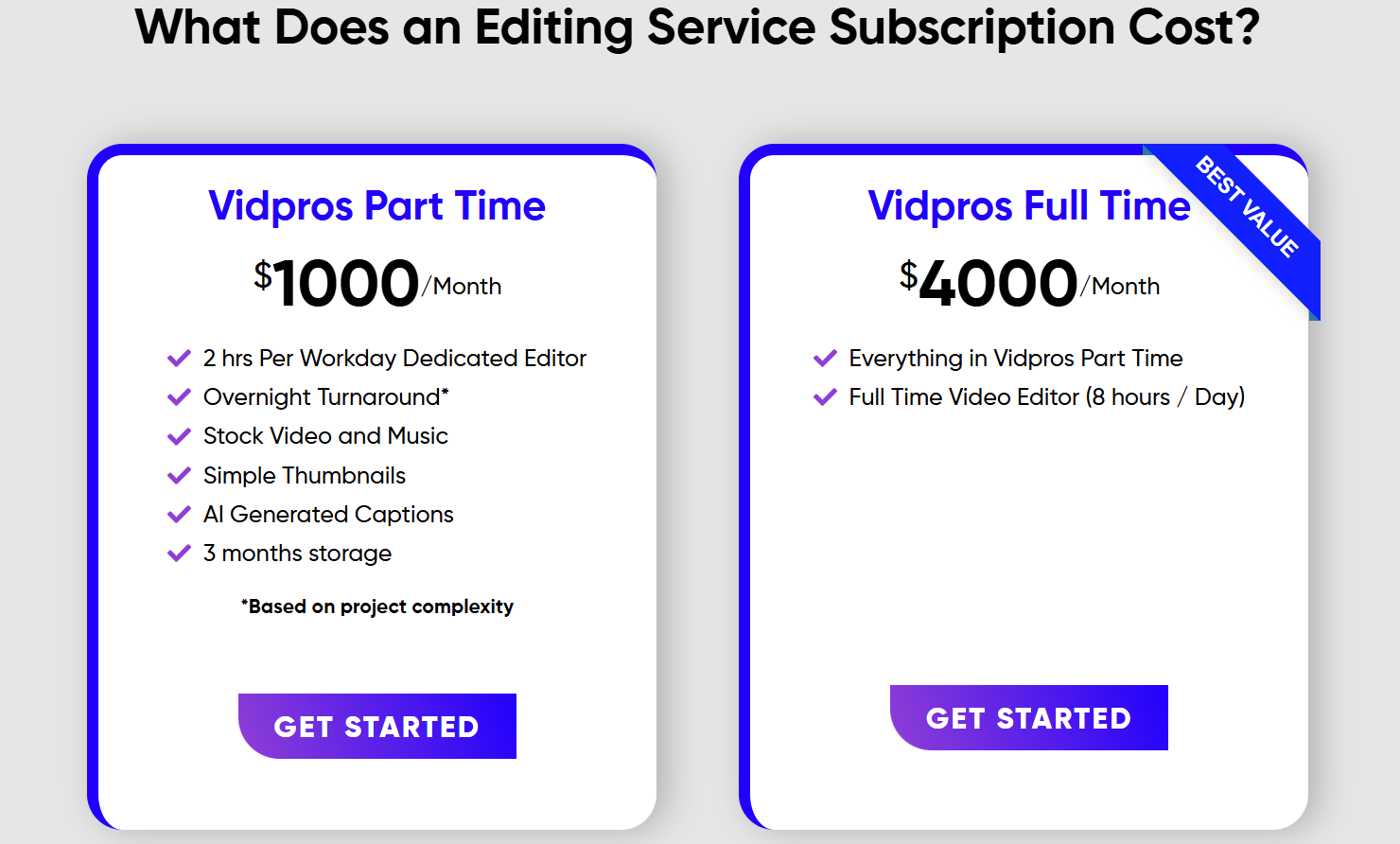
Like design and content, video agencies are also transitioning to productized delivery. Vidpros, for example, offers fractional video editing on a subscription basis, giving clients a dedicated editor without the overhead of a full-time hire.
A productized agency packages its services into fixed-scopes and prices that prospects can browse, pick, and buy without a custom proposal. The model works across almost every creative discipline, and what makes it stick is that the delivery process runs the same way for every client: the intake forms, defined turnaround times, and there’s no custom scoping on every engagement.
Agencies like Design Joy, 55Knots, Flowout, and Magier use this model. I'll explain why it works in the next section.
💡Read more: 8 Proven Ways to Reduce Subscription Churn for Agencies
The traditional agency model has one structural flaw that compounds as you grow: every new client means a new proposal, negotiation on scope, and a pricing conversation. You’d have unpredictable revenue because it depends on when (and how well) you close the next project.
The productized model fixes this.
When you convert your most repeatable services into fixed packages; defined deliverables, transparent prices, your prospects can browse, choose, and buy the package/services they want. That shift means:
The real-world proof is hard to ignore.
Read more: 15 Success Stories of Productized Services (with Revenue Numbers)
While this is how the structure helps, the model isn't for everyone. If an agency offers complex campaigns services with shifting scopes and multiple stakeholders, they’d need a custom approach.
If your service is repeatable, staying project-based is a choice, not a limitation. Agencies on recurring revenue don't just earn more predictably; they build operational muscle that compounds.
Every client onboarded the same way makes the next onboarding faster. Every delivery cycle tightens the process. The gap between a traditional agency and a productized one is in the unstable pricing model and the six months of compounding systems versus six months of starting from scratch on every engagement.
Read more: 3 Capacity Planning Strategies That Scale Agencies [2026]
Every agency regardless of type or model operates on what they sell, how they deliver it, how they get paid, and how they manage clients. The difference between an agency that scales and one that stays chaotic usually comes down to how well those four things are defined:
Every creative agency runs on four core components:
For a deeper look at how agencies price their services across both models, we wrote detailed guides on agency pricing guide and client management tools.
The productized model only works as well as the systems behind it. ManyRequests is a client portal with project management features to oversee your projects from beginning to end. Some of its most important features for your use case include:
When you're running a productized agency with 15, 20, or 30 recurring clients on the same service structure, every client needs to feel like they have a dedicated relationship with your agency.
ManyRequests lets you onboard clients into a fully branded workspace on your custom domain, customized to your taste.
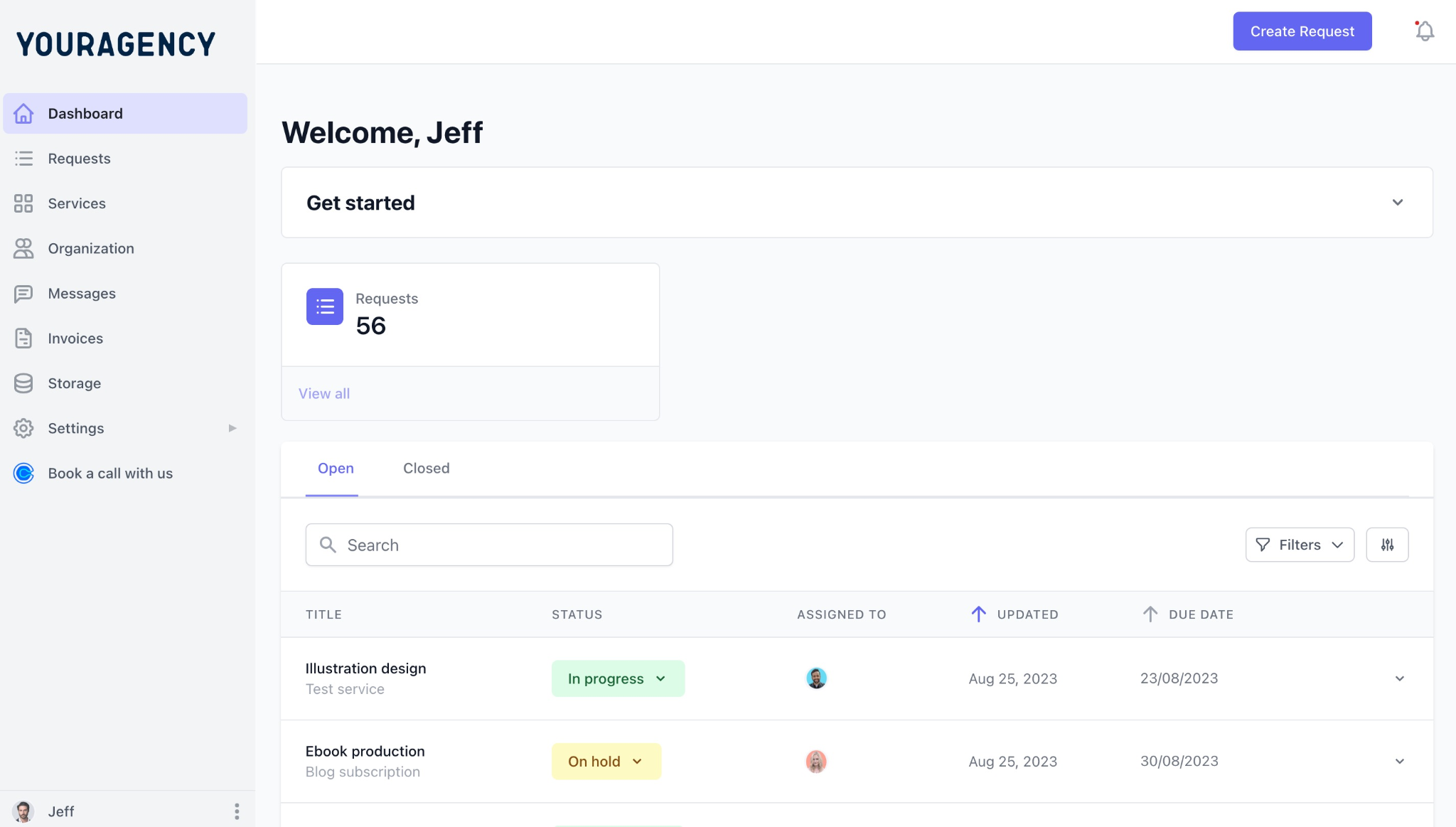
This means that you can remove every sign of ManyRequests and replace them with your agency name, logo, color, and font size like Prontto did here:
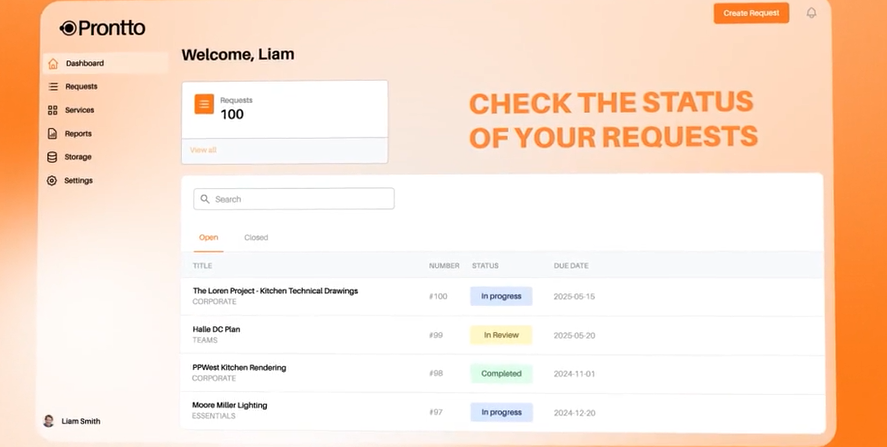
When your clients log into their portal, they’ll see your agency's branding instead of ManyRequests’.
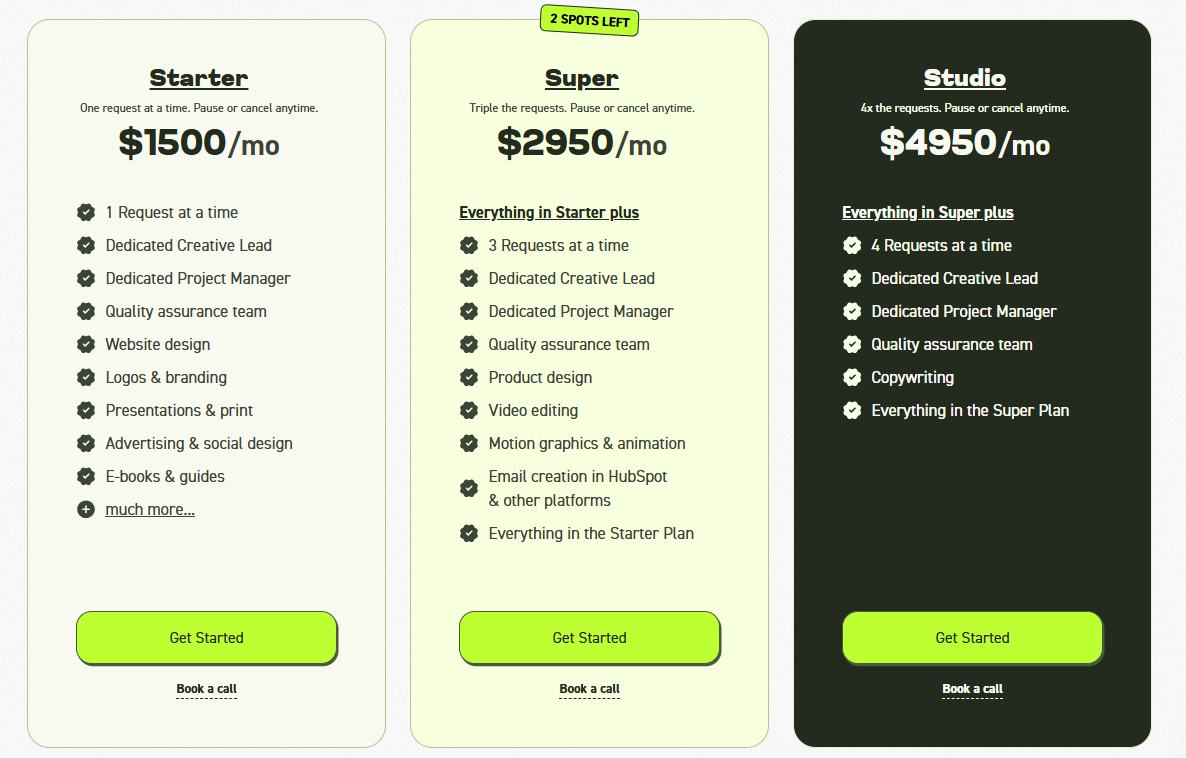
You can add all your fixed packages to ManyRequests service catalog, and your clients can browse through them, compare against the other packages, and subscribe without a sales call.
Prospects see your service offerings, pick a plan, and subscribe without the back-and-forth of no sales calls and long emails.
Here’s an example of the productized service feature from Teamtown, a client of ManyRequests:
ManyRequests lets you generate automatic invoices, so you don’t have to write manual invoices for every deliverable and every client.
Every client is on a defined tier, so invoicing is automatic, and clients are notified immediately.
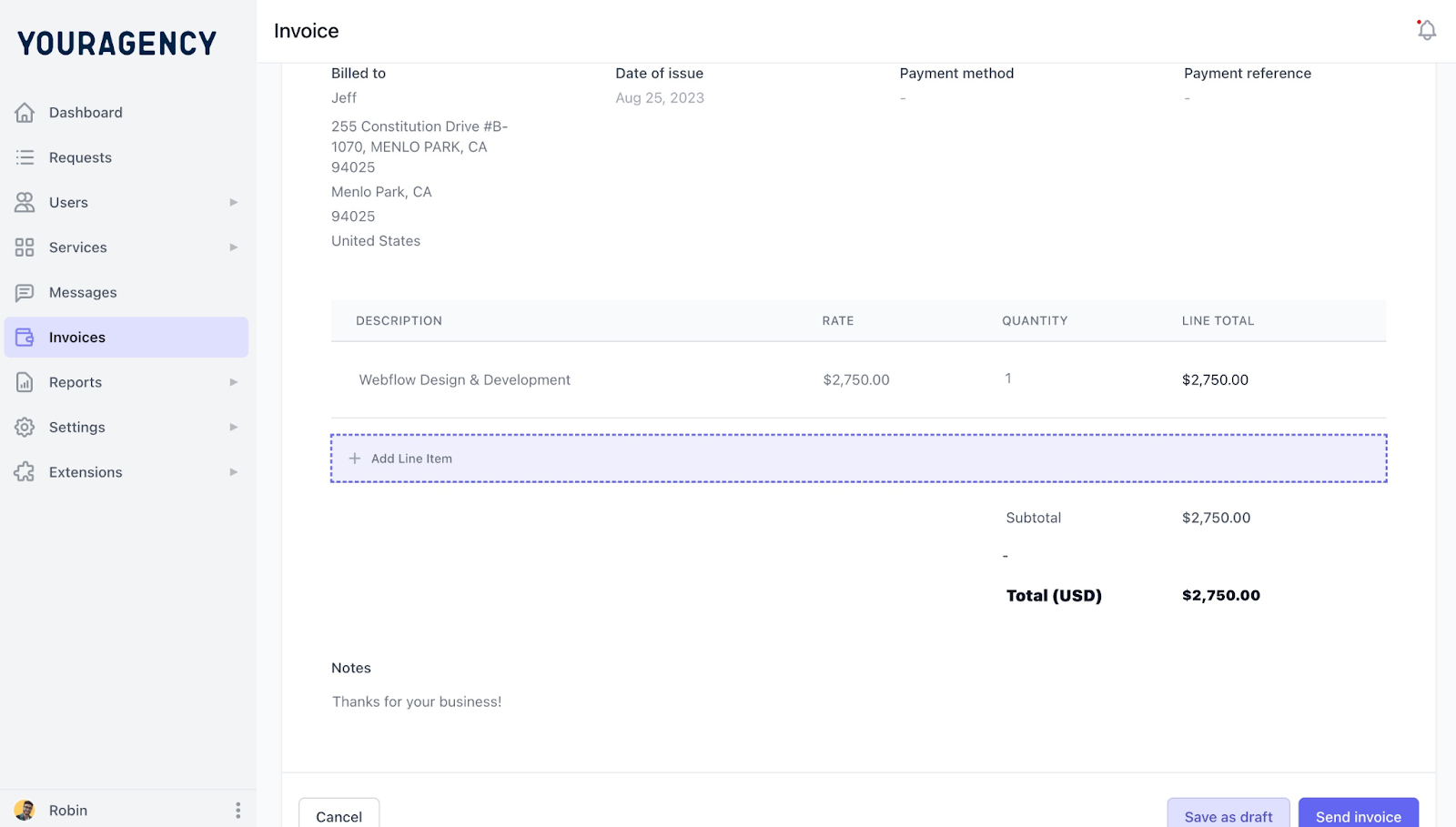
You also don’t need to integrate another billing software to manage payments. ManyRequests has Stripe embedded in the platform, so clients can pay directly to your account through the checkout option, as seen above.
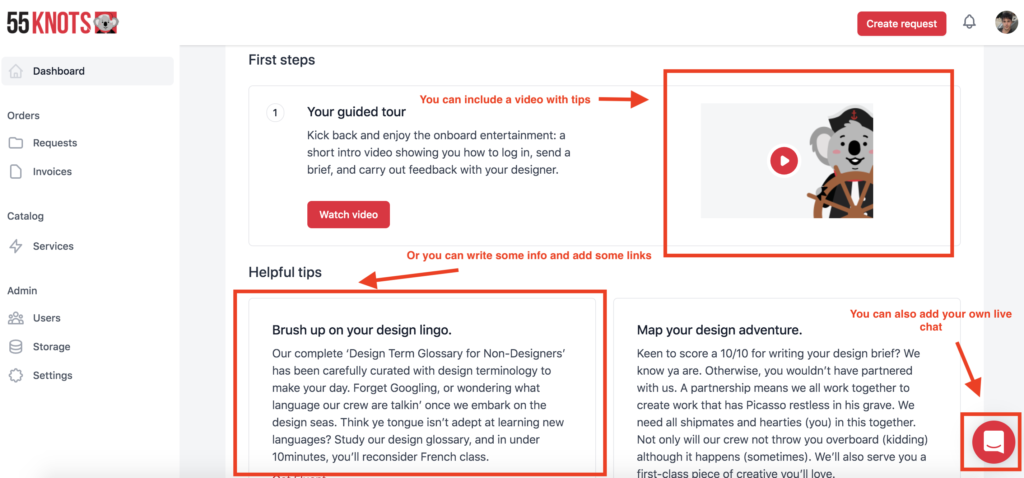
When a client logs in for the first time, they see an onboarding sequence you've built inside the portal. They can learn about things like your process, how to submit requests, who their point of contact is, and other FQAs you want to answer. You can completely customize the onboarding flow so new clients get the same context when they start working with you.

The onboarding feature is an easy way to welcome clients to your agency and the platform. Here’s an example from our client, 55Knots:
Your team can use ManyRequests to track time, see all active and completed tasks, assign tasks to team members (or contractors), set deadlines, and see progress statuses in one dashboard.
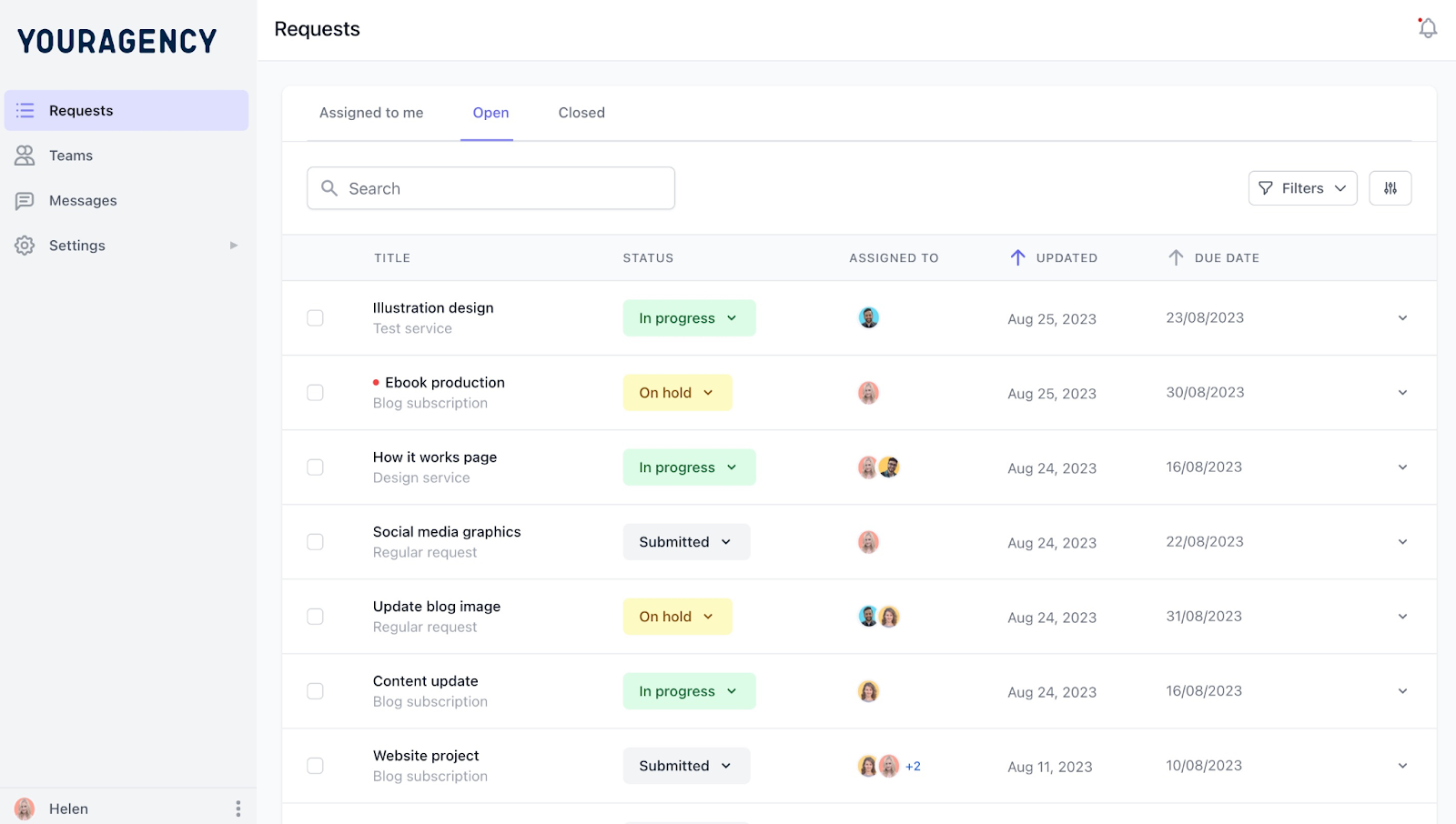
ManyRequests can help you manage your agency’s resources effectively, so you can see your team's capacity from a bird’s eye view.
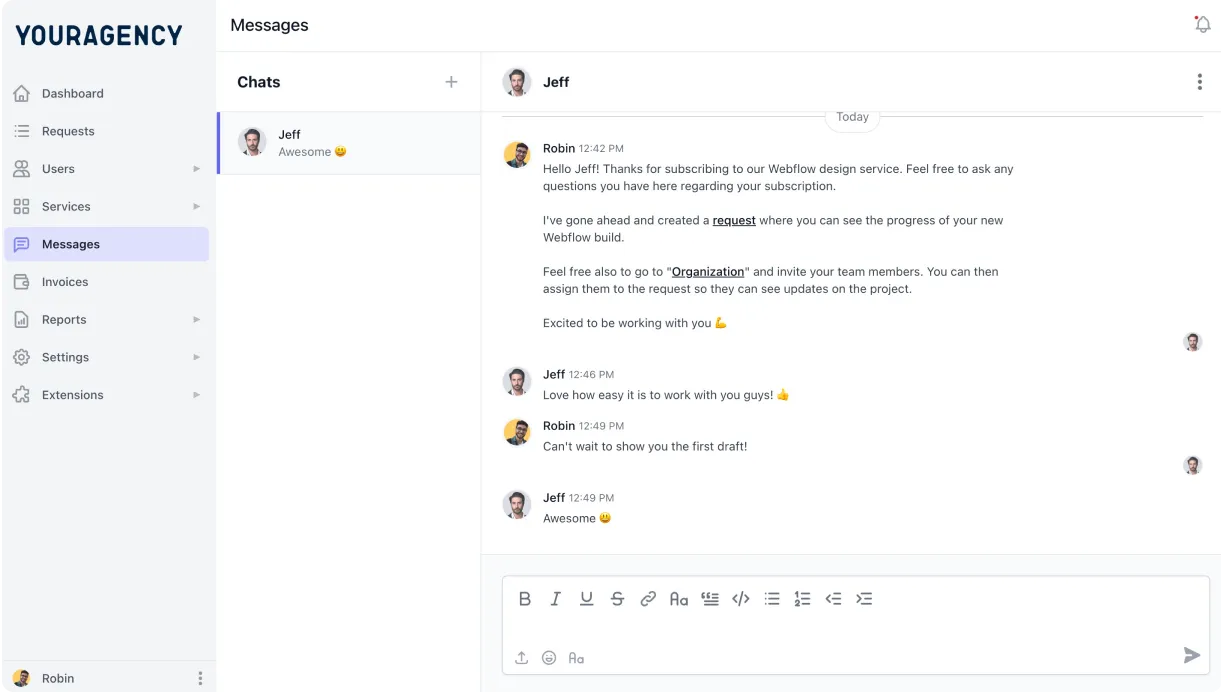
ManyRequests keeps every client conversation inside your portal, threaded to the relevant project. Your team can find contexts on projects and can leave Slack as well.
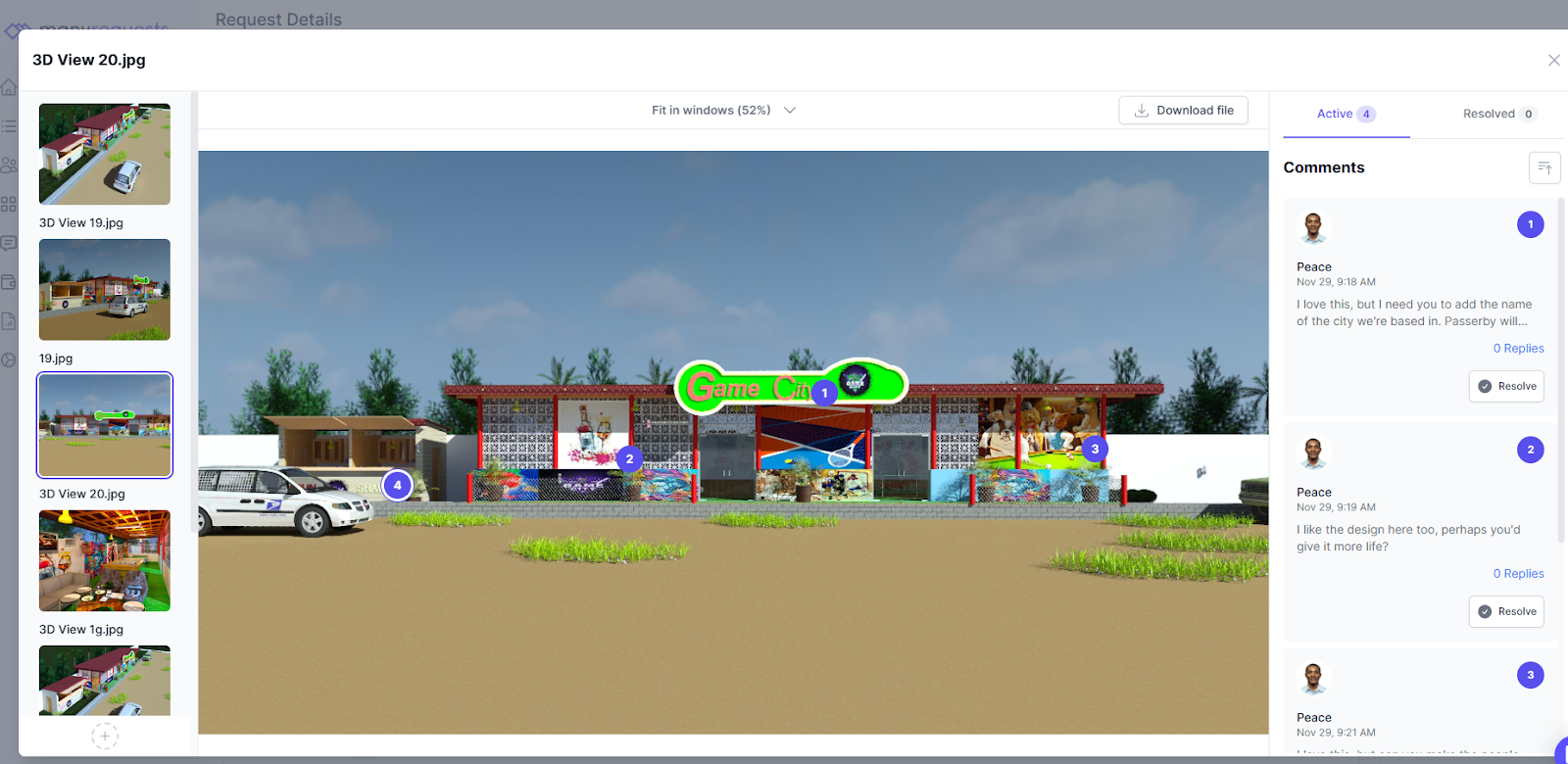
This shows precise areas a client wants you to edit with precise comments on what they want and how they want it. You can see the example here.
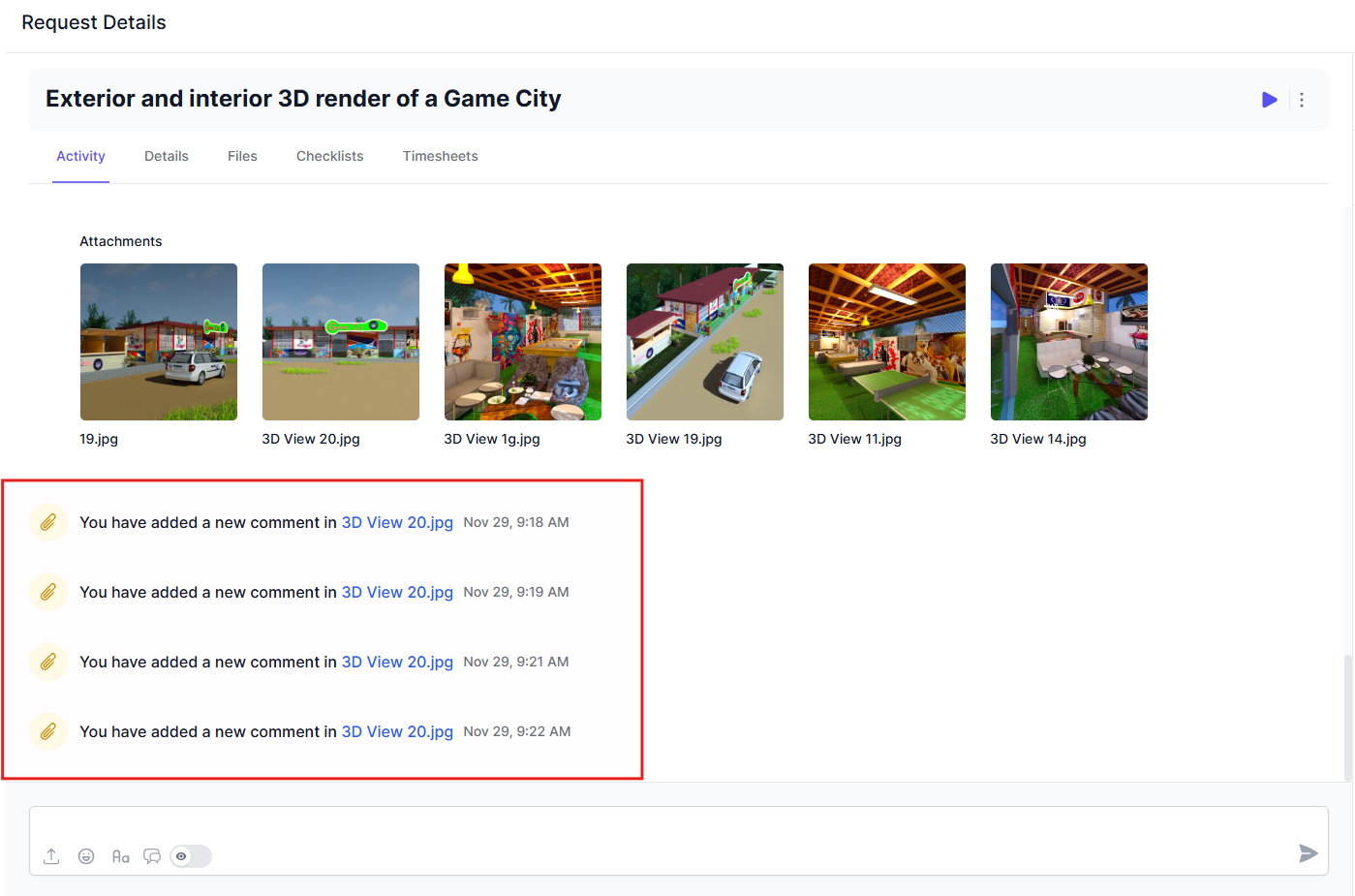
The impressive thing about this feature is that each comment on a design also appears in the task box, and you can click on it to go to specific feedback, as seen below. You can also tag different team members on each comment, especially if you need their expertise or insights.
These are the lessons that show up repeatedly from agency owners who've built something that works:
This is how you find your agency model. The service you can solve a real problem with is the service worth packaging.
Vince Opra started a YouTube agency around 2020. He focused on helping YouTubers with video ideation, editing, adding thumbnails, and uploading on YouTube. All his clients needed to do was record the video.
To get his first client, he says he messaged about 50 to 100 people he watched on YouTube and said something along the lines of:
"Look, I am a huge fan of your show; I am a huge fan of your channel. I would love to make some short-form clips for you for Instagram."
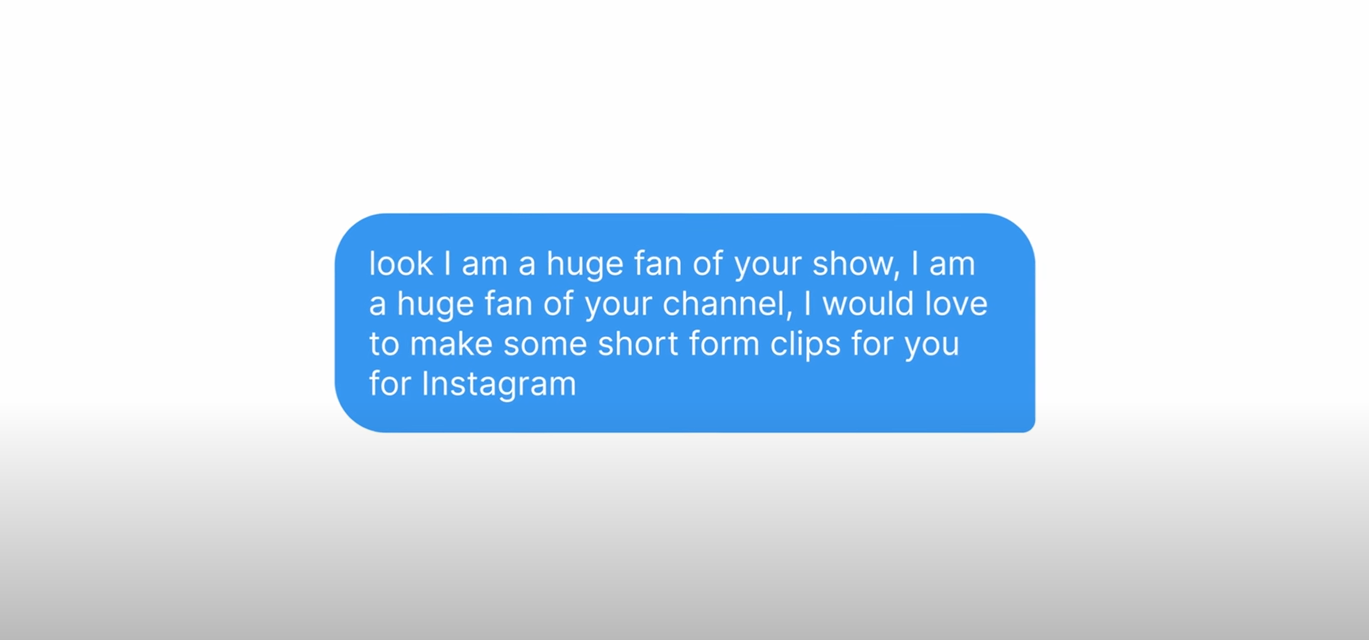
One of them said yes.
In his case, he knew these YouTubers could do better with their content to increase their reach, and he phrased his offerings around the need.
Greg Digneo from Content Guppy had the same story. He created a spreadsheet of 50 potential clients 15 minutes after he was fired from his full-time job on a Friday. These were people he had met in his 7-8 years in SEO, internet communities, had exchanged emails before, and a few friends who had their businesses.
His pitch was something around "Hey, at Time Doctor we built a process that got us 400,000 visitors/month and $10M revenue. I want to deploy this across other companies. Would you like to be a client?"
That was the social proof he needed to get started.
The summary is that you don't need to have it all figured out from the start. But you need to have seen a problem that you have the right skill set to solve, because there's no agency without the skill set to execute ideas or help business owners.
Your niche determines your model. The narrower your service, the easier it is to standardize and productize it.
Brett, the founder of a $1.3 million a year agency, says that regardless of the industry you are in, find the things you are good at and niche down. This is an offshoot of the first point and is exactly what Greg from Content Guppy did.
Greg's agency started by offering content writing and link-building services, but they struggled to succeed. "We were very average at best," he admits. After losing clients due to subpar content and link quality, he focused on link building.
Niching down changed his business. He focused on five sectors, built relationships and expertise, and delivered better results.
"When you niche down, you'll have built-in advantages," Greg explains.
The lesson? Don't try to be everything to everyone. Pick a specific service or industry where you can excel and build your reputation. Your expertise in a niche will often prove more valuable than being a generalist, especially when there's a lot of competition and you need to differentiate yourself.
Your first clients will tell you which model fits, so it's important to pay attention to what they keep coming back for.
Karl Hughes from Draft.dev was a CTO at an early-stage startup before he started his agency. The company started running out of cash and placed engineers on half-time to save money.
The uncertainty of the 2020 pandemic pushed him to choose between finding another job or starting a business.
Since he had previous experience writing technical content as a side gig, he started Draft.dev, a technical content marketing agency.
He contacted companies who might need his services and spoke to his developer friends who could create quality content for the clients he first landed.
The timing was right. Many tech companies that invested their marketing budgets in conferences and events shifted to content marketing during COVID-19. The first six months generated enough revenue to pay his bills. Then, in the first full year of operation (2021), he made $1 million in revenue, followed by $2.5 million the next year.
You can start as small as you can. Unlike Vince, who did free work for the first month with his first client, Karl charged from day one but scaled up as he continued.
Contributing to discussions in online communities can help you find clients faster than you think.
Paul Cox grew Church Co by becoming an active member in Facebook groups where church tech volunteers gathered. He didn't go on a spam spree to promote his services. He offered website design advice and answered questions.
People loved him and hired him. "Now if someone asks what they should use for their Church website in one of those Facebook groups, there's like hundreds of our customers in that group that are just recommending us," Paul explains.
Greg from Content Guppy used a similar approach. One of the ways he built his initial client base was through internet communities where he'd been active in marketing and SEO discussions. This strategy only pays off if you're consistent. Brett from Design Joy says he gets clients whenever he tweets, and that's because his revenue is connected to his visibility.

Brett from Design Joy discovered a graphic design agency providing productized services while working his 9-5 job. The model is simple: convert your services into standard packages with clear deliverables and fixed pricing.
He packaged his services into “off-the-shelf plans” (no hourly billing, no proposals). He built the whole thing in a Saturday (basically a one-page Webflow site, a Trello board, a Product Hunt launch).
He kept his full-time job for 3.5 years and resigned when he reached $80,000 in monthly revenue.
This is the same model that agencies like 55Knots, Flowout, and magier are built on today. The productized structure gives you predictable revenue and a path to scale in a way that you don't even need to hire more people.
You don't always need to niche down further or change what you're doing. Sometimes all you need to do is package your skills into sellable services and attract clients through any tactic that works for you.
According to Vince Opra and other agency owners, here are some tips that worked for them:
The agencies that scale without burning out aren't necessarily the most talented. They're the ones that stopped reinventing how they work for every new client and built a delivery system that can run in their absence.
The agencies that scale are the ones that package their most repeatable work into a structured, predictable model.
When you're ready to set that up, ManyRequests gives you the service catalog, client portal, intake forms, billing, and project management and everything you need to start your productized agency in one place. Start your 14-day free trial, no credit card required.
A creative agency is a business that provides creative services like design, content creation, video editing, or digital marketing to other businesses. The agency handles execution; the client focuses on their core business.
They use hourly rates, project-based fees, monthly retainers, and flat-rate subscriptions. Hourly rates typically run between $90 and $150, with minimum project spends averaging around $8,000. Productized agencies skip the negotiation entirely; so you can charge anything for the services you offer.
A productized agency packages its services into fixed-scope, fixed-price offerings clients can buy without a custom proposal. Every client goes through the same intake, the same delivery process, the same turnaround expectations — which is what makes it scalable without proportional hiring.
A retainer typically sells a bank of hours; the client draws down on them as needed. A subscription sells a defined scope of deliverables for a flat monthly fee, regardless of hours. Subscriptions are easier to price, easier to deliver, and easier for clients to understand.
Last updated: January 5, 2026
1. See how ManyRequests works in real life. Start a free trial and experience how productized agencies centralize requests, reduce chaos, and streamline delivery, without changing their entire workflow.
2. Read our Implementation Guide to launch smoothly with your team and clients.
3. Follow us on LinkedIn and YouTube for practical agency growth strategies
4. Check out The Productize Blueprint to learn how to turn your services into a scalable, productized offer.
Adetola Rachael Iyanuoluwa is a B2B SaaS writer and content marketer with 4+ years of experience creating SEO, human-focused content. She writes in-depth how-to guides and comparison articles content that help SaaS companies grow organic traffic and turn readers into customers. At ManyRequests, she produces practical, well-researched content that helps agencies and service businesses streamline operations and scale sustainably.